The Other Estremoz: Beyond Marble and the Market
Everyone comes for the Saturday market and leaves by lunch. But Estremoz only gives itself up on Sunday afternoon: the clay figure-makers, the pools full of locals, the shaded river beaches. A guide to the other Estremoz.
Everyone arrives in Estremoz through the same door. Saturday morning, the Rossio Marquês de Pombal packed to its last paving stone, stalls selling everything from sheep's cheese to checked cloth, and weekend visitors photographing the Tower of the Three Crowns against that white-blue Alentejo sky. It's lovely. It's also the Estremoz everyone sees and then forgets, because it looks exactly like the one they already saw in some travel magazine.
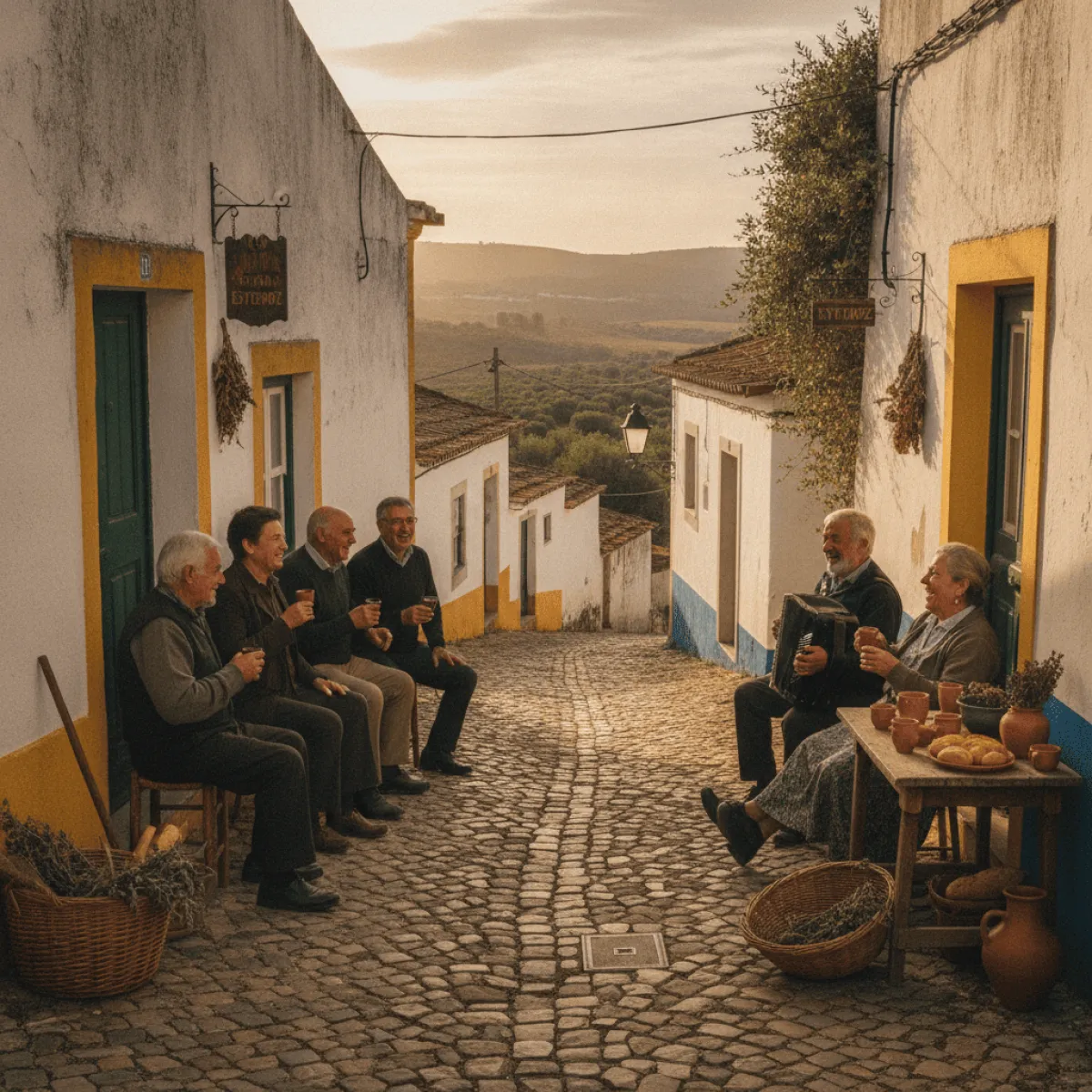
The market isn't the problem. The market is genuine and worth your time. The problem is that almost nobody stays for the afternoon, and almost nobody comes back on Sunday, when the town empties out and finally lets itself be seen. That's when Estremoz stops being a postcard and becomes a place where people actually live. This article is about that second town.
The lower town, where nobody points a camera
The coaches dump everyone in the upper town, by the castle and the pousada. You climb up, take the photo, climb back down. But the real life of Estremoz happens in the lower town, around the Rossio and in the streets that fan out from it: Rua Victor Cordon, Rua 5 de Outubro, the lanes dropping toward the Largo General Graça.
This is where the bonecos de Estremoz live, and let me be clear: I don't mean the souvenir shops up by the castle. I mean the fact that this hand-modelled clay figure, painted in colours that look eighteenth-century because they essentially are, was added in 2017 to UNESCO's list of Intangible Cultural Heritage of Humanity. Few towns the size of Estremoz hold a distinction like that and give it so little stage. Find the workshops of the figureiras in the lower town, talk to the people who still make them, and you'll understand that Queen Saint Isabel hiding bread in her apron, the nativity scene, the cycle of the seasons, are a way of telling the story of the Alentejo that no fridge magnet will ever manage.
If you come early, before nine, walk the Rossio while it's still empty. The cafés around it open their doors, the smell of toast and milky coffee drifts into the street, and you have the whole square to yourself. It's the opposite of Saturday's chaos and, honestly, it's when the square looks best.
What to eat, and what to actually order
Estremoz eats the way the whole Alentejo eats: slowly, with proper bread and with pork that tastes of something. I won't invent restaurant names I can't vouch for, but I can tell you what to look for on the menu and what to let pass.
Order açorda alentejana, that bread soup with garlic, coriander, olive oil and a poached egg breaking apart on top. Order migas, ideally with pork ribs or with wild asparagus if it's the season. Order ensopado de borrego, lamb stew over bread. And if you see it, order grilled black Iberian pork, because the Alentejo raises it better than almost anyone in Portugal. To drink, the regional wine, which is among the country's best and costs a fraction of a Douro of equivalent quality.
For dessert, local tradition demands encharcada, that convent sweet of eggs and sugar that is sweet to the limit of bearable and then a little beyond. One spoonful does for two people. The region's sheep's cheeses, especially in the cold months, are another way to finish. Expect somewhere between 12 and 18 euros a head in an honest place, without wine. On Sundays, check locally what's open, because many places close.
Where locals go when the heat bites
Here's the part the guidebooks ignore entirely. Estremoz in July and August is an oven. The thermometer crosses 38 degrees without asking permission, and the romantic idea of strolling the walls at noon quickly turns into regret. The right question isn't "what to visit", it's "where do the locals escape to".
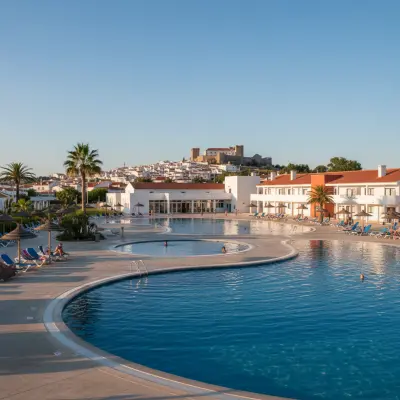
The most immediate answer is the Estremoz municipal pool complex. It has none of the glamour of a hotel infinity pool, and good riddance. This is where local families spend their August afternoons, where kids jump in the water all day long, and where, for a few euros at the gate, you buy the most valuable thing in the Alentejo in summer: shade and cool water. It's the most democratic spot in town and tells you more about how Estremoz lives than any monument.
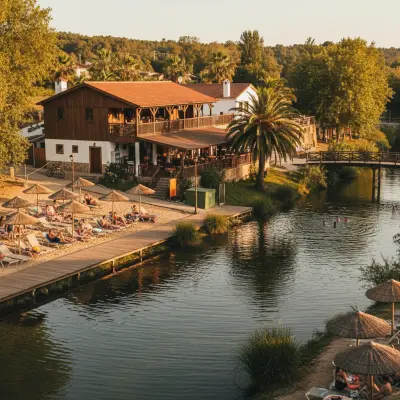
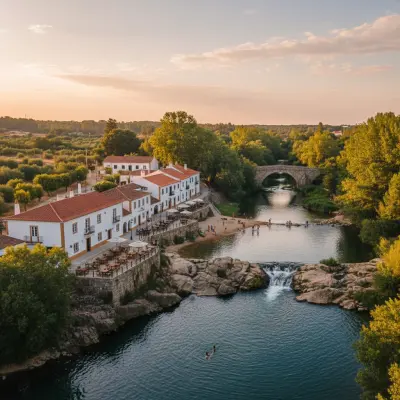
If you want real water, outdoors, it's worth heading out a little. To the north, a short drive away, sits the river beach at Fronteira, one of those inland beaches the Alentejo does so well: still, cool water, grass all around, picnic tables in tree shade, and zero of the stress of a coastal beach in August. Bring a packed lunch, bring a hat, and stay the whole afternoon. Further north still, near Sousel, the river beach at Azenhas d'El Rei offers the same register, with the bonus of a name that carries an old story of mills and water. Neither is Caparica. That's precisely the point.
Estremoz slowly, on two wheels
There's a way to see what lies between the town and these river beaches that changes the experience completely, and it's leaving the car parked. The landscape between Estremoz and the surrounding villages, cork-oak and holm-oak woodland, ancient olive groves, wheat fields that turn gold in May, was made to be crossed slowly.
That's exactly what the experience Cycling the Alentejo: Estremoz by Bike with Portugal Bike proposes. The high plain of this region is generous to anyone on a bicycle: quiet secondary roads, human distances, and the genuine possibility of stopping in a village, drinking an 80-cent coffee at the counter, and climbing back on. Do it in the morning, before the heat sets in, or in late afternoon, when the light turns honey-coloured and the fields smell of dry grass. It's the best way to understand why the marble of this region, visible in quarries cut like white wounds into the earth, made Estremoz what it is.
The marble, without the tourist leaflet
You can't talk about Estremoz without talking about marble, but you can talk about it differently. Forget the pousada and the institutional lobbies clad in stone for a moment. The marble of Estremoz, Borba and Vila Viçosa is one of the largest reserves on earth, and its presence is everywhere in an almost banal way: in the doorsteps of modest houses, in the stone sinks of old kitchens, on the counters of the tabernas. In any other town this would be luxury. Here it's simply what everything is made of, because it's what there is.
Notice the quarries as you enter or leave town by the right road. The turquoise pools that form at the bottom of disused quarries are an unreal colour, almost tropical, the result of rainwater over marble dust. They are not swimming pools, they are not for bathing, and some are dangerous and off-limits. But as a visual phenomenon, they say more about this land's identity than any explanatory sign.
When to go, and how to plan your time
If you can only come once, come between mid-April and mid-June, or in October. Spring brings green fields and poppies, the heat is still civilised, and the light is perfect in the morning and at day's end. Summer is for those who can handle serious heat and have a water plan, which you now do. Winter has its melancholy charm and the bonus of a generous Alentejo winter table, but bring a coat, because the Alentejo at night in January is colder than you'd expect.
Saturday is market day and therefore crowd day. If you want the market, arrive early and head out of the centre for lunch. If you want the quiet town, come on Sunday or midweek, accept that some places will be shut, and gain in exchange an Estremoz that feels like it belongs to you.
As a base, Estremoz works well for exploring the northeast Alentejo. It's a short hop from Évora, from Vila Viçosa with its ducal palace, from Borba and its wines. And it's close enough to Portalegre and the Serra de São Mamede for a day trip. If you head that way, it's worth reading the guide Portalegre Without the Tourist Traps first, working out which neighbourhoods are worth the walk on foot, and knowing in advance where the locals actually eat before you fall for any tourist menu. Portalegre and Estremoz make a natural pair: two Alentejo towns that reward anyone who stays for the second night.
What to take away from here
Estremoz doesn't give itself up on Saturday morning. It gives itself up on Sunday afternoon, once the market has packed away and what remains are the figureiras painting clay, the pools full of local families, the river beaches in the shade and the fields ready to be cycled. It's a town that rewards patience and punishes haste. Stay the extra night, jump into the water at a river beach where nobody points a camera, and you'll understand that the best of Estremoz is precisely what the coaches never stop to see.