Odemira's Percebes: The Shellfish Worth Risking Your Life For
On the coast of Odemira, just 80 licensed harvesters risk the Atlantic to collect Portugal's most expensive crustacean. Boiled in salt water with bay leaf, Costa Vicentina percebes taste like pure ocean, and three restaurants make them worth every euro.
There's a crustacean that divides Portugal into two camps: those who'll pay without blinking and those who stare at their plate thinking, "I'm eating what, exactly?" Percebes, goose barnacles, don't make immediate visual sense. They look like something you'd scrape off a ship's hull, not something you'd order alongside a bottle of cold white wine. But on the coast of Odemira, where the rocks of the Southwest Alentejo and Vicentine Coast Natural Park take the full force of the Atlantic, percebes are a kind of local currency. They're the reason a single plate can cost more than the rest of your dinner combined. And they are, if you ask me, the most honest thing you can eat in Portugal, because the flavour is the coast itself, concentrated into a five-centimetre stalk.
What They Are and Why They Cost What They Cost
Let's start with the basics, because if you've never eaten percebes, the ritual can be bewildering. The goose barnacle (Pollicipes pollicipes, for the technically inclined) is a crustacean that clings to wave-battered rocks in tight clusters the harvesters call "pinhas", pine cones. The edible part is the peduncle, the fleshy "leg" wrapped in a thin, leathery skin. On top sits a calcified claw you discard. The technique is straightforward: twist, peel the skin downward, eat. The flavour is an explosion of ocean, somewhere between lobster and clam, but with a salinity and texture that compare to nothing else.
The price? Expect €40 to €100 per kilo, depending on the season and harvesting conditions. Yes, it's expensive. But once you understand why, it makes sense.
The Percebeiros: 80 Licences for an Entire Coastline
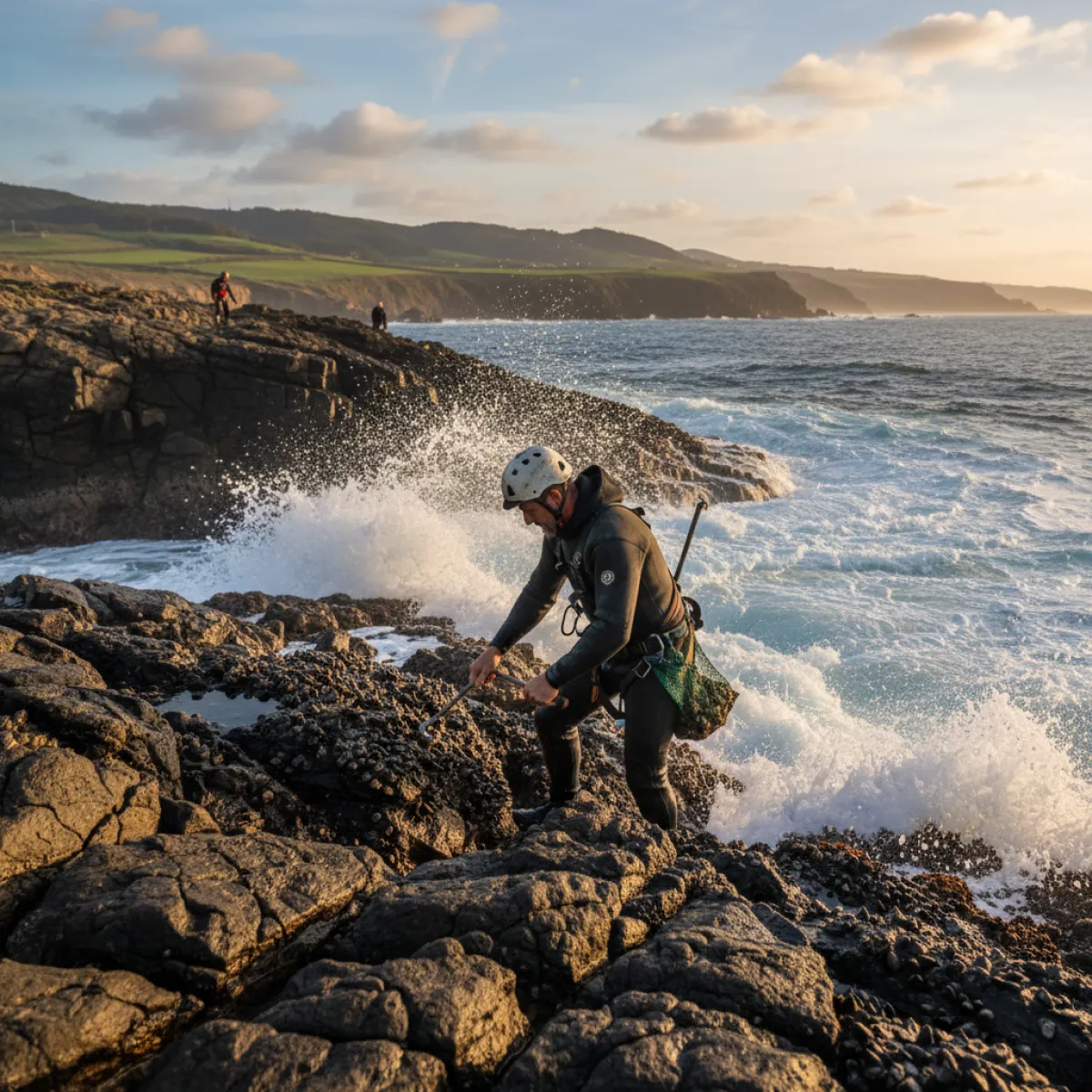
Along the coast between Sines and Vila do Bispo, only 80 professional harvesting licences exist, for the entire stretch of the Natural Park. These men (and they are almost all men) pull on wetsuits, rope themselves to the rocks, and descend to the intertidal zone armed with an "arrelhada", a tool originally designed for cleaning animal pens that someone, somewhere along the way, decided also worked for prying crustaceans off slippery rocks in heavy surf.
Harvesting happens at low tide, though even then the waves keep washing over the rocks. The daily legal limit is four kilos per harvester, and the minimum size is 25 millimetres, smaller barnacles must be left to grow. These regulations exist because in the 1970s, overharvesting nearly wiped the species out. Today, the Association of Shellfish Gatherers of Costa Vicentina and Southwest Alentejo, based in Aljezur, represents these professionals and oversees sustainable management.
When you eat percebes in Odemira, remember: every kilo on your table represents a man hanging off a rock while the Atlantic tries to knock him into the sea. The price starts making more sense.
Where to Eat: The Places That Matter
Marisqueira Costa Alentejana, Zambujeira do Mar
On Largo do Mira Mar, in the centre of Zambujeira, Costa Alentejana is where you go when you want serious shellfish. They're known for their "boats", enormous platters that arrive at the table loaded with cooked seafood, and percebes are a staple. The system is simple: choose a combination or order by portion. The percebes come boiled in salted water with bay leaf, as they should, no fuss, no sauces, nothing to mask the taste of the sea. Check prices locally as they fluctuate with the day's catch, but percebes typically run around €15 per portion as a starter.
Estrela do Mar, Zambujeira do Mar
At Avenida do Mar, 82, Estrela do Mar is another benchmark seafood restaurant in Zambujeira. The menu features percebes, octopus salad, "feijoada de búzios" (whelk stew), and whatever fish the boats brought in, sea bass, sea bream, conger eel. It's the kind of place where the waiter says "today we have..." and the list changes with the tide. When percebes are available, order them without hesitation. The "carne de porco à alentejana" is also solid, if you want to mix surf and turf in the same meal. Booking ahead is wise in July and August.
O Josué, Longueira-Almograve
At Rua José António Gonçalves, 87, in Longueira (the village attached to Almograve), O Josué serves Costa Vicentina percebes alongside lobster from their own tanks. It's quieter than the Zambujeira restaurants, which usually means less waiting and the same quality of product. The Almograve area deserves the trip regardless, the cliffs are dramatic, and the fresh fish along the coast from Porto Covo to Almograve has a freshness you simply won't find elsewhere.
When to Go and How to Eat Them
Peak percebes season runs from March to September, with the sweet spot between May and July. In winter, the sea is too rough for regular harvesting, and restaurant supply dwindles or disappears entirely. Visit in May or June, before the August invasion, and you'll get the best of both worlds: abundant percebes and restaurants without a queue at the door.
As for eating technique, don't overthink it. Grab the barnacle by the claw (the hard bit on top), give the peduncle a slight twist to loosen the skin, peel it downward, and eat. You will get your hands messy. You will drip. That's the deal. If they give you a cloth napkin, be suspicious, in a proper place, the napkins are paper and there's a roll on the table.
One warning: do not eat percebes with butter sauce, lemon, or anything else. The traditional preparation is boiling in water with coarse salt and a bay leaf, full stop. Any restaurant serving percebes "gratinéed" or "with herb sauce" doesn't know what it's doing.
Beyond the Barnacles: What Else to Do on the Odemira Coast
If you've come to Odemira for percebes, you're in one of the most beautiful stretches of coast in Portugal, and it would be criminal not to explore. The municipality is vast, the largest in Portugal, in fact, and the coastline is a succession of wild cliffs, empty beaches, and villages that still live from the sea.
In the morning, before your percebes lunch, it's worth navigating the Mira River estuary, an experience that shows Odemira's other side, not the battered coast, but the calm river that winds through green banks before emptying into the sea at Vila Nova de Milfontes. It's a different pace, a different kind of quiet.
For photographers, the blue hour at the Mira estuary delivers the kind of light no Instagram filter can replicate. Late afternoon, with the tide coming in and the sky shifting colour, is particularly rewarding.
If you're in the mood for a different kind of nature watching, birdwatching at Ria de Alvor from Odemira is a genuine surprise, the biodiversity along this coast is remarkable, and the wetlands attract species you won't easily spot elsewhere.
In the afternoon, if the percebes have whetted your appetite for coastal life, head to Porto Covo and explore the fishermen's quarter, a place where fishing nets still dry in the sun and front-door conversations happen at full volume and in no particular hurry.
Practical Information
Odemira has no meaningful public transport. You need a car. From Lisbon, it's about two and a half hours via the A2 motorway to the Odemira exit, then secondary roads to the coast. Zambujeira do Mar is about 20 minutes from Odemira town, and Almograve about 15.
At restaurants, percebes are typically sold per portion (around 200-250g) or per kilo. As a starter for two, one portion is enough. If percebes are the main event, order half a kilo and add a grilled fish to round things out. Pair with cold Alentejo white wine, an Esporão Reserva Branco or a Herdade do Rocim are reliable choices.
Final note: if someone offers you "Moroccan" percebes at a bargain price, walk away. Costa Vicentina percebes are shorter and fatter than their Moroccan cousins, and the flavour doesn't compare. Always ask about the origin. At a serious restaurant in Odemira, the answer will be the name of a beach or a rock, not a shrug.