Beyond the Postcard: Authentic Coastal Life in Porto Covo's Fishermen's Quarter
Discover the soul of Porto Covo beyond the tourist facades. A deep dive into the maritime heritage of the Fishermen's Quarter and the authentic flavors of the Alentejo coast.
The Pombaline Symmetry and its Limits
Arriving in Porto Covo often feels like an exercise in visual recognition. The white houses with blue trim, meticulously aligned around the Largo de Marquês de Pombal, suggest an Enlightenment-era order rarely found on the Alentejo coast. This square, designed in the 18th century as the centerpiece of a commercial utopia that never fully materialized, serves today as the village's drawing room. However, to find the true pulse of this community, one must look past the perfect symmetry and walk toward the cliffs, where the Fishermen's Quarter (Bairro dos Pescadores) clings to the rock with a tenacity that defies both erosion and mass tourism.
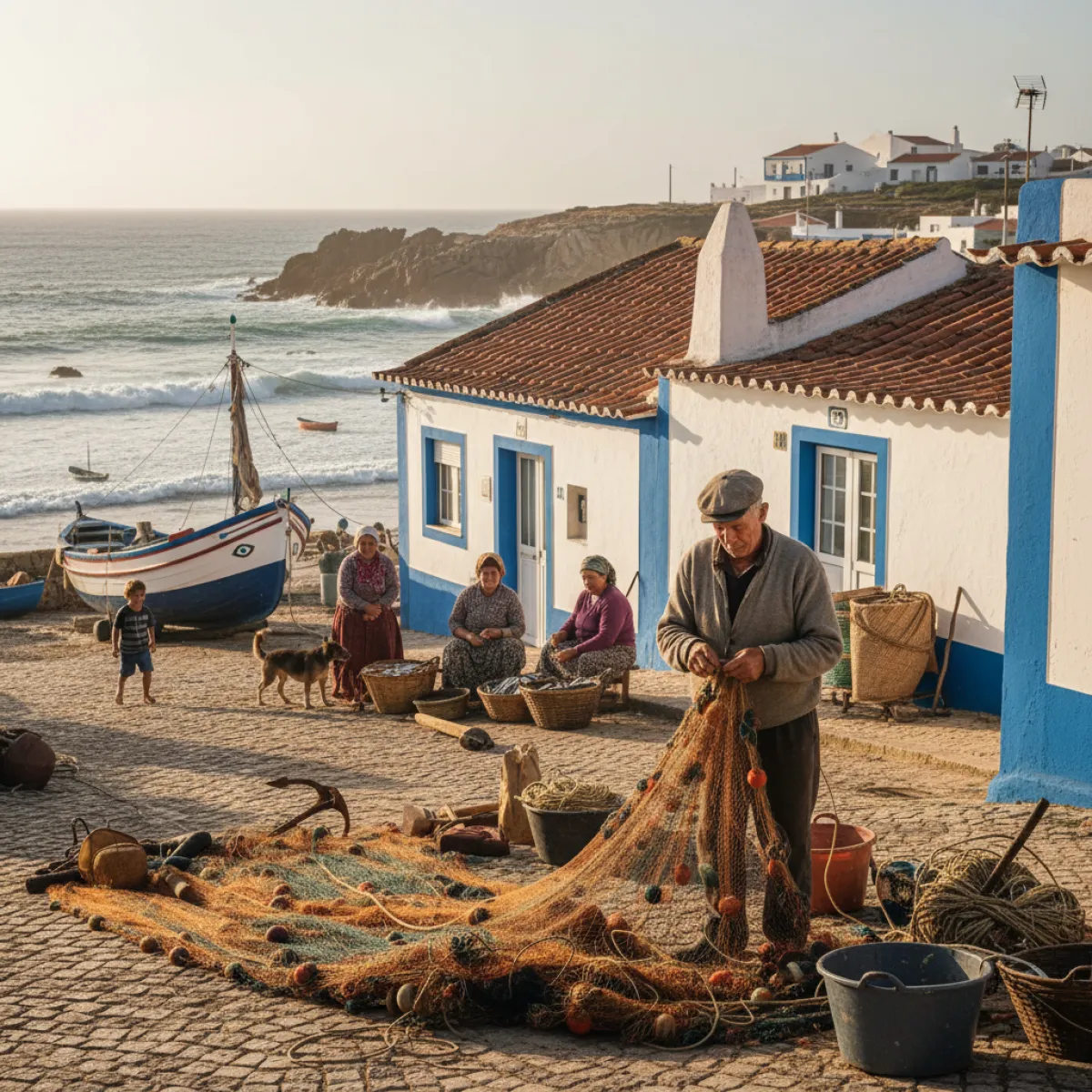
The Fishermen's Quarter was not designed by court architects. It grew organically, dictated by proximity to the Porto das Barcas and the need for shelter from the prevailing Northwest winds. Here, luxury is not measured in square footage or marble finishes, but in the ability to withstand the salt spray that corrodes iron and peels paint within months. It is a place of textures: stacked nylon nets, fiberglass boats named after saints and wives, and the omnipresent scent of seagrass and burnt diesel. Moving away from the tourist center and entering these narrow alleys is to understand that Porto Covo is not just a backdrop for Instagram photos, but a maritime outpost with a resilient identity.
The Maritime Craft and the Architecture of Survival
Life in the quarter follows the rhythm of the tides and sea state forecasts. While visitors sleep, local fishermen have already assessed the swell at the Ilha do Pessegueiro. This island, immortalized in Portuguese popular culture, serves as a sentinel and a natural breakwater. In the quarter, houses are low-slung, with small windows to conserve heat in winter and keep cool in summer. Many of these dwellings retain the small annexes where fishing gear was once stored, now converted into small rooms or storage areas, yet preserving the human scale that defines the area.
Watching men mend nets on the concrete floor is to witness an art form in decline. Fingers move with an agility that belies the roughness of the skin, tanned by sun and salt. There is no staging here for the tourist; it is hard, often underpaid work that sustains the gastronomy that the rest of the country comes here to find. If you wish to understand the unique light that bathes this transition between land and ocean, we recommend reading The Blue Hour: A Photographer's Guide to the Mira Estuary, which explores the visual aesthetics of this region with rare precision, capturing moments that most travelers ignore in their rush to the beach.
The Alentejo Table: Where the Sea is Protagonist
Eating in Porto Covo requires discernment. The temptation to follow the crowds to the restaurants on the main street is strong, but the reward lies in those more modest establishments frequented by those who know the names of the boats that brought the fish. Sea bream, sea bass, and sargo are the seasonal stars, grilled only with coarse salt and served with boiled potatoes and a drizzle of regional olive oil. But the true test of a local kitchen's authenticity is the *percebes* (goose barnacles). Harvested from the battered rocks of the cliffs by men who risk their lives with every tide, these crustaceans are the pure essence of the Atlantic distilled into a bite.
For a serious lunch, look for seafood rice or whelk stew (*feijoada de búzios*). Forget the tourist menus with faded photographs. A budget of 25 to 40 euros per person allows for a high-quality fresh fish meal, accompanied by an Alentejo Litoral white wine, whose saline notes perfectly complement the minerality of the dishes. The golden rule is simple: if the restaurant does not display the day's catch in an iced display case, keep walking.
The Balance Between Tradition and the Present
Real estate pressure is the greatest threat to the quarter's authenticity. Many fishermen's houses have been acquired by outsiders and transformed into local accommodations. While this has brought urban rehabilitation, it also risks turning the neighborhood into a museum without inhabitants. However, there is still visible resistance. It is in the pots of geraniums at the door, the shouted conversations from one window to another, and the habit of sitting on a stone bench to watch the world go by. This is the Porto Covo that matters, a place where the silence is only interrupted by the roar of the sea or the cry of seagulls.
For those traveling with time, the Fishermen's Trail (part of the Rota Vicentina) offers the best perspective on the village's strategic location. Walking south toward Vila Nova de Milfontes reveals beaches of raw beauty, such as Praia do Salto or Praia dos Buizinhos. It is a path of loose sand and dunes covered in endemic vegetation, where the scent of *perpétua-das-areias* dominates the air. It is in this geographical context that one realizes the importance of documenting the landscape, something discussed in detail in the guide The Blue Hour: A Photographer's Guide to the Mira Estuary, an essential tool for those who wish to take home more than just fleeting memories.
Logistics and Planning: When to Go
Avoid July and August if your goal is contemplation. Porto Covo transforms into a human anthill during the peak of summer, losing much of its serenity. Spring (April and May) and early autumn (September and October) are the ideal times. The light is softer, temperatures are perfect for walking, and restaurants are more available for a conversation about the origin of the ingredients. In winter, the village withdraws into itself. The wind can be biting, but there is a melancholic beauty in seeing giant waves crash against the harbor rocks while sheltering in a local cafe with a *café curto* and an almond cake.
Porto Covo needs no artifice to convince its visitors. Its strength lies in the honesty of its light, the harshness of its sea, and the simplicity of its people. By respecting the scale of the Fishermen's Quarter and seeking out local businesses, the traveler ensures that this coast remains more than just an illustrated postcard.
