The Blue Hour: A Photographer's Guide to the Mira Estuary
Discover how to capture the unique light of the Mira estuary during the Blue Hour. A technical and aesthetic guide for photographers visiting Vila Nova de Milfontes, exploring the best angles of Portinho do Canal and the river.
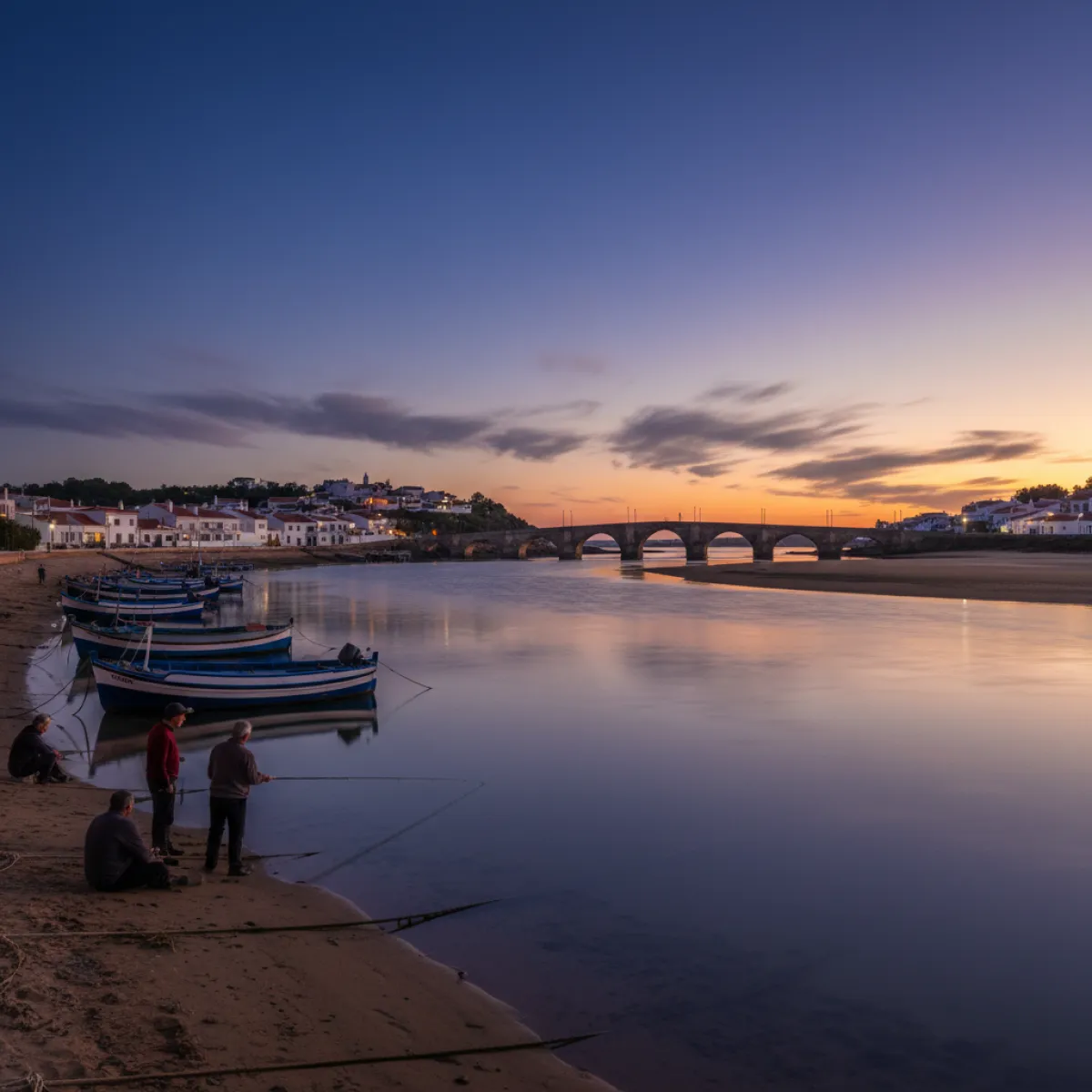
The Geometry of Atlantic Light
There is a specific quality to the light in Vila Nova de Milfontes that defies easy categorization. It is not the Mediterranean glare, saturated and direct, nor the cold clarity of Northern Europe. It is an Atlantic light, filtered by the humidity rising from the Mira River and the salt spray pushed inland by the ocean. For the photographer, this phenomenon reaches its zenith during the Blue Hour, that liminal interval between sunset and total darkness, where the sky adopts shades of cobalt and indigo, and the landscape seems suspended in an almost surreal stillness.
The inevitable starting point for any visual exploration of the town is Portinho do Canal. This small artisanal fishing harbor, nestled in the northern curve of the estuary, offers a unique topography. Here, wooden boats painted in primary colors that resist the erosion of time rest on the silt during low tide or float erratically when the river fills. The composition gains a textural depth here that is rare elsewhere on the Alentejo coast. The contrast between the rough concrete of the pier and the mirrored fluidity of the water creates long-exposure opportunities that demand patience and a sturdy tripod.
The Dynamics of River and Ocean
The Mira estuary is an ecosystem of thermal and visual contrasts. While the ocean batters the cliffs with methodical violence, the river maintains a deceptive placidity. Photographing these two realities requires a shift in perspective. To capture the essence of the intersection between fresh and salt water, it is advisable to explore the best beaches in Vila Nova de Milfontes, not for their recreational value, but for their morphological structure. Praia da Franquia and Praia do Farol offer natural vanishing lines, where wind-sculpted sand serves as a foreground for the distant lights of the south bank.
The true soul of the Mira, however, reveals itself from within. For the photographer seeking angles impossible from dry land, taking a boat tour on the Mira River is a pragmatic decision. From the water, the town reveals itself as a whitewashed amphitheater leaning over the blue. It is from this perspective that one understands the scale of the estuary and how light reflects off the slopes covered in endemic vegetation. During the blue hour, the river transforms into a low-frequency mirror, capturing the sky's last chromatic gradations with a fidelity that no digital sensor can fully replicate without careful light metering.
Technique and Equipment in the Estuary
Working with low light in the Alentejo requires a technical rigor that many underestimate. The use of graduated neutral density (GND) filters is essential to balance the sky's luminosity with the deep shadows forming along the riverbanks. If you are shooting at Portinho do Canal, opt for an aperture between f/8 and f/11 to ensure both the foreground boats and the Mira Bridge in the background maintain the necessary sharpness. ISO sensitivity should be kept at its base value to preserve dynamic range and avoid noise in the darkest areas of the image.
Patience is the most valuable tool. Often, the decisive moment occurs twenty minutes after the sun has disappeared below the horizon, when the balance between the town's artificial light and the twilight's natural light equalizes. It is the moment when sodium lamps begin to puncture the darkness with amber points of color, creating a fascinating thermal contrast with the deep blues of the sky and water.
The Post-Shoot: Culture and Gastronomy
Landscape photography is a solitary and often physically demanding activity. When the light finally fades, the town offers refuges that invite reflection on the work done. Knowing where to eat in Vila Nova de Milfontes is as important for the discerning traveler as knowing how to choose the right lens. For those seeking an experience that balances Alentejo tradition with a contemporary aesthetic, Rituals Milfontes presents itself as a sophisticated option, ideal for decompressing after hours of concentration behind the camera.
The local gastronomy, rich in fresh fish and shellfish from the estuary, serves as the perfect counterpoint to the austerity of the coast. A razor clam rice or a 'caldeirada' stew, consumed without haste, are part of the ritual for those who understand that traveling through Portugal is an exercise in slow observation. The Alentejo does not let itself be captured by those in a hurry; it requires one to slow down, listen to the movement of the tides, and respect the cadence of the fishermen who still use the river for their livelihood.
Visual Conclusion
Vila Nova de Milfontes will remain a pilgrimage destination for those who value the aesthetics of the Portuguese coast. The Mira estuary is not just a geographical feature; it is a lesson in composition and light. Walking along the riverbanks, from the fort to the curve of the Portinho, the photographer finds a visual narrative that speaks of resilience, natural cycles, and a beauty that refuses to be obvious. The Blue Hour is the daily tribute nature pays to this place, transforming the ordinary into the exceptional and the estuary into a landscape of infinite possibilities.
