Stonemason Marks Workshop in Batalha: A Hands-On MCCB Visit
In a family workshop at the MCCB you carve a stonemason's mark into a block of ançã limestone, the same stone that clads the monastery. I walked out with a rough chunk of rock under my arm and a concrete sense of what every metre of that Gothic façade really cost.
There's a story locals like to tell in Batalha cafés: when the master stonemasons of the monastery died, they were buried near the stone they had carved. The graves are gone, but the marks are still visible if you know where to look. Small signs cut into the blocks, some on the floor, some at chest height, shaped like letters, crosses, fishhooks, stars. Every stonemason had his own. It was how he got paid.
The Museu da Comunidade Concelhia da Batalha, or MCCB, builds a family workshop around exactly this tradition. They call it Marcas de Canteiro, literally Stonemason's Marks. It's the kind of activity that doesn't show up on the big booking platforms because most editions are free, registration runs by phone, and the whole thing is closer to a community programme than a commercial tour. Which is precisely why it's worth knowing about.
Getting there and signing up
The museum sits on Largo Goa, Damão e Diu, number 4, a two-minute walk from the monastery. Drive in and you'll find free parking near the Multiusos pavilion. Take the train to Leiria and the bus on to Batalha and you'll step off across the road from the entrance. Workshops run on Saturdays and during school holidays, with mandatory registration and a cap of around fifteen people.
Pricing depends on the session. Workshops folded into European Heritage Days or the museum's Stone Cycle programme tend to be free. Others, tied to school holidays and artist residencies, may carry a token fee. The rule I've learned to follow: phone (+351) 244 769 878 or email geral@museubatalha.com a week ahead. There's no online booking, and the calendar appears on the museum's events page with limited advance notice. Confirm the price directly with the education service before you turn up.
What you actually do
The session opens in a room with limestone floors and white walls. There's a small selection of stones with authentic marks, pulled from older buildings around the municipality, alongside facsimiles of monastery documents that recorded payments per mark. The educators explain, patiently, that this wasn't art. It was bookkeeping. Each crew had a sign, cut it into the corner of every finished piece, and the bursar tallied the marks at the end of the month.
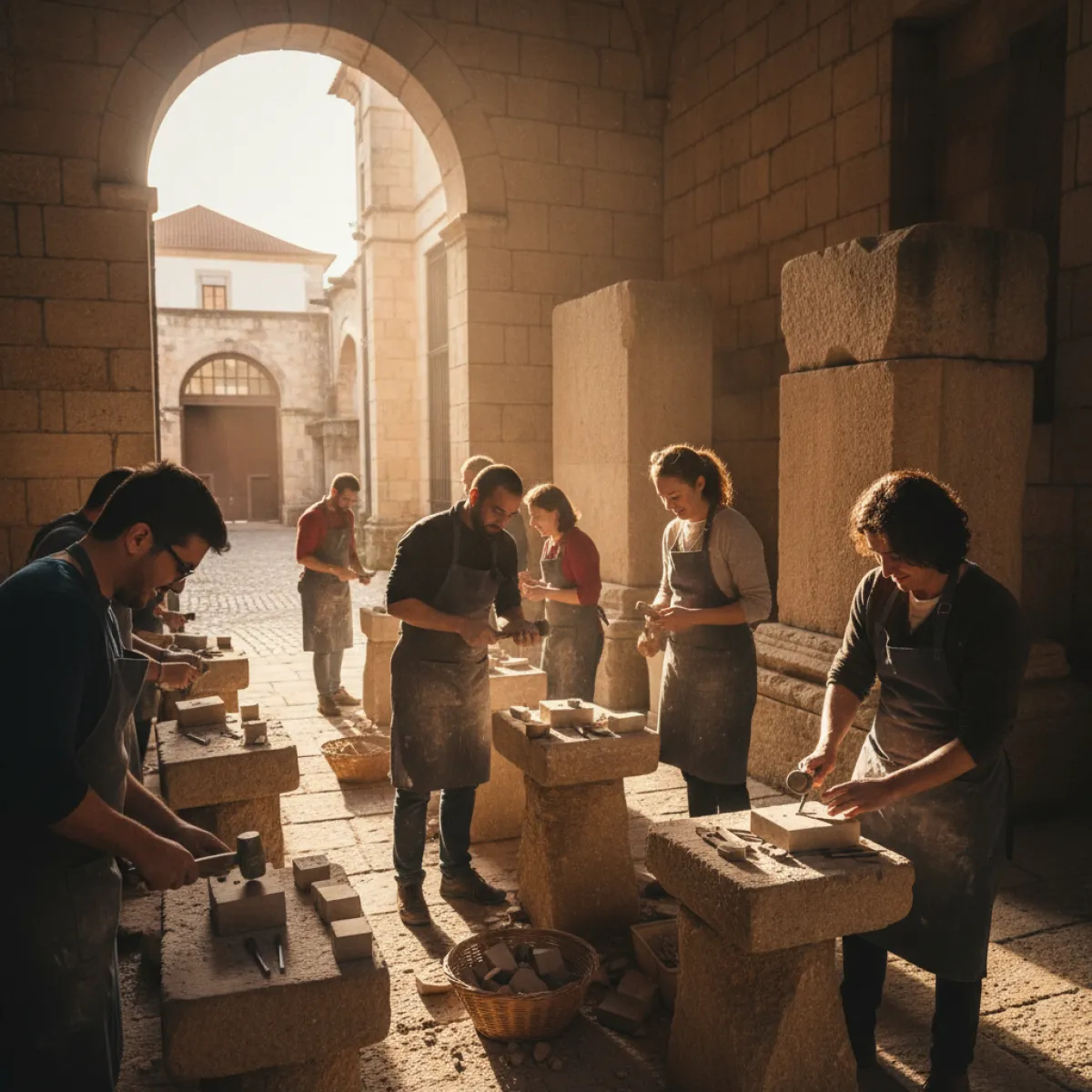
Then you go hands-on. You're handed a piece of ançã limestone, the same pale, workable variety that clads the monastery, roughly fifteen by ten centimetres. You also get a small chisel, a rubber mallet, and safety goggles. The instructor shows you the angle of attack, usually around forty-five degrees, and how the stone responds to short, dry strikes. You learn to score a line in half an hour. You learn in five minutes that you can ruin it if you push too hard.
The best moment, in my view, comes when you choose your personal mark. The educators bring out a binder with over a hundred marks catalogued at the Batalha Monastery. You can invent one from scratch, borrow one that turned up on a block of the royal cloister, or merge two. I watched an eight-year-old copy a mark that looked like an upside-down pitchfork and learn from the educator that the same shape exists carved into a step at the Unfinished Chapels. He left with the stone tucked under his arm like a diploma.
What to wear and bring
- Closed shoes. Limestone dust gets everywhere and fine grit slips into sandals.
- Clothes you don't mind dusting. A pale film settles on sleeves and knees. It washes out, but plan for it.
- A water bottle. The museum has a fountain, but it's easier to carry your own.
- A camera, but no flash inside the permanent exhibition rooms.
- If you bring a child under six, call the education service first. They can adapt the workshop with softer stones and plastic tools, but they need notice.
The rest of the day
The workshop runs ninety minutes to two hours. The museum is worth another hour after that, especially the exhibition A Pedra e a Batalha: da matéria à vida, which connects geology, craft, and community. Save the monastery for late morning, right after the workshop, with a fresh sense of what every metre of that stone cost. Reading our connoisseur's guide to Batalha before you arrive sets the context. For the architectural side, the essay on the geometry of a vow and the silence of stone is the one to pre-read.
For lunch I head to Restaurante Dom Duarte, two blocks from the museum, where grilled cod costs about half what the monastery-facing places charge. Late afternoon, walk up to Miradouro da Portela das Cruzes to watch the ridge swallow the valley in shadow. In May and June the light fades slowly, and the limestone turns the colour of warm honey.
Why it's worth doing
It's rare to walk out of one of these workshops feeling like you've actually learned something useful. Most Portuguese tourist experiences hand you a polished, hollow product. Here, you walk out with a rough piece of stone marked by your own hand, and a concrete sense of how much labour sits behind a façade like the monastery's. Next time you step into the Unfinished Chapels, you'll find yourself scanning a square metre of wall for three or four marks you would otherwise have walked past. It's a slower, more physical, more honest way to read Batalha. And it remains one of the cheapest things you can do in town.