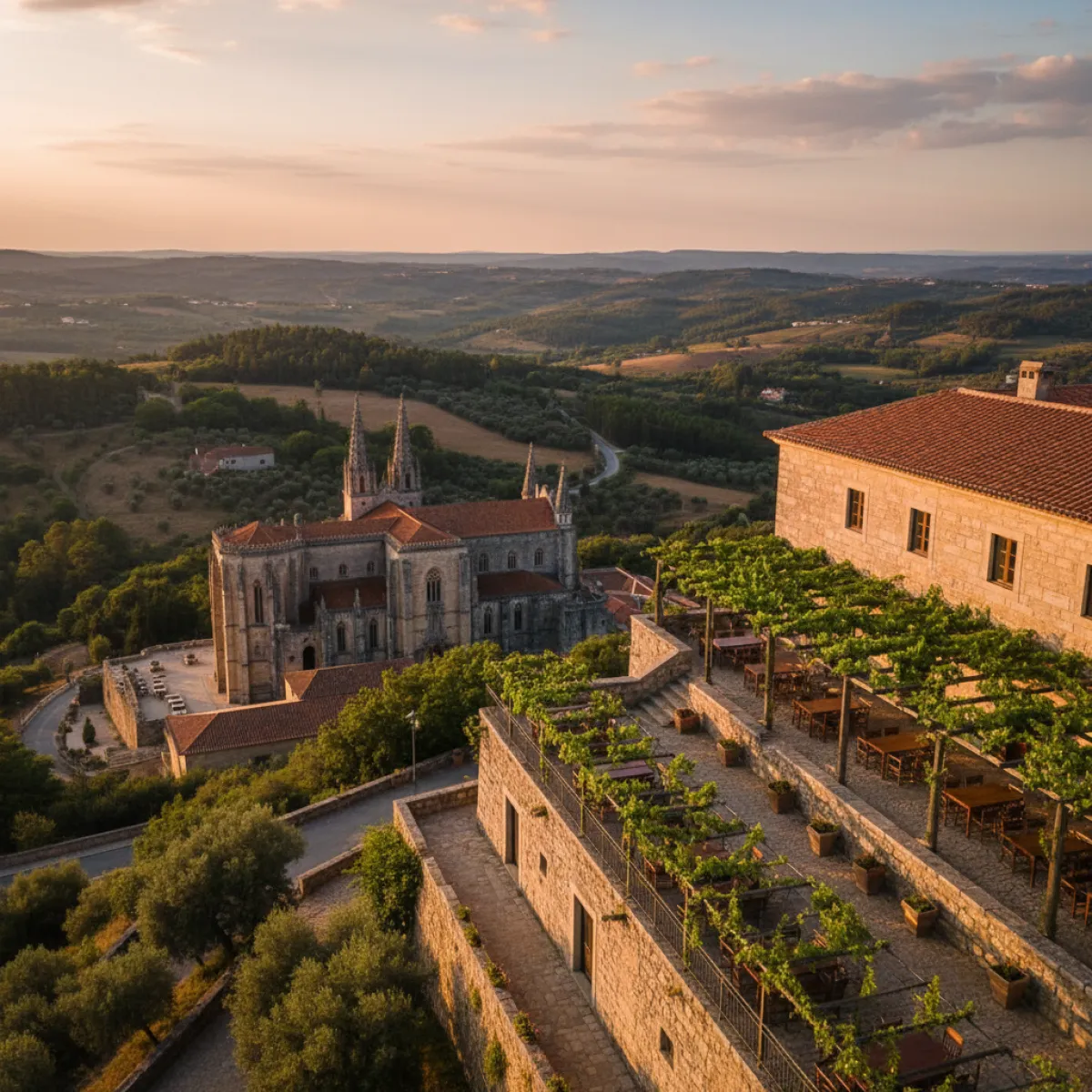
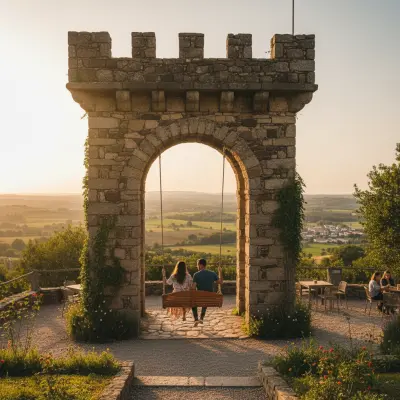
The Miradouro da Portela das Cruzes is not on Batalha's tourist board map, and that is half the point. It sits in São Mamede, a rural parish a short drive from the monumental center, at a quiet road junction most visitors to the Monastery never see. It is a small stone belvedere: a low wall, a bench or two, a name on a post. You go there to look at the view of green hills dotted with white houses and clay roofs, and then you leave. That is the entire proposition.
What you actually see
The view is domestic, in the best sense of the word. No Atlantic drama, no mountain vertigo. Just a rolling valley, olive trees, small vineyards, kitchen gardens, and in the distance the jagged line of the Serra de Aire e Candeeiros. The houses are scattered without much urban logic, the way they tend to be in central Portugal's interior parishes, and in late afternoon the limestone walls catch a pinkish light that lasts about twenty minutes and then is gone. That is the moment to be here. Mornings are too harsh, midday flattens the valley into nothing.
The belvedere itself is tiny. A low stone wall, a bench, a sign. Five or six people fit comfortably. If a small group arrives, wait five minutes; they always move on.
How to get there
The address is Portela das Cruzes, São Mamede, 2495-031 Batalha. By car is by far the easiest: from Batalha town center, head towards São Mamede on the municipal road and, at the entrance to the hamlet of Portela das Cruzes, the belvedere appears at the side of the road, signposted. It is roughly ten minutes from the Monastery. There is informal parking for two or three cars on the verge, no meters, no fuss.
Public transport is harder. Buses connecting Batalha to the rural parishes run on reduced timetables, especially on weekends. If you do not have a car, it is more sensible to negotiate a short taxi run from Batalha (a quick round trip with a fifteen minute wait should be reasonable, confirm directly with the driver before setting off) than to gamble on the return bus.
When to come
Late afternoon, always. Ideally an hour before sunset, with time to watch the light shift. In summer that means around eight in the evening; in winter, half past five. On windy or rainy days, skip it: the spot is fully exposed and there is no shelter.
Spring is the best season. Fields are green, wildflowers still line the road, and the temperature lets you stand still for ten minutes without giving up. By dry August the landscape goes yellow and hard, though there is an austere appeal to that too. For a wider read of the area in golden hour, pair this stop with our piece on The Limestone Twilight: Where the Sun Sets in Batalha, which maps out the other high points around the municipality.
What to do around it
On its own, the viewpoint is a twenty minute affair. You need to fold it into a longer itinerary, which is why we always pair it with the Monastery of Batalha a few kilometers away. That building is, plainly, one of the three most important works of Gothic architecture in Portugal. The recommended reading before you walk into the cloister is our guide Batalha: The Geometry of a Vow and the Silence of Stone, which explains why that lacework stone looks like nothing else in the country.
For lunch before you head up to São Mamede, or dinner after you come down, the most reliable choice in the center remains Restaurante Dom Duarte: regional cooking, honest portions, decent house wine. If you want to understand why Batalha deserves more than the half hour the tour buses give it, read Beyond the Stone: A Connoisseur's Guide to Batalha.
Practical advice
- It is free. No ticket booth, no opening hours, accessible around the clock. You will spend zero euros on site, so bring a coffee from Batalha; there is nothing to buy here.
- Footwear. The stone is uneven and the road shoulder sometimes carries loose gravel. Trainers are fine; thin strap sandals are not.
- Toilets. None. Last useful stop is in São Mamede village or back in Batalha center.
- Drones. Technically open ground, but there are homes nearby. If you fly, do it briefly and discreetly. The neighbors are entitled to their quiet.
- After dark. No lighting. If you come for the stars, bring a torch and leave before your eyes give out.
- Kids. Fine, but watch the road. There is no barrier on the traffic side.
Who this is for
Anyone in Batalha for the architecture who wants five minutes outside the tourist circuit. Anyone who likes Portuguese rural landscape without staging. Patient photographers, slow travelers, couples looking for a quiet place to talk before dinner. It is not for people who need spectacle. It is for people who understand that, in central Portugal, beauty is often a small thing without a plaque, at the side of a secondary road. Twenty minutes. More than that is overdoing it. Less than that means you missed the point.