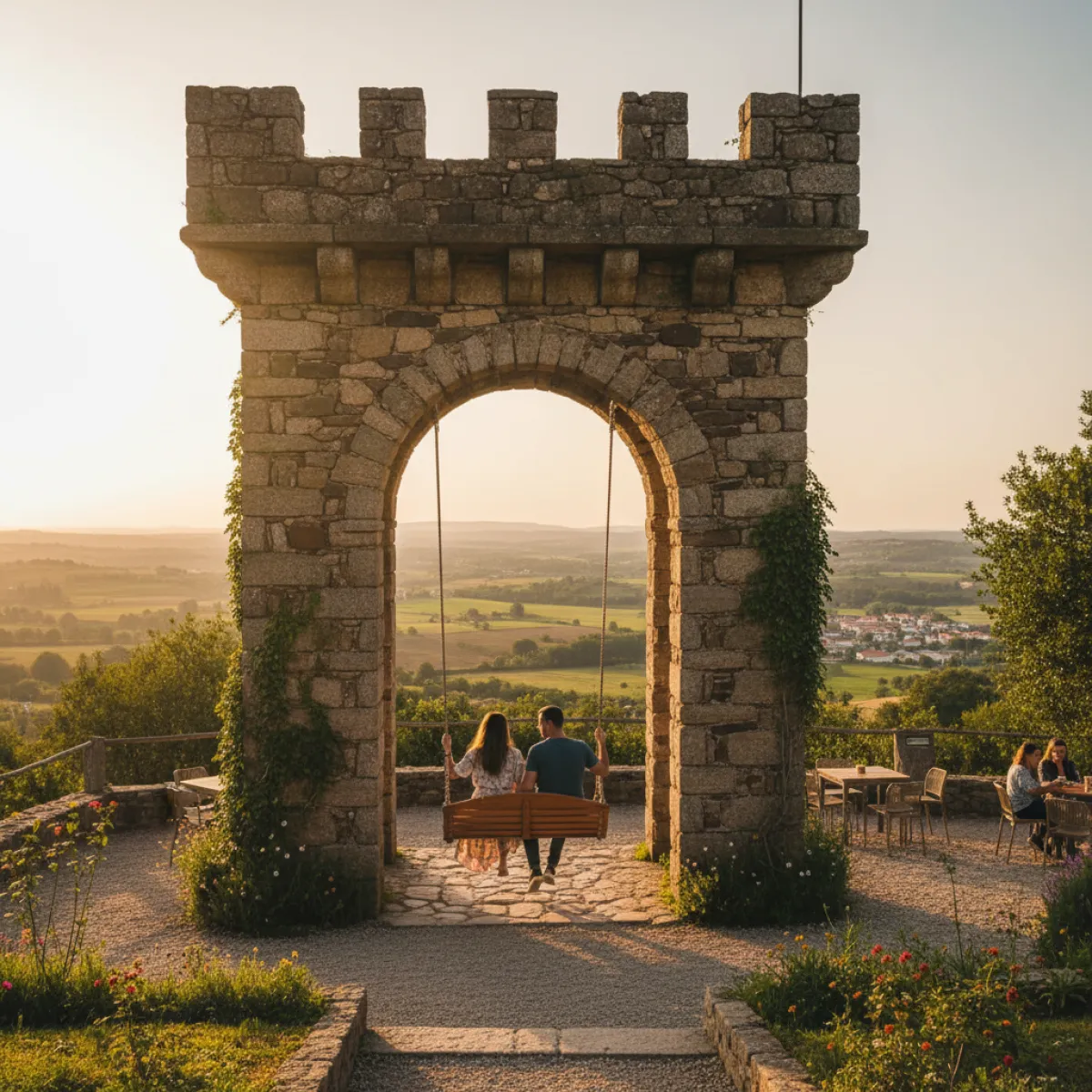
The Baloiço da Torre sits in Barrosinha, a small locality within Reguengo do Fetal in the parish of Batalha. It is exactly the kind of stop that makes sense to slot between a coffee in town and the drive home before the sky changes colour. There is no ticket office, no posted opening hours, no attendant explaining the place. There is a two-plank swing, two seats, facing south, planted at 320 metres of altitude, with the Serra de Aire e Candeeiros range in front of you and the valley of Reguengo do Fetal sloping down toward Batalha behind it. The visit itself is short, the view is generous, and the honest first thing to say is this: do not go just for the photograph. Go for the drive and the late afternoon.
Where it is and how to get there
The address is Barrosinha, Reguengo do Fetal, Batalha. From the centre of Batalha, expect about ten to fifteen minutes by car, climbing the road up toward Reguengo do Fetal, past low houses, dry stone walls and olive trees gaining ground on the limestone. The final stretch is a packed dirt track, drivable in any normal car outside of heavy rain. In wet winter weather, take it slow: the last hundred metres get slippery and there is no lighting. Public transport is not realistic, the bus drops you kilometres away and the rest is on foot along an unshouldered road. A taxi or your own car is the only sensible option.
There is no designed car park. People leave the car on the verge, tucked in so as not to block the agricultural traffic. On spring and summer weekends it is normal to find three or four cars already parked, especially after 6pm. If the spot looks crowded when you arrive, do not stand around waiting. Drive fifteen minutes through Reguengo do Fetal and come back.
What you actually see
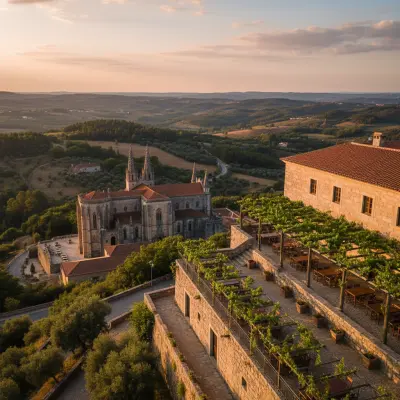
The swing is set on a limestone shoulder open over the valley. In the foreground, the white houses of Reguengo do Fetal; further out, the town of Batalha, with the unmistakable bulk of the Monastery picking out when the light is right. To the southwest stretches the Serra de Aire e Candeeiros, that pale-stone, low-scrub landscape that defines this entire region. On clear days the Atlantic shows up as a grey line on the horizon. This is exactly the kind of panorama that earns its place on a viewpoint route through the area, and it pairs well with the Miradouro da Portela das Cruzes, which is fairly close and offers a different angle on the same valley.
When to go, and when not to
The short answer: late afternoon, about an hour before sunset. The longer answer is that this place is oriented toward the west, with the serra acting as a backdrop, and the last two hours of light are what justify the trip. Show up at noon in July, with 35 degrees and no shade, and you will regret it. Show up at sunrise and the sun is behind you, leaving the view you came for in flat shadow. The good window is roughly between 5.30pm and dusk in winter, and between 7.30pm and 10pm in summer. If you want the fuller case for sunset in this corner of the country, read The Limestone Twilight: Where the Sun Sets in Batalha before plotting the route.
Avoid days of thick fog, which happen here often enough in winter and spring, and on which you simply will not see anything. Strong wind also kills the fun: the swing moves nicely, but anything from 40 km/h in gusts and it goes from playful to uncomfortable. On rainy days the final track gets bad and the wood stays soaked for hours.
Practical tips
- Price: free. No ticket, no till, no QR code. The € rating is literal here, in the sense of "you do not pay".
- Hours: there are no official hours. Because it is open-air and unfenced, it is technically accessible 24 hours, but there is no lighting at all after dark. Bring a torch or headlamp if you stay past sunset.
- Reservations: not a thing. If you arrive and the swing is occupied, wait your turn. Ten minutes usually does it.
- Footwear: trainers or light boots. Not sandals, not flip-flops. The path is uneven and there is loose stone.
- Children: the swing is a two-plank seat with no harness, and it sits on a shoulder with a drop in front. Small kids only with an adult holding them, the whole time.
- Toilets: none. Sort that out at a café in town before driving up.
- Bins: none. What you bring up, you bring back. The amount of plastic that ends up in places like this is embarrassing.
- Drones: technically possible, but read the room. On a busy weekend it is rude.
Combining it with other stops
The Baloiço da Torre will not fill an afternoon on its own. It works as part of an itinerary. An honest suggestion: start in the centre of Batalha mid-afternoon, walk the Monastery and the streets around it, ideally with the context from Beyond the Stone: A Connoisseur's Guide to Batalha in mind. If you want a more architectural read, the piece Batalha: The Geometry of a Vow and the Silence of Stone is the one to take with you. Around 5.30pm, drive up to Reguengo do Fetal. Do the more open viewpoint first, then the swing, stay for sunset, and drop back into Batalha for dinner.
For dinner, Restaurante Dom Duarte is a safe pick in town, a few minutes by car from the swing. Book ahead, especially Friday to Sunday, because the room is small and it fills up.
What to bring
An extra layer, even in July, because at 320 metres and at the end of the day the wind cools things off quickly. Water. A full phone battery if you intend to take photos, because you will take more than you expect. A small cloth or towel to wipe the seat if it has rained in the previous hours. And, frankly, patience: the photogenic angle attracts people who take a long time to nail their shot, and the only civilised way to handle that is to wait your turn without a fuss.
Is it worth it?
Yes, with conditions. If you are in Batalha for a night, if you enjoy late afternoons outdoors, and if you accept that ten minutes sitting on a swing watching the sun drop over the Serra de Aire e Candeeiros is a legitimate way to spend time, this place delivers. If you are expecting an attraction with infrastructure, a café, a toilet and a tidy car park, this is not it. It is a swing on a hillside. That is all it is, and sometimes that is enough.