Beja by Bike: Flat Routes Through Alentejo Wheat
Cycling out of Beja is the opposite of what most expect from the Alentejo: flat terrain, empty roads, and holm oaks for shade every few kilometres. ParkeBike rents electric bikes with an audio-guide app and has the best route in the area, between Trindade and Trigaches.
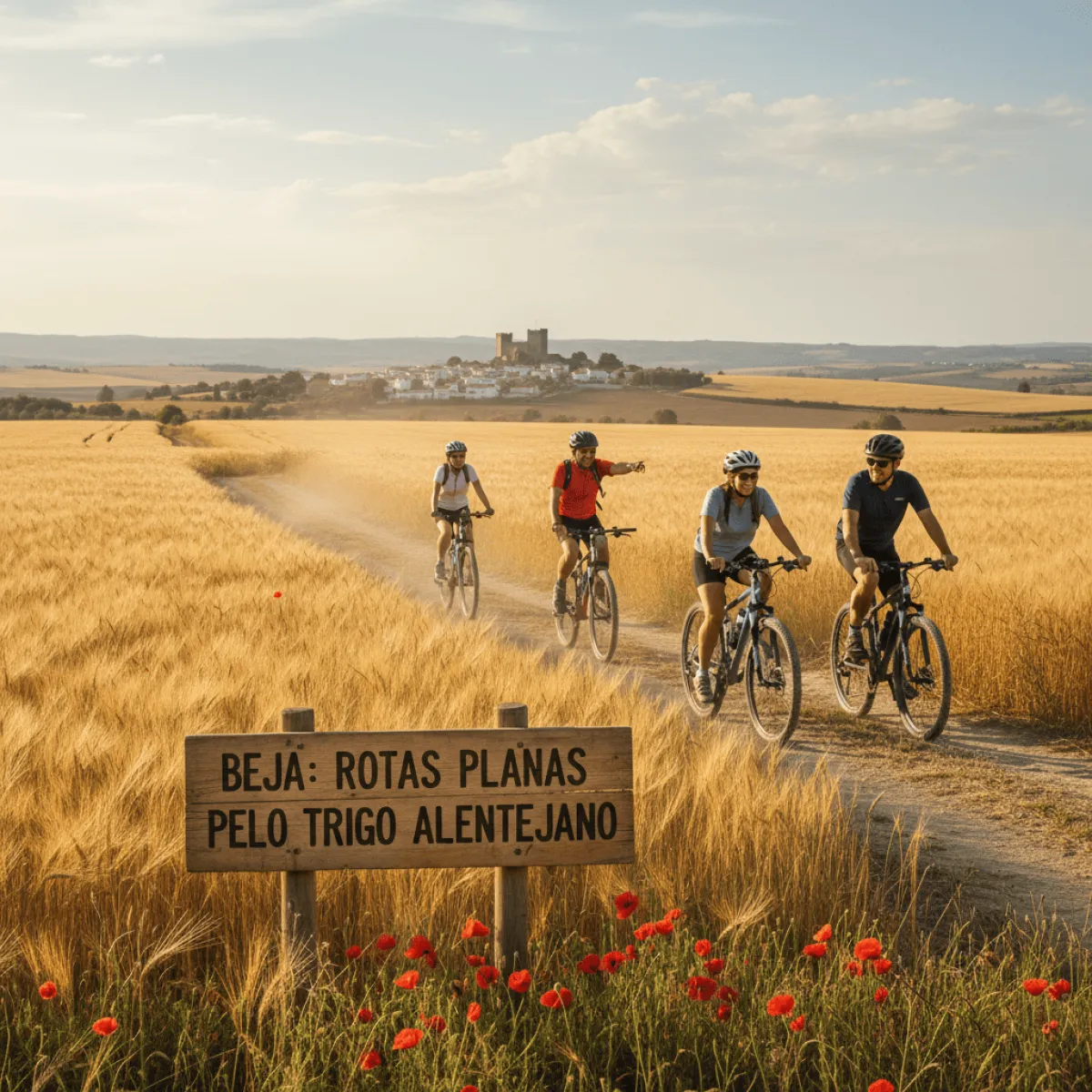
Beja is one of the few Portuguese cities where you can leave the historic centre, take a left at any secondary roundabout, and within fifteen minutes find yourself surrounded by wheat all the way to the horizon. The terrain is almost flat. Cars are rare. Holm oaks throw shade every few kilometres. It is ideal cycling territory, and that is exactly what ParkeBike (operated by XMSBikes) has been building from its base on Rua dos Marceneiros, 12, near the newer industrial edge of town.
Who ParkeBike is and what they offer
ParkeBike is a Portuguese company that started in Sintra and opened a Beja outpost with a fleet specialised in electric bikes, mostly fat-tire eBikes. The wide tyres forgive uneven surfaces, packed dirt, and the loose gravel that defines rural Alentejo lanes. The model is simple: you rent the bike, load the Routzz Guide App on your phone, and head out without a guide. Routes appear on screen with turn-by-turn navigation and audio commentary on what you are looking at.
It is not exactly a guided tour, and that is one of the reasons I like it. In Beja, with this heat and this light, having someone behind you explaining every olive grove would be exhausting. The freedom to stop when you want, photograph a 200-year-old holm oak or a herd of merino sheep, and remount when you feel like it, makes the difference.
What the routes are actually like
The absolute advantage of cycling out of Beja is the gradient. We are on the Baixo Alentejo plateau, and a full morning's accumulated climb rarely passes 150 metres. For anyone who has never cycled in this region, it is a surprise. Nothing like the Serra de São Mamede or the inland Algarve. Here you pedal with almost no effort, even on a regular bike. On an electric one, it is butter.
Routes leave the city via the Aljustrel road or the Penedo Gordo lane, both with light traffic. The first five kilometres are transition: you pass the last workshops, a tractor dealer, and suddenly the tarmac narrows and the green (or gold, depending on season) carpet begins. In May and June the wheat is high and still green. In July it is harvested and the fields turn straw-yellow. In October, after the first rains, purple flowers appear under the olive trees.
The best stretch, for my money, is the section between Trindade and Trigaches, following the old Aljustrel railway line. There is a solitary holm oak at kilometre seven that serves as a landmark to anyone who pedals here. Stop. Drink water. Look around. It is the kind of landscape where nothing seems to be happening and everything is: cicadas, the distant rumble of a tractor, a goat bell, and nothing else.
When to go and how long to ride
September to November and March to May are the right windows. Forget July and August, or leave at six in the morning and be back by ten. In peak Alentejo summer, with 40 degrees, cycling between 11am and 5pm is not difficult, it is dangerous.
For a first contact with the region, plan two to three hours. That covers 20 to 25 kilometres comfortably with stops. If you want a full day, there are circular routes of 40 to 50 km that pass through Beringel, loop around the hill, and return to Beja from the other side. If you plan to come back to the city at sunset, it is worth combining the ride with a night at the Pousada Convento de Beja, set inside the former convent of São Francisco. A hot shower in the cloister courtyard after six hours of pedalling is one of the best rewards this city offers.
Prices, hours, and how to book
ParkeBike operates Monday to Friday, 9.30 to 12.30 and 14.30 to 18.30, and is closed on weekends, which is the only real weakness if you are in Beja only on a Saturday. It makes sense to book ahead through the website (parkebike.com) or by phone at +351 968 725 761, especially if you want an electric model. Confirm current half-day and full-day rates directly with the provider, since they vary by bike type and season.
Helmet, lock, basic repair kit, and access to the Routzz app with preloaded routes are always included. The bike comes with a rear rack, which is handy if you want to strap on a cool bag with bread, cheese, and fruit for a mid-ride picnic. Highly recommended.
What to bring and what to avoid
- Clothing: breathable shorts, light-coloured t-shirt, sleeves if it is summer (the sun burns sideways). Closed shoes. Forget sandals.
- Water: two litres per person minimum. There are no rural cafés between hills. Public fountains exist but do not always work.
- Sun protection: SPF 50, hat, sunglasses. Alentejo light is brutal even under clouds.
- Charged phone: the Routzz app drains the battery. Bring a power bank.
- What to avoid: showing up unbooked on weekends with a fair or festival in town, when local demand spikes. Riding without a helmet (legally required in some contexts on Portuguese roads and, more importantly, on dirt with loose stones, it is just stupid).
How to fit it into a Beja trip
The bike works well within a two or three-night stay in Beja. The day before riding, do a slow read of the historic centre with this guide on the geometry of silence in town, which helps explain why Beja feels both empty and full at once. If you would rather walk than cycle, or alternate the two, the hiking trails of the region are worth knowing, since some overlap with the bike routes.
And for the day weather turns, because it does even in Alentejo, there is an article on indoor refuges in Beja that are actually worth it. Cancelling a ride because of heavy rain is a sensible call, not a defeat.