Forte de São Brás de Vila do Porto
Perched on top of the cliff, this 16th-century fort holds within its walls the first parish church of Santa Maria. No ticket queues, no tour buses, just stone, wind and the right angle on the port of Vila do Porto.
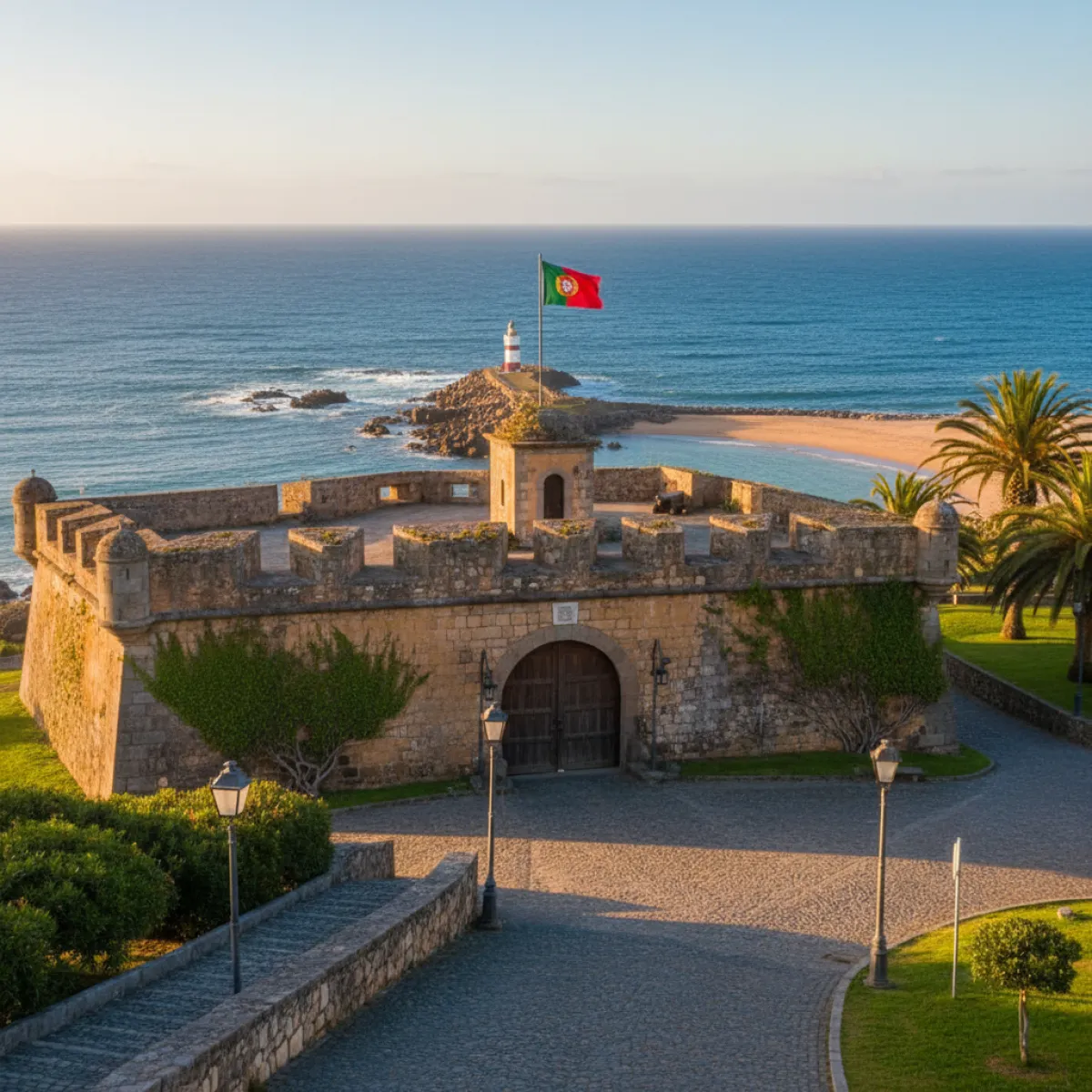
The Forte de São Brás sits on top of the cliff that closes off the port of Vila do Porto, looking out over the harbour like someone keeping watch on a front door. It was built in the 16th century, during the Filipino period, with a very specific brief: stop the pirates and privateers who were turning the Atlantic shipping lanes into a personal hunting ground. Santa Maria was the first island in the Azores spotted by Diogo de Silves in 1427, and for centuries that also meant being the first to take a hit. The fort is the stone reply to that problem.
What you actually see when you get up there
The official address is Cimo da Rocha, 9580 Vila do Porto, Santa Maria, Azores, and the name is the clue: we are on top of the rocky escarpment that frames the port to the south. From below, at the quay, you see the structure cut against the sky, low and stubborn, in the way most Azorean fortifications are: function over swagger. From up top, you get the angle: the U-shaped bay, the basalt taking the swell, and, on a clear day, the silhouette of São Miguel pinned to the horizon.
Inside the walls is the Chapel of Nossa Senhora da Conceição, and this is the detail most visitors miss: it was the first parish church of Santa Maria island. Before the Igreja Matriz that now anchors the centre of Vila do Porto existed, this was where people prayed. The chapel is small, sober, the white lime that defines Azorean religious architecture, and it has the curious quality of sitting inside a military structure. To me, that has always been the most honest metaphor for life on these islands: pray and defend, in the same building, at the same time.
Getting there and when to go
If you fly, the airport is Santa Maria (SMA), a few minutes by car from the centre of Vila do Porto. From the town centre to the fort is about ten minutes on foot, a moderate uphill, or three by car. If you arrive by boat, even better: the fort is literally staring down at the quay. Walk up if you can. The climb gives you the geography lesson the building was built to teach: you start at sea level, you end at the gun line, and you understand why someone in 1500-something thought this exact spot was worth fortifying.
Entry is in the budget category (price €), which makes it accessible on any travel budget. Reliable opening hours and a phone number are not posted online, and the interior is not always open to the public. Check directly with the Vila do Porto tourist office before climbing, especially if you want to see inside the chapel. Even if the gates are shut, the outside and the natural lookout over the port pay back the walk.
Practical tips nobody tells you
- Go in late afternoon, between 5pm and sunset. The light on the stone goes gold and the wind drops. In the morning the sun is on the wrong side and the fort sits in shadow.
- Wear shoes with grip. The rock around the fort is uneven and slippery in damp.
- No café, no toilets at the site. Eat, drink, and use the bathroom in town before you head up.
- Wind. There is always wind. A thin shell beats a thick coat.
- You do not need two hours. Thirty to forty-five minutes is enough if you are looking. Allow an hour if you are photographing.
What to pair it with
Vila do Porto is small, and most of it works on foot or in short hops by car. If you want to keep collecting views, head up to the Miradouro da Macela, which gives you another angle on the south coast and the open fields inland. It is one of the highest points in the area and pairs well with the fort: one is defensive and low, the other is airborne and wide.
If you like a planned route, our guide to the side of the island nobody looks for walks you through the less obvious circuit between the town, the fajãs and the shoreline. For a lunch idea, our Azorean cheese trail piece is more useful than most restaurant recommendations: Santa Maria has a small but real production of cured cheese that lives on in tiny grocers, and a wedge with bread on a stone wall near the fort beats most tourist menus.
The neighbourhood: Cimo da Rocha
Cimo da Rocha is not a neighbourhood in any city sense. It is a topographic name, the top of the rock. Around the fort you find scattered houses, low dark stone walls, vegetable gardens, the occasional vine clinging to a terrace. It is residential and quiet, and the best way to read it is to walk for half an hour without using GPS. Cars are few, dogs bark less than you think, and people nod when they pass you. As a rule, you nod back.
Why it matters
Azorean forts are not castles in the continental medieval sense. They are pragmatic, low-slung, designed for gunpowder and naval artillery, with thick walls and narrow gun ports. The Forte de São Brás is a textbook example, scaled to Santa Maria. It does not have the theatre of São Sebastião in Angra or São João Baptista on Monte Brasil, but it has something those do not: silence. No tour buses, no ticket queues, no souvenir kiosks. Just stone, the chapel, the wind and the port. If you want to understand why Santa Maria is the oldest settled island in the archipelago, start here. Vila do Porto was not picked at random, and this fort explains half the reason. The other half is in the fields and the island as a whole, and that, like our piece on the Alentejo poppy fields in spring, is a story for another visit.
