Alentejo Poppy Fields: A Spring Driving Route in Red
From mid-April to early June, the fields between Évora and Beja turn violently red with wild poppies. A two-to-three-day driving route through secondary roads, with wine in Vidigueira, migas in Évora, and the silence of Mértola.
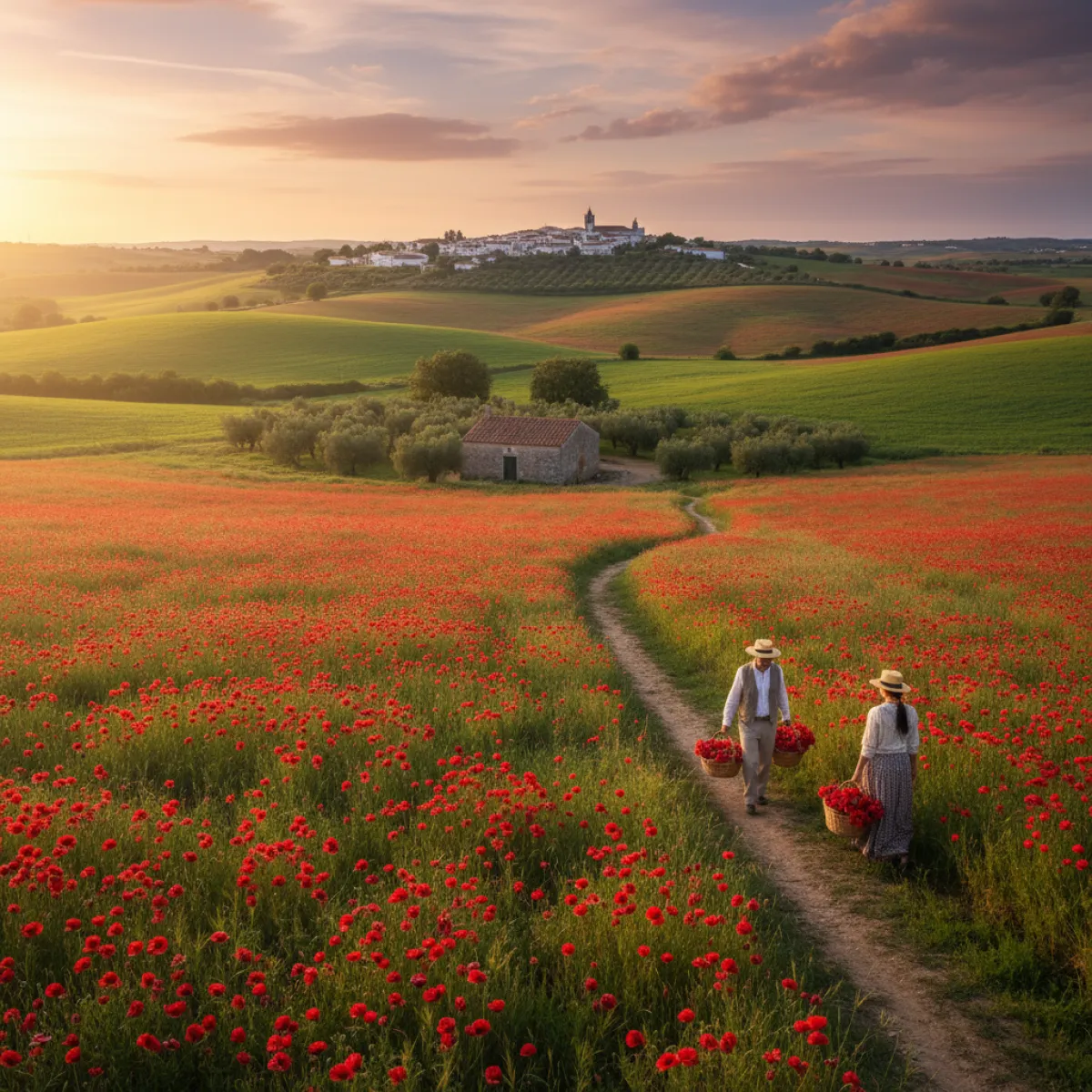
There's a narrow window, roughly mid-April to early June, when the Alentejo does something nobody expects from Portugal's driest, brownest region: it turns violently red. Poppy fields carpet entire plains between Évora and Beja, turning back roads into corridors of colour that look digitally enhanced but smell like wet earth and wild grass.
This isn't a tick-the-box itinerary. It's a driving route for people who enjoy pulling over on an empty road and staring at a field that has no entrance fee, no opening hours, and no gift shop. The Alentejo in spring is free and spectacular, and almost nobody talks about it.
When to go and what to expect
Poppy bloom timing depends on winter rainfall. A wet winter means fields start opening by mid-April. A dry one pushes it to May. Peak bloom usually lasts three to four weeks. The best time for photography is early morning, between 7am and 9:30am, when low-angle light makes the reds almost fluorescent. At midday, strong sun flattens the colours. Late afternoon brings them back.
There's no official poppy field map. They appear in agricultural land, along national roads and dirt tracks. The unpredictability is part of the appeal. But certain areas are consistently good, year after year.
The Red Triangle: Évora, Arraiolos, and Montemor-o-Novo
If you only have time for one area, pick the triangle between these three towns. The EN114 connecting Évora to Arraiolos is particularly generous with roadside poppies. Drive slowly. Pull over when you spot red patches in the distance. Most fields are on private land, but nobody minds photographs taken from the road or verge.
Arraiolos deserves at least an hour. The town is famous for its hand-embroidered rugs, a centuries-old tradition, and the hilltop castle offers a 360-degree view across the Alentejo plain. On a clear spring day, you can spot red patches on the horizon from the top of the walls.
In Montemor-o-Novo, the ruined castle is another natural viewpoint. The road between Montemor and Évora via the EN4 passes through open fields where poppies compete with yellow and blue wildflowers. It's a beautiful chromatic mess.
Where to eat in this area
In Évora, I don't need to tell you to try black pork. That's as obvious as telling someone in Lisbon to eat pastéis de nata. But I will say this: look for migas com carne de porco instead of the standard tourist plate. Migas, made from stale bread, garlic, and olive oil, are deep Alentejo comfort food, and in many local restaurants they're better than anything with a fancy name. For wine, you're in prime Alentejo DOC territory. A regional red, properly served, runs 3 to 5 euros a glass in most restaurants outside Évora's historic centre.
The Beja Road: EN18 and surroundings
The second area I'd recommend is the road between Évora and Beja, particularly the stretch between Vidigueira and Cuba. Yes, Cuba. There's a town in the Alentejo called Cuba, and it's more interesting than you'd expect. The national road connecting these two towns cuts through cereal fields where poppies grow like glorious weeds.
Vidigueira, where Vasco da Gama is buried (in the Igreja das Relíquias), is also a serious wine area. The whites from the Vidigueira sub-region are among the Alentejo's best: fresh, mineral, perfect for a spring lunch. Look for wineries offering tastings; many charge between 5 and 15 euros per person, but check locally as schedules vary.
Beja itself is an underrated city. The Museu Rainha D. Leonor, housed in the former Convento da Conceição, is worth visiting. The Torre de Menagem, at 40 metres, is Portugal's tallest keep and offers a commanding panoramic over the plain. Entry is a few euros.
The wild stretch: Mértola and the Lower Alentejo
If you want to escape everything and everyone, keep going south to Mértola. The road from Beja to Mértola via the EN122 is one of the most beautiful drives in the country, and nobody seems to know about it. It passes through cork oak groves, open fields, and, in spring, carpets of wildflowers that include poppies but also dozens of other species.
Mértola is a museum-village on the Guadiana river. The historic centre is tiny, walkable in half an hour, but it has a medieval mosque converted into a church (the only case in Portugal), a castle, and a quality of late-afternoon light that justifies staying for sunset.
Don't expect gastronomic sophistication in Mértola. Expect honest food: lamb stew, açordas, cured sheep's cheese. Restaurants are few and simple. Check hours locally, especially outside peak season.
Practical tips for the route
- Rent a car. There's no alternative. Poppy fields are on secondary roads with no public transport.
- Bring water and sunscreen. The Alentejo in May can hit 30°C.
- Don't walk into the fields. Photograph from the roadside. The land belongs to farmers who don't need tourists trampling their crops.
- Fuel up in Évora or Beja. Petrol stations between towns are scarce.
- Accommodation: Évora is the most practical base, with options from hostels to hotels with pools. Expect 60 to 120 euros per night for a double in mid-season. Beja is cheaper and less touristy.
Beyond the red: other reasons for spring in the Alentejo
The poppies are the excuse, but the Alentejo in spring has much more. Storks are nesting on bell towers and electricity poles. The cork oak groves are green and full of life. The temperature is ideal for walking: warm but not punishing, unlike summer when thermometers push past 40°C and any outdoor activity becomes an endurance test.
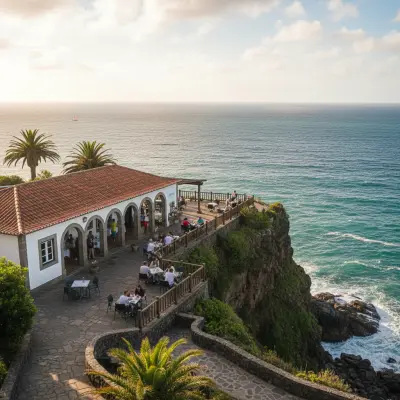
If the Alentejo in spring is mainland Portugal at its finest, it's worth remembering that the country offers radically different landscapes beyond the continent. For those who want to swap flat plains for volcanic geography and Atlantic horizons, the Miradouro da Macela on Santa Maria island in the Azores delivers a completely opposite perspective: instead of flat red stretching to the horizon, you get vertical blue as far as the eye can see.
The Azores work as a perfect counterpoint to the Alentejo. Where the Alentejo plains offer horizontal silence, the islands deliver vertical drama. If you're planning a longer trip through Portugal, our guide to 24 hours in Horta shows how to make the most of that singular port city. And if food is central to your travels, as it should be, the gastronomic trek through Ponta Delgada proves that Azorean cuisine has its own distinct identity well beyond the famous Furnas cozido.
For panoramic view hunters who fell in love with the Alentejo's horizons, the best viewpoints and rooftops in Horta are the Atlantic complement you didn't know you needed.
The route in brief
Day 1: Base yourself in Évora. Drive the EN114 to Arraiolos early morning for poppy fields in low light. Lunch in Arraiolos. Afternoon in Évora's historic centre, dinner.
Day 2: Évora to Vidigueira via the EN18. Stop in Cuba. Wine tasting in Vidigueira. Continue to Beja for dinner and overnight.
Day 3 (optional): Beja to Mértola via the EN122. Morning in the museum-village, lunch, then return or continue south to the Algarve.
The Alentejo in spring needs no marketing. It needs a car, a road, and someone willing to stop when they see red. It's one of the few natural spectacles in Portugal that charges no admission, has no queue, and gets better with every kilometre of secondary road you drive.