Walking Mogadouro: The Rock-Cut Wine Presses Trail
Twelve kilometres across the Planalto Mirandês, seven wine presses cut into the rock two thousand years ago, and almost nobody on the way. An honest guide to walking Mogadouro with decent boots, a paper map and a room booked at A Casa do Gi.
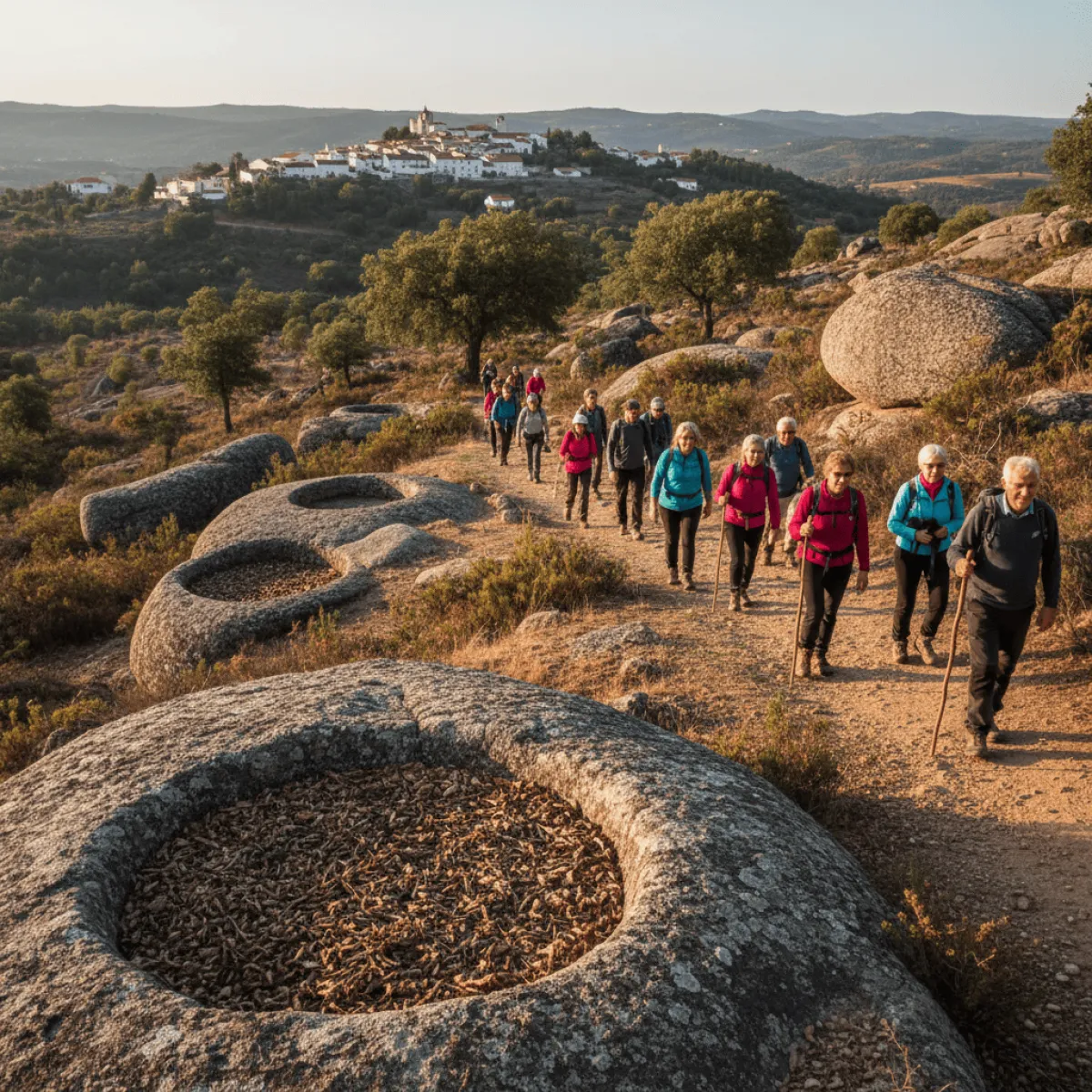
Here is something nobody tells you before you come to the rock-cut wine presses of the Planalto Mirandês: they are not signposted the way they should be. There is no fancy panel, no ticket office, no audioguide in four languages. They are out there, carved into the granite two thousand years ago, waiting for you to remember they exist and go to the trouble of finding them with a paper map and decent boots.
That is half the charm. The other half is the silence. In mid-May, at nine in the morning, you can walk three hours across the plateau without crossing a single human being. You hear the wind in the black oaks, the distant clink of a sheep bell, and occasionally an Egyptian vulture sliding low across the sky, because yes, this is the right corner of Portugal to spot them.
Why this trail, and why now
The lagares rupestres are pressing tanks cut directly into granite outcrops, used from Roman times until at least the eighteenth century to crush grapes and make wine. The Planalto Mirandês holds one of the largest concentrations in the Iberian Peninsula. More than a hundred have been catalogued in the broader area between Mogadouro, Miranda do Douro and Vimioso. Some are simple: one rectangular basin with a drainage channel. Others have two basins, cut steps, deep scars from the wooden beam press. All worked into living rock, no cement, no mortar, no recent restoration.
What makes this fascinating is not the beauty, because frankly there is no obvious beauty. It is the human scale. Someone, twenty centuries ago, picked that specific stone, on a plateau exposed to the wind, and decided that wine would be made there. And wine was made. Generation after generation. Until one day it stopped, and the stone remained.
Best window to walk: mid-April to mid-June, or late September to November. In summer the plateau cooks at 38 degrees with no shade for five kilometres. In winter it is grey and freezing, although it has its own kind of poetry if you like empty landscapes (incidentally, anyone curious about plateau-in-winter logic should read the Montalegre winter photography itinerary, different plateau, same principle).
The route, no fluff
The most accessible trail starts in Bemposta (the village of Bemposta, not the dam) and forms a roughly twelve-kilometre circuit passing seven catalogued presses, with discreet tile panels nearby. Plan four to five hours on foot, with proper stops to photograph and to sit on the stone and think about your life choices.
Shorter alternative: the mini loop from Vale de Porco, about six kilometres, three presses, two hours. Good option if you bring children, or if you arrive late and want to be back before lunch.
Minimum kit: two litres of water per person, hat, sunscreen (even in May the UV on the plateau is brutal), boots or trail shoes (lots of loose rock), and a phone GPS with offline tracks downloaded. Network coverage is patchy. Do not rely on Google Maps to get you out of nowhere.
What you will see, press by press
- Lagar de Picote 1: the most photogenic. Two connected basins, beam press, lateral notch for the screw. Direct view over the Douro Internacional valley.
- Lagar da Ribeira da Aveleda: small, isolated, easy to miss. My personal favourite, precisely for that reason. Sit there in the shade of a juniper and have coffee from your flask.
- Lagar do Penedo Durão: imposing, with cut steps descending into the tank. Has an interpretation panel.
- Lagar do Convento (Bemposta): reused in medieval times, with a Christian cross superimposed on older markings. Archaeology in strata, no pompous adjective required.
The remaining three are variations on the theme. If you have seen four, you have basically seen them all. The point is not to collect them, it is to walk from one to the next.
Where to sleep (and how not to choose wrong)
Mogadouro is not Lisbon or Porto. The accommodation offer is small but honest, and if you book a week ahead you will get a room in places that beat any generic roadside hotel.
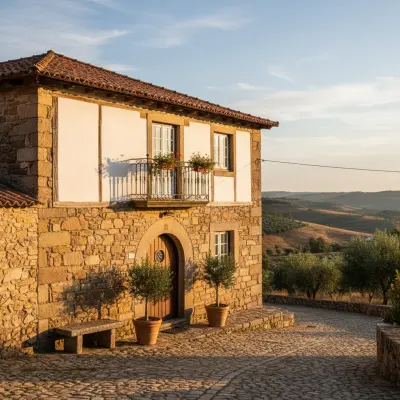
My number one recommendation, no hesitation, is A Casa do Gi, a stone house restored with common sense: wide-plank floors, a working fireplace, two bedrooms, breakfast with local-bakery bread and homemade jam. Gi knows where the presses are and will lend you a hand-annotated map if you ask nicely. It is also the kind of place where, if you arrive worn out from a hike, nobody judges you for having soup and cheese for dinner and going to bed at nine.
Equally solid alternative: Casa das Águas Férreas, more isolated, with a garden, ideal for a group of four or if you want to cook. Properly equipped kitchen, not the symbolic stove-and-two-bowls version. Difference from Casa do Gi: you are further from the town centre, so a car is mandatory.
Eating in Mogadouro: the plain truth
Mogadouro lives well on two things: posta mirandesa and almond. The posta is the prime cut of the Mirandesa breed cow, grilled over coals, usually served with boiled potato, greens and regional olive oil. No sauce. No fancy garnish. It does not need any. If a restaurant offers you posta with Roquefort sauce, leave the way you came in.
Always order the posta rare, even if you normally prefer medium. This meat loses everything if it goes past medium rare. And order regional red wine. There are small plateau producers who deserve more attention than they get.
On almonds: Mogadouro has one of the largest productions in the country. Blossom season, between mid-February and early March, turns the plateau into something absurdly beautiful, white and pink as far as the eye reaches. If you can sync a visit with that window, do it. In May, what remains is the almond pastries, which you find in any decent bakery in the town centre.
What else to do while you are around
If the wine-press trail leaves you hungry for more, and you have two or three days, there are smart combinations to make.
One is going down to the Sabor. The lower Sabor reservoir is essentially unknown, and that is lucky if you want still water at first light with no motorboats. I seriously recommend the kayaking trip on the Lagos do Sabor from Mogadouro, especially if you book the earliest morning slot. You see roe deer drinking on the bank, herons, and on a good day Bonelli's eagles. Cost sits in the typical half-day range. Confirm operator locally, there is more than one.
Another combination nobody makes but should: cross the plateau to the other side of Trás-os-Montes and realise this region is not one homogenous block. If you have two extra days, read the guide on Montalegre Beyond Barroso before you plan, because the landscape changes, the food changes, the accent changes, and people who assume Trás-os-Montes is uniform always leave either disappointed or surprised.
The perfect walking day, hour by hour
You wake at seven. Coffee and toast at Casa do Gi or wherever you are, calmly. Out the door around eight-thirty, twenty-minute drive to the trailhead in Bemposta. Park in the shade if you find any. In May, there is still some.
From nine to noon: walk the first four presses. Take a long break, half an hour, at Lagar da Ribeira da Aveleda. Take your shoes off. Eat an apple. Do not take photographs for those thirty minutes. Trust me.
Noon to one-thirty: continue to the remaining presses. Light lunch, sandwich or fruit, at Lagar do Penedo Durão, Spain over your right shoulder.
One-thirty to four: easy descent, back to the car. Shower, civilian clothes, rest until dinner.
Late afternoon, and this matters because the plateau in June has a light that is genuinely worth money, drive up to a high viewpoint for sunset. There are several good ones, and I detailed the best in the Mogadouro at Sunset guide. Bring a jumper. The wind drops when the sun does, and the temperature can fall ten degrees in twenty minutes.
Honest logistics
Getting there: by car, no serious alternative. From Lisbon roughly five hours. From Porto, three and a half. There is a Rede Expressos bus to Mogadouro, but then you really need a vehicle for the trails, and there are no taxis circulating in plateau villages.
When to come: ideal window is the first half of May and the first half of October. Avoid August. Also avoid the weekend of the Festas de Santiago in Mogadouro (late July), not because the festival is bad, it is good, but because you will not get silence on the plateau.
Cost of a weekend, two adults, with accommodation, meals, local fuel and one extra activity like the kayaking: reasonable, clearly below what you would pay for an Algarve equivalent. Confirm prices in advance but do not expect to be ripped off.
What not to expect: nightlife, interactive museums, perfect signage, restaurants open after ten. What to expect: people who greet you on the street without knowing you, bread that tastes like bread, and the rare feeling of having found a place that still works on its own terms, not on the ones Instagram demands.