Vila Viçosa: Where to Stay to Match Your Style
Vila Viçosa has three distinct zones to stay in: the monumental center by the Ducal Palace, the medieval Castle hill, and the outskirts with marble hotels and rural estates. Each offers a different version of the Alentejo, and the choice completely changes the experience.
Vila Viçosa is a small town. You won't need a map, you won't get lost in unfamiliar neighborhoods, and most guests could walk from one end to the other in twenty minutes. But that doesn't mean it doesn't matter where you drop your bags. In a compact town, the difference between waking up beside the Terreiro do Paço and waking up on a rural estate five kilometers out changes the entire experience. And Vila Viçosa deserves a deliberate choice.
The mental map you need
Forget neighborhood divisions. In Vila Viçosa, think in three zones: the monumental center around the Terreiro do Paço and the Ducal Palace, the Castle hill with its medieval core, and the rural outskirts stretching toward Serra d'Ossa. Each offers a different version of the Alentejo, and none is wrong. The question is what you want to see when you open the window in the morning.
Zone 1: The Terreiro do Paço and the monumental center
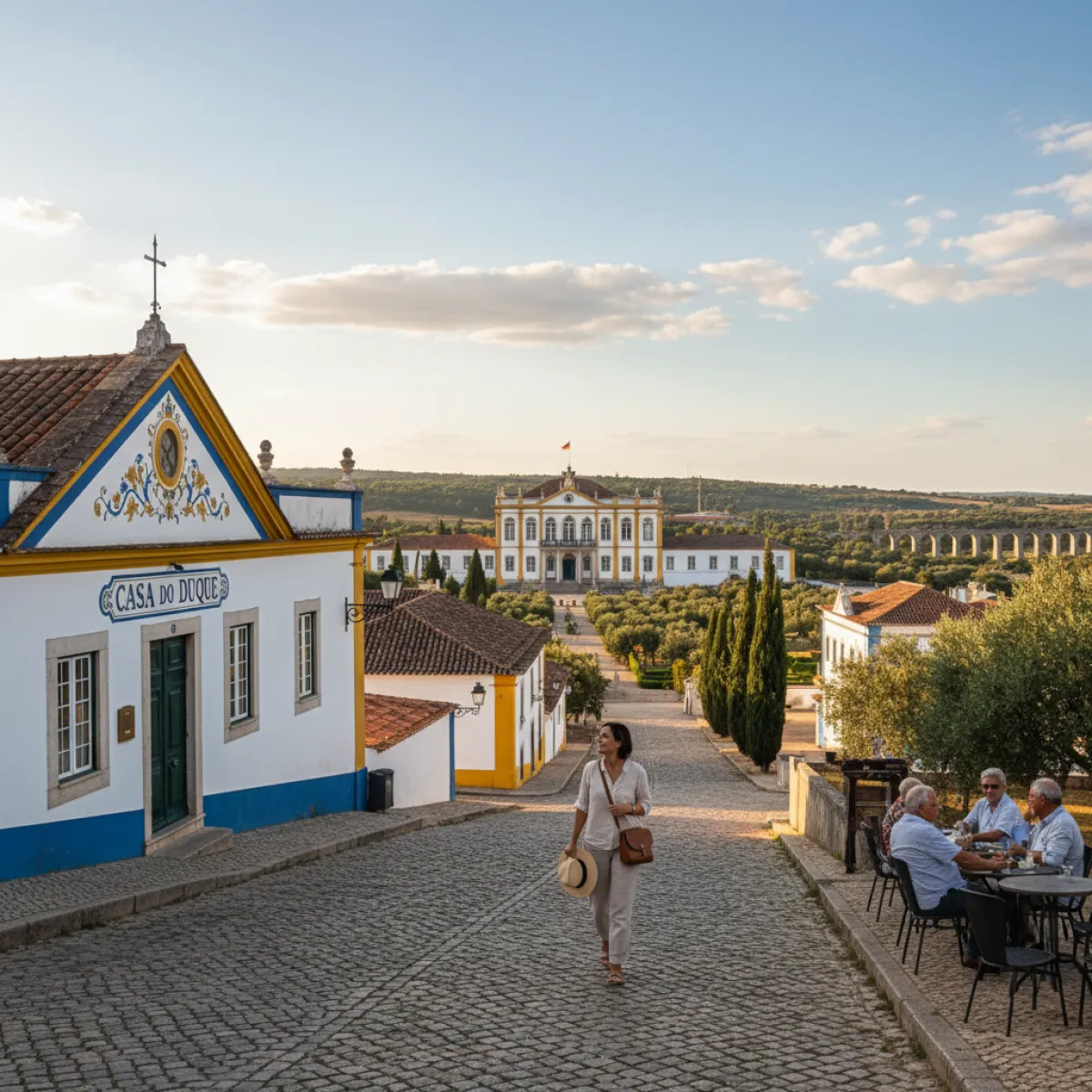
This is where Vila Viçosa plays its hand. The Terreiro do Paço is a 16,000 square meter square flanked by the 110-meter façade of the Ducal Palace in pink Estremoz marble. On one side, the former Augustinian Convent. On the other, the Convent of Chagas, now converted into a pousada. At eight in the morning, before the tour buses, the square is nearly empty, with light hitting the marble in ways no phone camera can properly capture.
If you want to be at the epicenter, the Pousada Convento de Vila Viçosa is the obvious pick. Housed in the 16th-century Convent of Chagas de Cristo, it retains its cloisters, tile-lined corridors, and that cool dimness only buildings with meter-thick walls can produce. There are 39 rooms, including suites. It has an outdoor pool, and the Antigo Refeitório restaurant serves Alentejo cuisine in a space that was, in fact, a nuns' refectory. Prices vary by season, but expect somewhere between €100 and €180 per night for a standard room. Check directly, because seasonality changes everything.
The advantage here: walk out the door and you're in the middle of history. The cafés on the Terreiro do Paço serve coffee at normal prices, not tourist-inflated ones. Restaurante Restauração, nearby, has an unpretentious terrace and serves ribs, migas, and lamb with the honesty you'd expect from the Alentejo. It's not fine dining. It's real food.
The downside: from May to September, weekends bring day-trippers, mostly to the Ducal Palace. Nothing dramatic. This is Vila Viçosa, not Sintra. But if you're after absolute isolation, you might prefer another zone.
Who this zone is for
Couples who want culture on the doorstep, car-free travelers who prefer everything on foot, and anyone who values the idea of having breakfast in a 16th-century cloister.
Zone 2: The Castle hill and the medieval core
Most visitors walk up to the Castle of Vila Viçosa, take a photo of the walls, and walk back down. Mistake. The area around the castle, at the top of the hill, is the oldest part of Vila Viçosa. It predates the Ducal Palace, with narrow streets, whitewashed houses, and a quiet that's different from the square below. The castle itself has a square plan, walls measuring roughly sixty meters on each side, circular turrets, and a moat reinforced during the Restoration Wars of the 17th century. Inside the walls stands the Sanctuary of Nossa Senhora da Conceição, patron saint of Portugal, with its original imagery.
Accommodation here is more limited. There are no large hotels on the hill, but there are private houses and small guesthouses that appear on booking platforms. A Casinha da Vila, for instance, sits near both the castle and the Ducal Palace. These are simpler options, no spa, no pool, but with the appeal of sleeping inside a medieval perimeter.
The advantage: genuine quiet. At night, the castle hill is probably the most peaceful spot in town. And sunrise seen from the ramparts, with the Alentejo plain stretching to the horizon, is worth the 6:30 alarm.
The downside: fewer services. There's no restaurant or café on the hill itself, so you'll need to walk down to the center to eat. It's five minutes on foot, but on a rainy winter night it can feel like more.
Who this zone is for
Independent travelers who like accommodation with character, photographers who want morning light without interference, and anyone who prefers silence to convenience.
Zone 3: Marble as luxury, the outskirts as retreat
And then there's the third option, the one I'd recommend to anyone who wants to use Vila Viçosa as a base for exploring Central Alentejo. I'm talking about staying just outside the historic center, but at a comfort level that old-town buildings, with their structural limitations, can't always match.
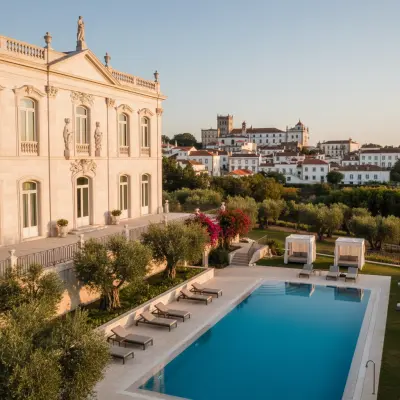
The Alentejo Marmòris Hotel & Spa is the prime example. A member of Small Luxury Hotels of the World, this hotel is built almost entirely from marble, which makes complete sense in a town that has quarried marble for centuries. Rooms have individually designed marble bathrooms: some in pink marble, others in tiger marble. The restaurant features a table carved from a single block of stone found in the owners' quarry. But the real argument is the Stone Spa, excavated inside a former marble quarry spanning 900 square meters, where the original rock walls, the natural drip of water, and the small stalactites forming overhead create an atmosphere no urban hotel spa can replicate. The marble stone massage is, according to those who've tried it, the treatment not to miss. The hotel has both indoor and outdoor pools, and prices reflect the positioning: check directly, but expect to pay upwards of €150 per night.
On the outskirts of town, there are also Alentejo farmsteads and rural estates, like Herdade Ribeira de Borba, technically in the neighboring municipality but minutes away, with outdoor pools and the slow rhythm of a working agricultural property. These are options for people who want to wake up among olive trees and vineyards, with silence broken only by birdsong and the occasional tractor.
Who this zone is for
Couples on a romantic getaway who want a spa and pool, families who need space, and anyone using Vila Viçosa as a base for driving around the Upper Alentejo.
What to do from each zone
Regardless of where you stay, Vila Viçosa is an excellent base for exploring the region. Visiting the Ducal Palace is non-negotiable: the interior holds a collection of azulejo tiles, frescoes, tapestries, and porcelain that rivals any palace in the country. The Castle and its Archaeology Museum round out the historical visit.
For nature lovers, the guided hiking trails on Serra d'Ossa are an excellent way to experience the landscape around the town with someone who knows the terrain. Serra d'Ossa is the highest point in the region, with views that reach Spain on clear days.
And if Vila Viçosa gives you an appetite for interior Alentejo, Portalegre is just over an hour north and deserves at least a weekend. We have a guide to a real weekend in Portalegre that cuts through the tourist noise, and another on neighborhoods worth walking on foot. If you go, don't miss checking where locals actually eat in Portalegre, because the difference between eating at a tourist spot and a real one is, as always in the Alentejo, enormous.
When to go and how to get there
Vila Viçosa is about 170 kilometers from Lisbon, which translates to just over two hours via the motorway to Estremoz and then by national road. There's no direct train: driving is the most practical option. Rede Expressos runs bus connections, but schedules are limited and journey times exceed three hours. Coming from Évora, it's about 55 kilometers, less than an hour.
Best time to visit: spring (March to May) and autumn (September to November). The Alentejo in summer easily exceeds 40°C, and while hotels with pools help, walking around town at midday in July is an endurance exercise. Winter is mild compared to northern Portugal, but can be rainy.
The verdict
If I had to choose, I'd stay in the monumental center for a first visit, at the Marmòris for a getaway with someone special, and on the Castle hill for a slower, more contemplative second visit. But the truth is Vila Viçosa is small enough that any choice works. The important thing is to go. This town, with its marble-lined streets and ducal history, is one of the most underrated places in Portugal. And frankly, I'd like it to stay that way.