The White Gold Trail: A Guide to the Marble Quarries and Workshops of Estremoz
Explore the 'White Gold' of the Alentejo with our definitive guide to the marble quarries and artisanal workshops of Estremoz. A deep dive into the stone-built soul of Portugal's most luminous town.
The Tectonic Soul of Alentejo
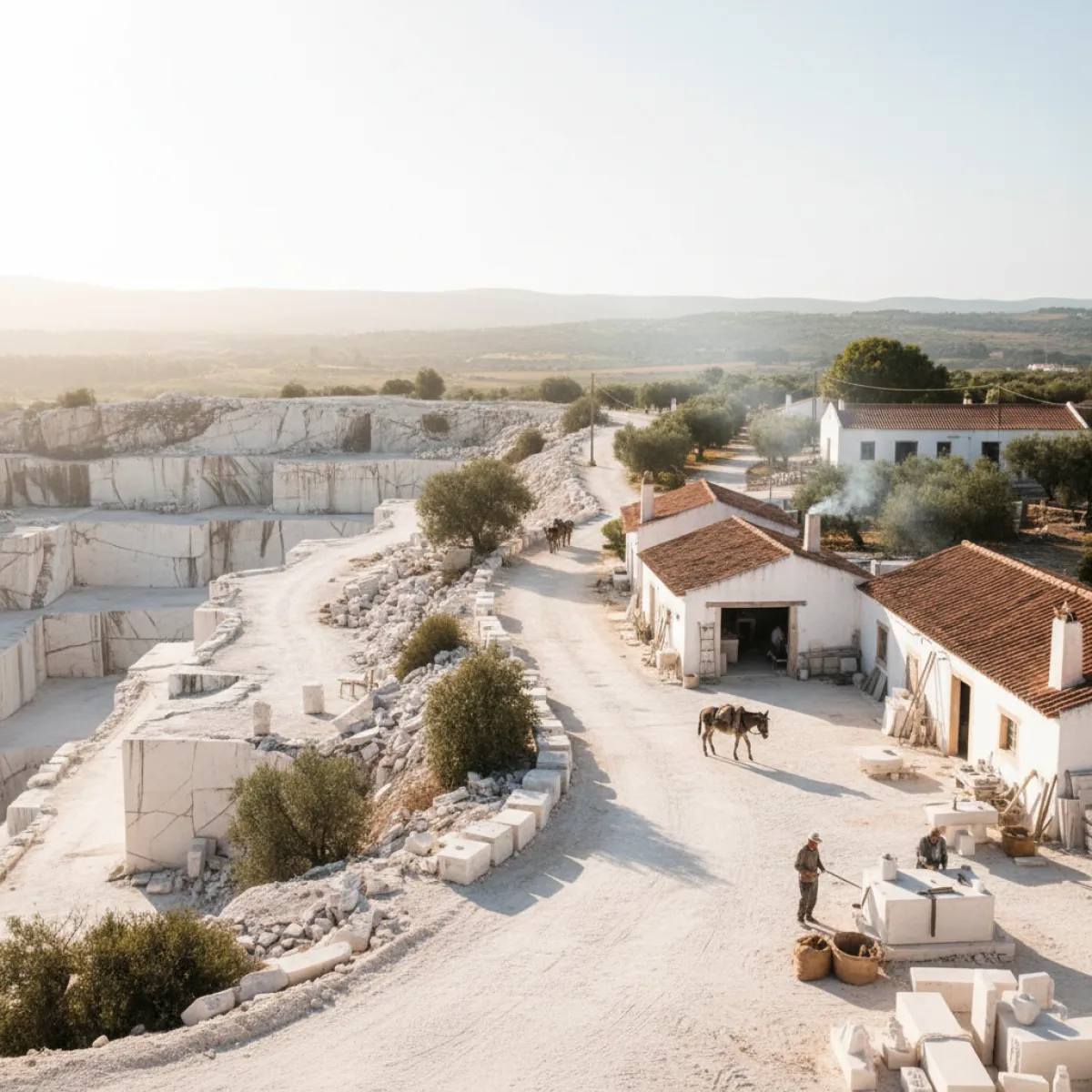
Estremoz does not merely sit upon the Alentejo landscape; it erupts from it. Built atop an anticlinal of high-grade marble, the town is a masterclass in the intersection of geology and urban planning. Here, marble is not a decorative afterthought reserved for the elite; it is the skeletal structure of the everyday. It forms the curbs of the sidewalks, the thresholds of modest homes, and the heavy troughs where livestock drink. This 'White Gold' lends Estremoz a preternatural glow, a luminous quality that makes the town feel as though it were carved from a single, monumental block of stone.
To truly understand this region, one must abandon the surface. The 'Marble Triangle', comprised of Estremoz, Borba, and Vila Viçosa, is home to some of the deepest open-cast quarries on the planet. Unlike the dark, claustrophobic shafts associated with coal, these quarries are vast cathedrals of blinding white. Standing at the edge of a pit like 'Vigária' is a lesson in perspective. Looking down 150 meters into the earth, the massive excavators and trucks appear as mere ants, laboring to extract the raw material that will eventually define the skyline of a distant metropolis. It is a landscape of profound silence and immense weight, much like the atmosphere described in Stone and Silence: A Sentimental Guide to Évora.
The Aesthetics of Extraction
Visiting the quarries is an exercise in precise timing. These are active industrial sites, not theme parks. Hiring a specialized guide is essential, not only for safety but to decipher the language of the stone. One must learn to distinguish the 'Estremoz White', prized for its purity, from the 'Rosa Portugal', which carries a delicate, flesh-toned blush. The extraction process is a slow-motion ballet of diamond-wire saws and heavy machinery. It is a gritty, dusty reality that stands in sharp contrast to the polished elegance of the final product. For those who have already experienced the slow pulse of the Alentejo in nearby cities, Estremoz provides the raw, industrial counterpoint to that refined heritage.
The Saturday Ritual at the Rossio
If the quarries represent the extraction of wealth, the Rossio Marquês de Pombal represents its distribution and celebration. Every Saturday, this vast central square hosts a market that remains one of the most authentic in Southern Europe. Amidst the stalls of pungent sheep’s milk cheeses, hand-woven baskets, and live poultry, marble makes its domestic debut. You will find heavy mortars and pestles, bookends, and lamp bases, all carved by local hands. It is a place to observe the unpretentious utility of the stone. If you are following a precision itinerary for the Alentejo capital, a Saturday morning detour to Estremoz is non-negotiable for its sensory density.
Contemporary Craft and Sculptural Futures
The future of Estremoz marble lies in the hands of a new generation of designers and traditional stonemasons who occupy the workshops lining the steep streets leading to the Upper Town. Entering these spaces is like stepping into a winter landscape; a fine white dust covers every surface, from the heavy wooden workbenches to the eyelashes of the carvers. The process is grueling and loud, yet the results are increasingly delicate. Modern artisans are pushing the limits of the stone, creating pieces that feel impossibly light, translucent bowls, wafer-thin furniture components, and abstract sculptures that challenge the stone's inherent rigidity.
This artisanal renaissance is turning Estremoz into a destination for those seeking more than just souvenirs. Collectors come here to commission bespoke pieces, attracted by the unique geological fingerprint of each block. The relationship between the artisan and the rock is intimate; they listen for the 'ring' of a hammer against the stone to detect hidden fissures. It is a level of craftsmanship that demands respect and a slow, considered approach to travel.
Practicalities: Mastering the White Gold Trail
When to Go and Budgeting
The ideal window for Estremoz is from March to May, when the wildflowers carpet the plains and the heat in the quarries is manageable. Autumn, specifically October, offers the added drama of the wine harvest. Budget for a high-end experience: expect to spend between €250 and €400 per day for two people, covering a stay in a converted palace, private quarry tours, and exceptional dining. This is a region where quality is accessible but commands a fair price.
What to Order: The Alentejo Table
Dining in Estremoz is an exercise in hearty tradition. At 'A Cadeia Quinhentista', a restaurant housed in a 16th-century prison, the setting is as compelling as the menu. Order the 'bacalhau' with a crust of traditional corn-bread or the slow-cooked black pork cheeks. The wine list is a tribute to the local terroir, look for robust reds from the Estremoz or Borba DOCs. For a more contemporary take on regional flavors, 'Alecrim' serves excellent 'petiscos' (Portuguese tapas). Always prioritize the local olive oil; it is often bright green, peppery, and world-class.
The Architecture of Rest
For a stay that mirrors the town’s regal history, the Pousada Rainha Santa Isabel is the undisputed choice. Perched in the 13th-century keep, its rooms are filled with antiques and offer views that stretch toward the Spanish border. For those preferring a more discreet, boutique atmosphere, Pateo dos Solares Charm Hotel provides a sophisticated retreat with a focus on wellness and local materials, tucked just inside the city walls. Both options allow you to immerse yourself in the stone-built heritage of the Alentejo without sacrificing modern comforts.
The Eternal Return to the Stone
Leaving Estremoz, one notices the marble everywhere, in the grand monuments of Lisbon and the luxury lobbies of London and Dubai. But stripped of its international prestige, the stone remains a local truth. It is the weight of the past and the foundation of the future. Estremoz is not a place for the hurried traveler; it is a destination for those who wish to see the very bones of Portugal, polished to a brilliant, blinding white.
