The Language of the Border: A Deep Dive into Mirandese Identity and the Pauliteiros Dance
Explore Miranda do Douro, where the Mirandese language and the martial Pauliteiros dance preserve a unique identity on the Trás-os-Montes plateau. A journey through the culture, gastronomy, and cliffs of the Douro.
The Plateau Wind and the Defiance of Stone
Arriving in Miranda do Douro is not merely a matter of travel; it is a transition into a different frequency of Portuguese reality. Here, the Mirandese Plateau stretches out with a rawness that challenges the softness of the coast. The landscape is dominated by granite, heather, and the deep incision of the Douro Cliffs (Arribas), where the river stops being a carrier of fine wine and becomes an uncompromising geological border. It is within this historical isolation that one of the most resilient identities in the Iberian Peninsula was forged.
Unlike other regions that diluted their particularities into national homogeneity, Miranda has remained faithful to two fundamental pillars: its language and its rhythm. Mirandese (or Lhéngua Mirandesa) is not a rustic dialect or a phonetic curiosity; it is Portugal's second official language, a direct descendant of the ancient Astur-Leonese that survived on the fringes of Lisbon's power. Walking through the streets of Miranda is to hear the sound of a Portugal that could have been, but here chose to remain.
Lhéngua Mirandesa: The Phonetics of Survival
To the outside observer, Mirandese sounds like a rhythmic collision between archaic Portuguese and Leonese Spanish. However, its structure is complex, carrying a heritage that dates back to the 12th century. Its officialization in 1999 was not an act of legislative charity but the recognition of a daily reality: in the villages of Sendim, Duas Igrejas, or Picote, Mirandese is the language of affection, livestock, and the land. It is a language felt in the sharp palatals and a grammar that preserves verb forms long lost elsewhere.
This linguistic resistance is inseparable from geography. Miranda has always looked more toward Zamora than toward Porto. This isolation allowed local culture to breathe without being smothered. If we compare it to other frontier areas, such as the route leading to the Roman legions' legacy and the ancient thermal springs of Chaves, we realize that Miranda maintained a much more impermeable cultural barrier, protected by the deep gorges of the Douro International park.
The Pauliteiros Dance: Warfare as Art
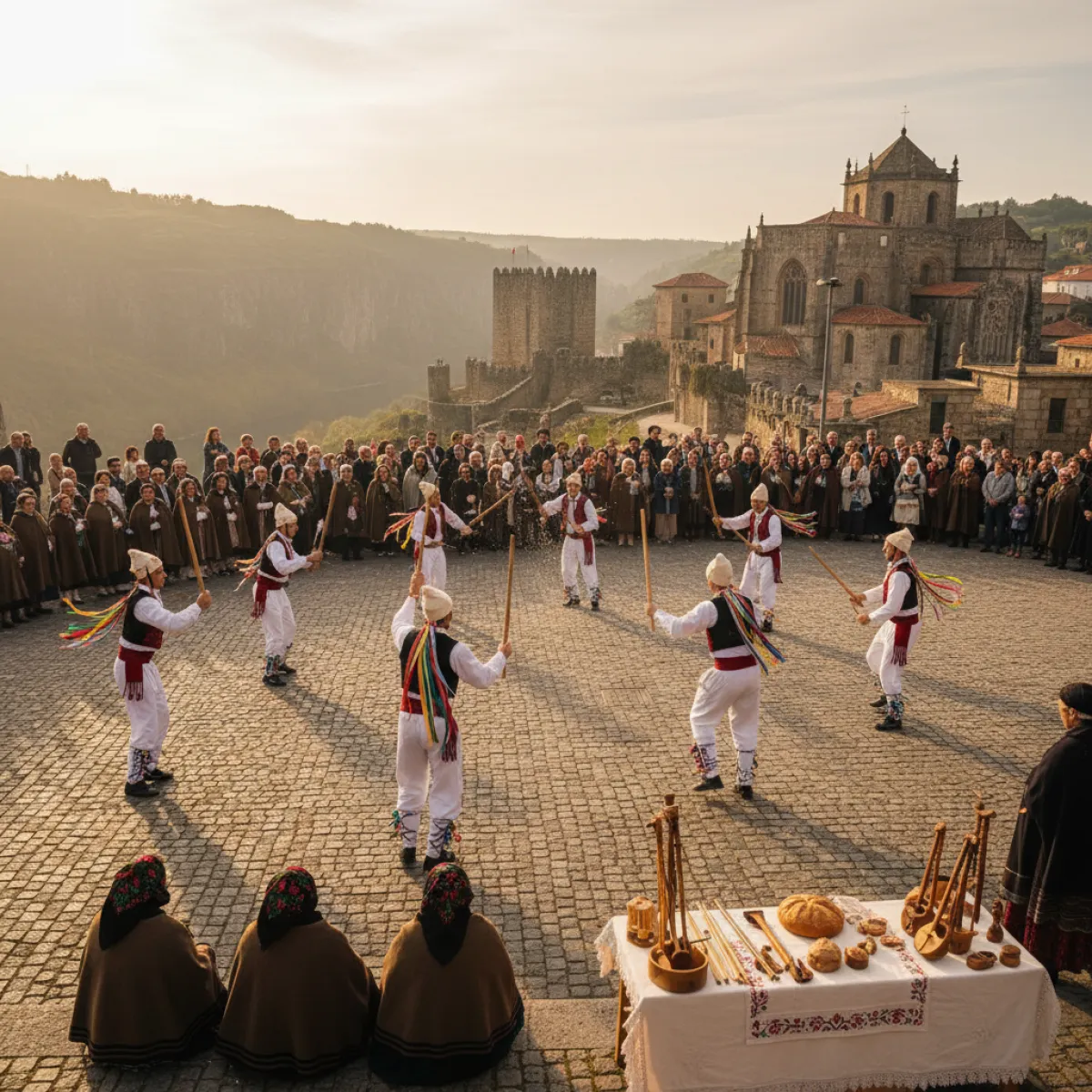
If the language is the spirit, the Pauliteiros Dance is the body of this region. To watch a group of Pauliteiros (or lhaços) is not to see a folk show for tourist entertainment; it is to witness a ritual of masculinity, coordination, and collective memory. The eight dancers, dressed in embroidered cotton skirts, vests, and flower-adorned hats, strike their sticks with a controlled violence that echoes ancient Celtic sword dances or Roman military training rituals.
The sound is hypnotic. The pastoral flute (gaita-de-foles), the bass drum (bombo), and the snare drum mark the tempo, while the dry crack of ash wood rings against the granite squares. Each choreography, or lhaço, tells a story, sometimes of agricultural labor, sometimes of social mockery, sometimes of religious devotion. There is none of the lightness found in the circle dances of Minho. Mirandese dance is telluric, heavy, almost martial. It is an assertion of presence in a territory that, historically, was a no-man's-land.
Highland Transitions: From Silence to the Table
The Mirandese identity does not exist in a vacuum. It dialogues with the rest of the Trás-os-Montes region through striking contrasts. While to the north we find the silence of Montesinho and its winter retreat, Miranda offers a drier vibration, more exposed to the sun and wind. If Montesinho is the gentle mountain and the chestnut, Miranda is the hard plateau and the beef.
The local gastronomy is a direct reflection of this productive austerity. The Posta Mirandesa is its ultimate expression. It is not just a steak; it is a cut of Mirandese breed beef, raised extensively, grilled with coarse salt over holm oak embers. Simplicity is its greatest virtue. It must be served pink inside, accompanied by 'batatas a murro' (punched potatoes) and turnip greens that, in these cold lands, gain a simultaneously spicy and sweet flavor.
As we descend the plateau toward the west, the robustness of the beef gives way to other complexities. This is what one finds when exploring the Mirandela region, where the palate becomes more processed and smoky, moving well beyond the alheira into Mirandela’s culinary resilience. This journey between Miranda and Mirandela is the best way to understand the diversity of the Portuguese northeast: from the purity of raw meat to the sophistication of bread-based sausages.
Practical Guide to the Plateau
When to Go
Avoid the peak of summer, when the heat on the plateau becomes scorching and the Douro reflects light with blinding intensity. The ideal time is late August, during the Santa Bárbara festivities, where the Pauliteiros take to the streets in full regalia, or in the deep winter (December and January). In winter, frost covers the plateau, and the gastronomic experience becomes more meaningful. The 'L'Zaba' winter festival (the boy's festivals) in surrounding villages offers a glimpse of ritual masks that pre-date Christianity.
Where to Eat and What to Order
- O Mirandês: Located in the center of Miranda do Douro. Order the Posta, but start with the 'chouriça de mel' (honey sausage), a local specialty that challenges the conventions of sweet and savory.
- Balbina: In Sendim. An honest spot where 'arroz de fumeiro' (smoked meat rice) accompanies meats that actually taste like what they fed on.
- What to order: Besides the Posta, look for the 'Cordeiro de Raça Churra Galega Mirandesa' (roasted lamb) and, for dessert, the 'Bola Doce de Miranda', a leavened dough with cinnamon and sugar that resembles a denser, more textured version of sponge cake.
Logistics and Budget
Miranda do Douro is accessible via the IP4/A4, but it is a long drive from Porto (about 3 hours). Ideally, stay overnight in rural tourism houses in villages like Picote, where you can wake up overlooking the Douro canyon. Budget around €40-€50 per day for high-quality meals. Visits to the Museu da Terra de Miranda are essential to contextualize the language and costumes; the cost is nominal (less than €5), but the cultural value is immense.
Conclusion: The Border as a Destination
Miranda do Douro teaches us that the border is not the end of a country, but the beginning of a culture. The preservation of Mirandese and the persistence of the Pauliteiros are not anachronisms; they are declarations of cultural independence. In an increasingly standardized world, the Mirandese Plateau remains a stronghold of granitic authenticity, where time is measured by the strike of sticks and the cadence of a language that refuses to be silenced by progress.
