The Jewish Legacy of the Highest City: A Walk Through Guarda's Judiaria
At a thousand meters above sea level, Guarda's Jewish quarter stands as a silent witness to resistance and faith. Discover the marks etched in granite and the robust gastronomy of Portugal's highest city.
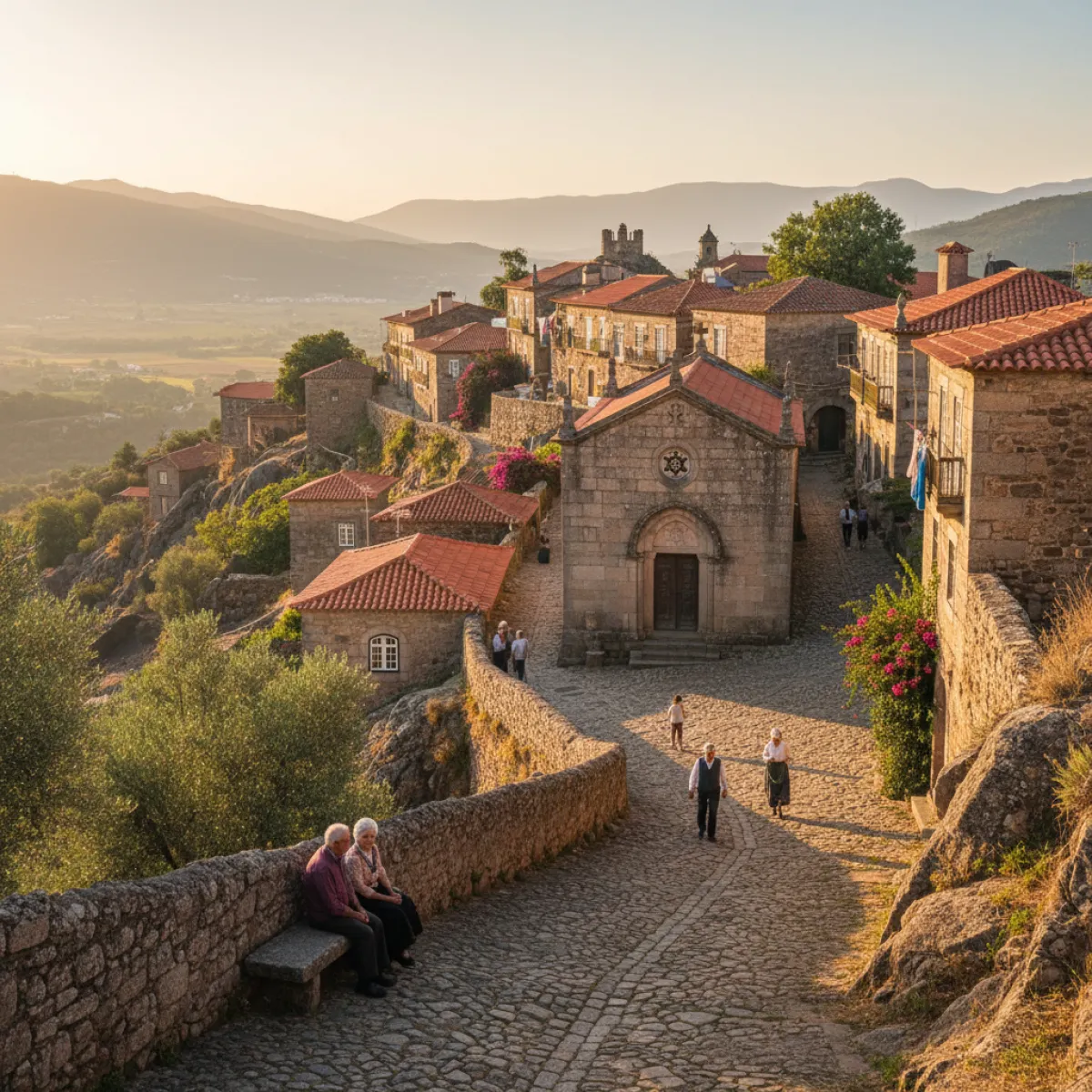
The Granite Silence at One Thousand Meters
Guarda does not apologize for its weather. Perched at an altitude of over a thousand meters, marking the transition between the Beira plateau and the ridges of the Serra da Estrela, the city asserts itself through its granitic toughness. Here, the wind, the famous nortada, is not merely a meteorological event but a permanent resident that shapes the character of its inhabitants and the aesthetics of all that endures. Within this landscape of resilience, we find one of the most preserved and historically dense Jewish quarters (Judiarias) in Portugal.
To walk through Guarda is an exercise in verticality. While many of Portugal’s historic cities have softened over time, Guarda retains its military skeleton. The Judiaria, located adjacent to the medieval walls between the Porta do Sol and the Porta d’El Rei, is the heart of this survival narrative. Do not expect the decorative exuberance of Lisbon’s Manueline style or the Baroque elegance of Minho. In Guarda, beauty lies in sobriety and memory etched into cold stone.
The Grammar of Doors: Marks of a Silenced Faith
As you descend Rua do Amparo, your gaze must shift from the mountainous horizon to the door jambs. It is here that the past reveals itself in its rawest form. For centuries, Guarda’s Jewish community was one of the kingdom’s most significant, protected by the monarchy for its economic and technical importance, yet pushed to the edges of the walls by social and religious pressure. Following the Edict of Expulsion in 1496 and the subsequent Inquisition, forced conversion turned Jews into New Christians (cristãos-novos). However, the stone does not lie.
Small crosses, hurriedly or deeply engraved into door frames, tell the story of those attempting to prove a new faith to save their lives, while often keeping the old one secret behind closed doors. It is a vocabulary of resistance that fits perfectly into a Portugal Itinerary: A Week in the Heart of the Country, where history is layered like geological strata. These marks of crucifixion are scars on an urban fabric that has changed little since the 15th century.
Rua do Salvador and the Labyrinth of the Jewish Quarter
The epicenter of the Judiaria is Rua do Salvador. The houses, narrow and tall, with their double doors, one for the home, one for trade, reflect Jewish pragmatism. The light that penetrates these alleys is scarce, even on the sunniest days, creating a play of shadows that heightens the sense of being in suspended time. It is a fascinating contrast to the grandiosity of the Guarda Cathedral (Sé), which rises just meters away like a spiritual fortress of granite.
The relationship between the Sé and the Judiaria was one of mutual necessity and deep tension. While Jewish artisans and physicians were indispensable to the city’s operation, their physical proximity to the center of ecclesiastical power was closely monitored. Today, this proximity allows us to traverse centuries of history in less than a ten-minute walk. For those seeking to understand Portuguese urban evolution, this transition is as fundamental as the experience described in Coimbra: The Grammar of Time in Portugal’s Intellectual Capital, though here the scale is more intimate and austere.
The Mountain Palate: Substance and Tradition
Guarda’s gastronomy is a direct reflection of its geographical isolation and the need to combat the cold. One does not come to this city for light dishes or fleeting trends. The focus is on the product: Serra da Estrela cheese, dense rye bread, and cured meats that carry the flavor of smoke and time. At Restaurante O Telheiro or Belo Horizonte, your order should gravitate toward the codfish (bacalhau à Conde da Guarda) or lamb chops, always paired with wine from the Beira Interior region, whose mineral notes cut through the richness of mountain fare with surgical precision.
For those who appreciate the ritual of the smokehouse, Guarda’s morcela (blood sausage) is mandatory. Unlike the versions found on the coast, here the blood and fat are balanced with cumin and cloves, resulting in a flavor that is simultaneously rustic and sophisticated. This is a cuisine of patience, ideal for those following The Measured Pace: A Seven-Day Passage from Lisbon to Porto via the Ria, where the timing of a meal is respected as a sacred part of the journey.
Planning and Pragmatics
Visiting Guarda requires strategy. Between November and March, snow and ice are common, lending the city the aura of a Nordic tale but making long walks difficult. Spring and early autumn are the ideal seasons, when the air is crystalline and the views over the Côa Valley and Estrela are infinite. The budget for a two-day stay is moderate, allowing for high-quality guesthouse stays at rates substantially lower than those in Lisbon or Porto.
Set aside a morning to visit the Museu da Guarda, housed in the former Episcopal Seminary, to contextualize the region’s archaeological finds, but devote the rest of your time to getting lost. Guarda is not a city of closed museums, but an open-air museum-city. Climb to the Keep (Torre de Menagem) to understand the city’s strategic position and then dive back into the Judiaria, where history isn't in display cases but in the echoes of footsteps on stone slabs.
The Five F's of Guarda
The city defines itself by its five F's: Forte (Strong), Fiel (Faithful), Farta (Abundant), Fria (Cold), and Formosa (Beautiful). It is a precise synthesis. Its strength comes from its walls; its loyalty from its political history; its abundance from the Beira fields; its cold from its altitude; and its beauty from an urban ensemble that refuses to be just another tourist stop. Leaving Guarda, one feels they have touched the backbone of Portugal, a place where identity was forged in the cold, in silenced faith, and in eternal granite.
