The Geometry of the Wind: Modernism in Praia da Vitória
Discover Praia da Vitória through a new lens, where formal rigor and American influence have created a unique modernist laboratory in the Azores. An essential guide to the architecture, light, and flavors of the bay.
The Precision of the Bay and the Aesthetics of Air
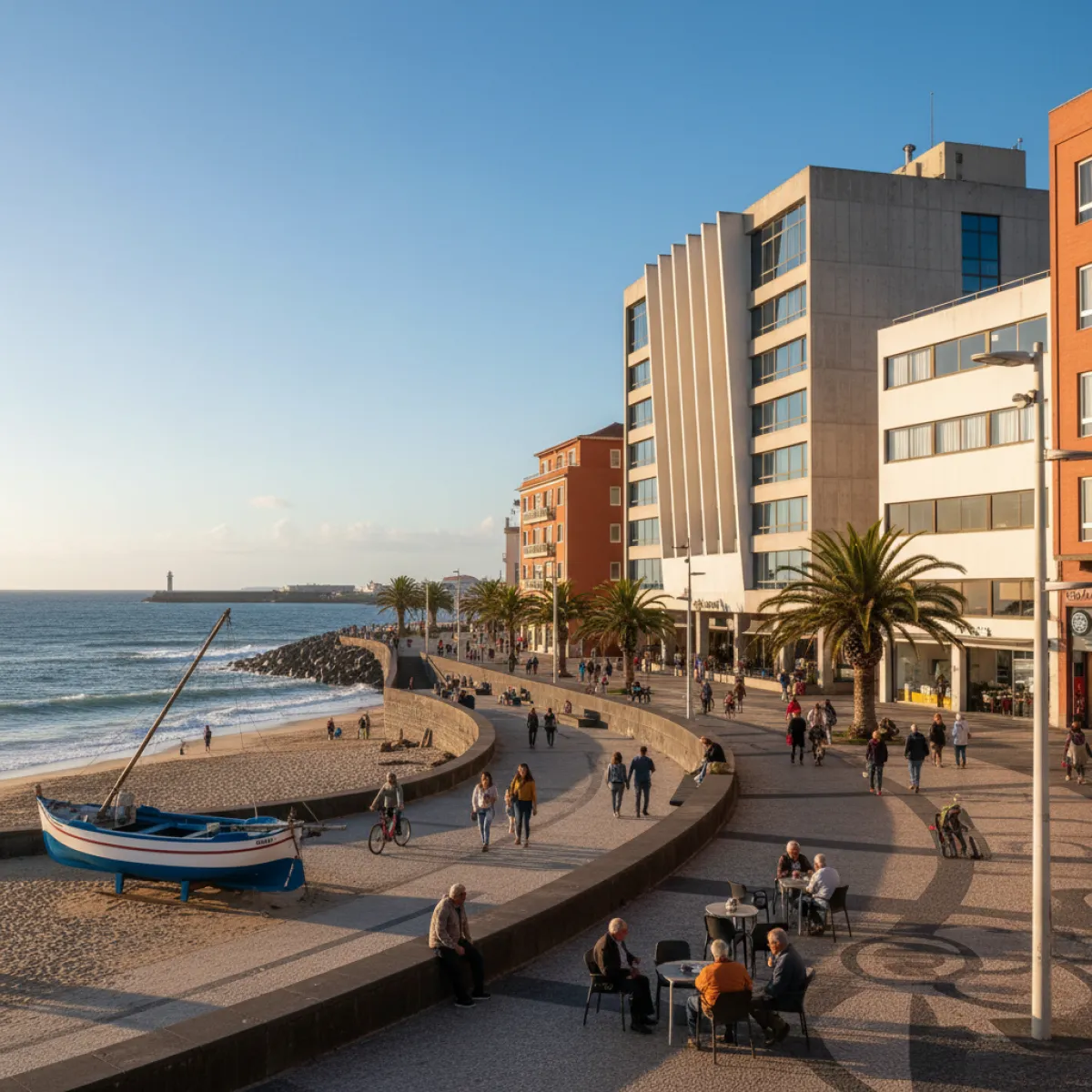
There is a nearly mathematical precision in how Praia da Vitória presents itself to those arriving in Terceira for the first time. While Angra do Heroísmo delights in its curvilinear Baroque and pastel shades telling tales of overseas empires, Praia, as locals affectionately call it, opted for a different dialogue with the Atlantic. Here, architecture does not merely seek to shelter; it attempts to decipher the power of the Ramo Grande, that vast plain where the wind is not just a weather condition but a silent architect that shaped the pitch of roofs and the sturdiness of facades.
Walking along Avenida Beira-Mar is to understand that this city is an exercise in resilient modernity. The 1980 earthquake, which left deep marks on the Azorean soul, was for Praia da Vitória the catalyst for an urban reinvention. Unlike museum-like preservation, Praia embraced concrete, glass, and straight lines, creating a fascinating contrast with the black basalt that punctuates the coast. It is a city that feels closer to a Californian coastal metropolis than a colonial outpost, a direct legacy of the proximity to the Lajes Air Base and the pragmatic cosmopolitanism that the American presence injected into the island for decades.
The Shadow of Lajes and Functional Design
One cannot speak of Praia da Vitória without looking at the sky and the neighboring Lajes Base. This presence did not just bring jazz, chewing gum, and wide cars to the island; it brought a mentality of spatial efficiency. The public buildings constructed in the second half of the 20th century in the city reflect this pragmatism. The Auditório do Ramo Grande is perhaps the most flagrant example: a structure that uses volume to create a cultural space that seems to have been sculpted by the constant winds of the bay. Its geometry is challenging yet deeply integrated into the flat landscape of the area.
While on other islands time seems to have stopped in a maritime romanticism, as seen in 24 Hours in Horta: Cosmopolitan Soul in the Heart of the Atlantic, in Praia da Vitória time is kinetic. There is a constant movement in the wide streets, a grid-like organization that facilitates circulation, and a light that, reflecting off the sands of the largest bay in the archipelago, gains a silver intensity that highlights the sharp edges of modern design.
Horizontality as a Philosophy
The beauty of Praia da Vitória lies in its horizontality. While Horta rises like an amphitheater over the channel, offering vertical perspectives that we detail in Atlantic Vantage: The Finest Rooftops and Panoramic Views in Horta, Praia invites a sweeping, low-level gaze. The Miradouro do Facho is the only point of vertical rupture, from where one can observe the perfect urban layout, where immaculate white houses align like giant domino pieces facing the deep blue.
This horizontality extends to social life. The Municipal Market, with its iron and masonry structure, is the gravitational center of a city that values local products without the artifacts of excessive gourmetization. Here, fish arrives fresh from the adjacent auction and Ramo Grande cheeses are sold by those who know the genealogy of the pastures. It is a luxury stripped of pretension, where the quality of materials, whether on the plate or in the construction, speaks louder than ornament.
Gastronomy: Between Tradition and Modernism on the Plate
The table in Praia da Vitória reflects this duality. If in São Miguel we witness a flavor revolution described in The Volcanic Plate: A Gastronomic Trek through Ponta Delgada, in Terceira the revolution is made through the refinement of tradition. Fish Alcatra, served in restaurants lining the marina, is a mandatory dish. Unlike the meat version, which is heavier and more autumnal, fish alcatra is an ode to the sea: Amberjack or Blackbelly Rosefish slowly cooked in a clay pot with white wine, onion, and spices, resulting in a thick broth that demands local corn bread to be fully appreciated.
- Where to Eat: Look for establishments on Rua de Jesus and the Marina area. Always ask for the grilled fish of the day or the traditional Fish Alcatra.
- When to Go: Late spring and early summer offer the best light for architectural photography and ideal temperatures for enjoying the bay.
- Budget: A high-quality dinner with local wine ranges from €40 to €60 per person.
Praia da Vitória is, ultimately, a city for those who appreciate detail and the intention behind the form. It is a place where modernist architecture is not a historical mistake but an intelligent response to a challenging environment. In the middle of the Atlantic, between landing planes and departing boats, Praia remains as a testament that design, when guided by the wind and light, can create spaces of absolute harmony.
