The Architecture of Port: Understanding the Douro's Lodges in Peso da Régua
A deep dive into the architectural evolution of Peso da Régua, from Pombaline legacy to contemporary industrial reuse, revealing how schist and iron shaped the capital of the Douro Valley.
The Pragmatism of Riverine Aesthetics
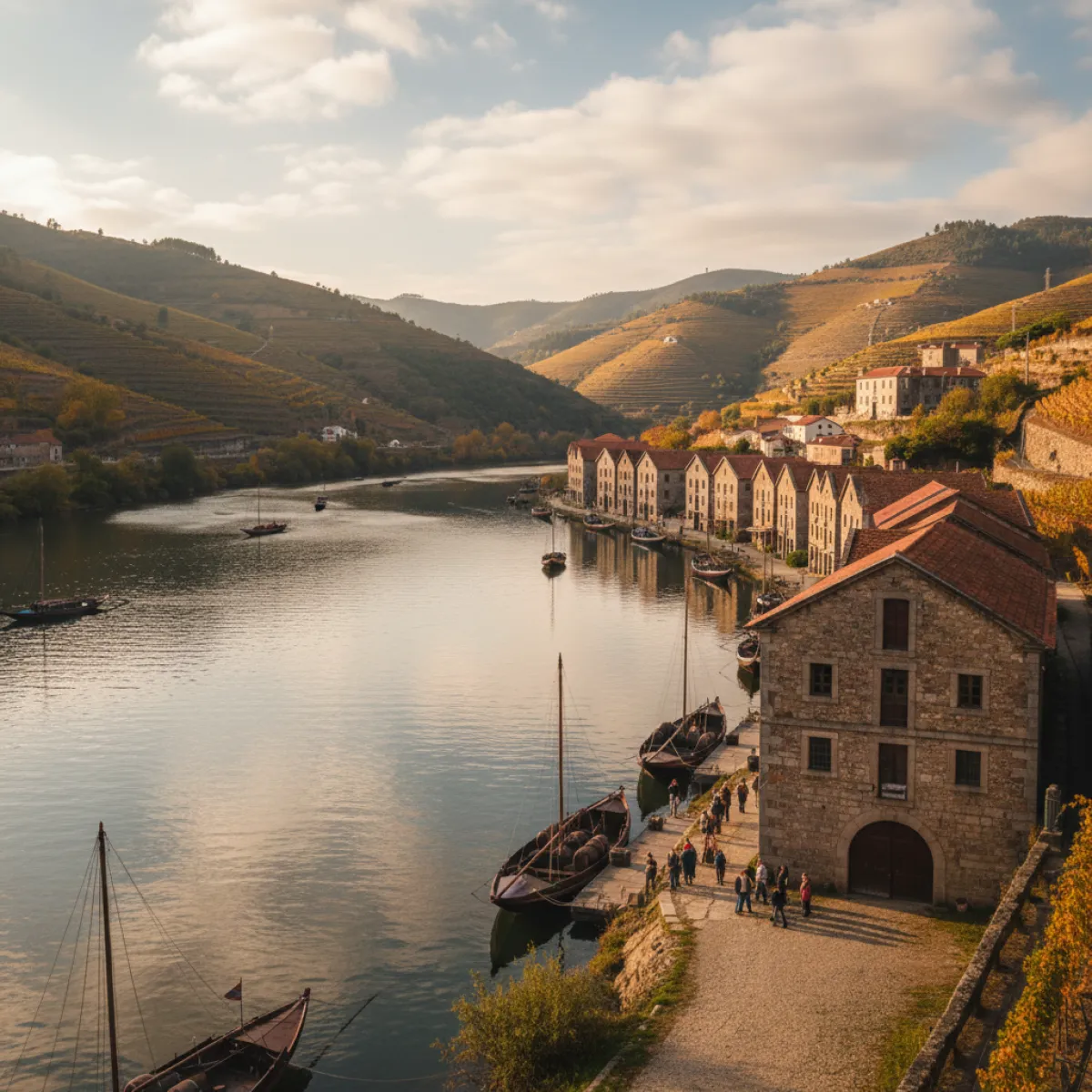
Peso da Régua does not present itself with the romantic delicacy found in other towns of the Douro Valley. It is a city of robust physiognomy, shaped by a very clear historical function: the entrepôt. If Pinhão is the heart of the vineyards and Vila Nova de Gaia the stage for aging, Régua is the logistical nerve center, the place where wine left the slopes to face the river. This function dictated an architecture that is, above all, pragmatic. The lodges lining the river and the railway line were not designed for contemplation, but for preservation and movement. However, it is precisely in this constructive honesty that its contemporary aesthetic value resides.
Walking along the waterfront, one observes a succession of horizontal volumes, built with schist walls of considerable thickness. This choice of material was not merely a matter of geological proximity; schist, with its massive thermal inertia, was essential for maintaining stable temperatures in a valley where the thermometer can exceed 40 degrees Celsius in summer. The architecture of Régua is an exercise in passive environmental control, a lesson in historical sustainability that predates modern bioclimatic construction concepts by centuries.
The Geometry of Pombaline Legacy
To understand Régua, one must look back to 1756, when the Marquis of Pombal created the world’s first demarcated wine region. The headquarters of the General Company of Agriculture of the Vineyards of the Alto Douro, now transformed into the Museu do Douro, is the supreme example of this era. The building, recently rehabilitated with exemplary sobriety, retains its original granite and schist structure while incorporating modern glass and steel elements that underscore the region’s transition into modernity. The scale of the windows, the height of the ceilings, and the robustness of the interior wine presses speak of an era when wine was a state matter, demanding an architecture of representation and authority.
This authority extends to the urban organization. Régua was designed for transport efficiency. It is interesting to note how the town develops in levels, mirroring the terraces of the vineyards that surround it. The transition between the river and the upper plateau is marked by a density of buildings that served as residences for commissioners and merchants, contrasting with the horizontality of the lodges near the quay. While the opposite bank invites explorations such as The Inland Coast: River Escapes and the Luxury of Stillness in Lamego, Régua maintains an unwavering focus on labor and commerce.
Schist and Iron: The Industrial Revolution in the Douro
The arrival of the Douro Railway in the 19th century permanently altered the architectural grammar of the region. Iron became the new protagonist, visible in the railway bridge spanning the river and in the Régua station itself. The station is not just a place of transit but a repository of public art, with its tile panels (azulejos) narrating the cycle of the vine. However, from an architectural standpoint, the most fascinating element is the adaptation of old railway warehouses for new uses.
The restaurant Castas e Pratos is perhaps the best example of industrial conversion in the city. Located in a former CP freight warehouse, the space preserves the original wooden beams and schist walls, creating an atmosphere that is simultaneously cosmopolitan and deeply rooted in local history. Here, architecture serves to elevate the gastronomic experience, reminding the visitor that they are in a working space that has become a temple of taste. The use of industrial materials, wrought iron, aged wood, and raw stone, creates a visual continuity with the bridges and rails that define Régua’s horizon.
The Transition to Granite and Altitude
As we climb the slopes toward Lamego, the architectural landscape changes tone. Schist gives way to granite, and the horizontality of the warehouses gives way to the verticality of towers and churches. This shift in materiality reflects a change in spirit. If Régua is the domain of commerce, Lamego is the domain of spirit and noble residence. Understanding this duality is fundamental to appreciating the Douro in all its complexity. Visitors exploring the city during the colder months might find a different perspective in Lamego in Winter: The Geometry of Comfort and the Silence of Granite, where the architecture focuses on creating spaces of shelter and contemplation.
This relationship between the two cities is symbiotic. Régua provided wealth through the river, and Lamego offered social and religious structure. This hierarchy is visible in the facades of the manor houses that punctuate the path between the two. These are buildings that use granite to demonstrate permanence and power, in contrast to the more ephemeral functionality of the vineyard support structures found on the banks of the Douro.
Sound and Shadow in the Cellars
Entering a Port wine lodge in Régua is a sensory experience that goes beyond smell. There is a specific acoustic in these spaces, a reverberation that stems from the dimensions of the vats and the density of the walls. The silence is almost sacred, interrupted only by the occasional sound of a pump or the echo of footsteps on the earthen or stone floor. This sonic identity is an integral part of the Douro's architecture, something that also manifests in other forms of cultural expression in the region, as described in The Resonance of Granite: Fado and the Sonic Identity of Lamego.
Light, or the absence of it, is another crucial architectural element. The lodges are designed with minimal openings, strategically located to allow air circulation without compromising the interior temperature. Wooden shutters, often painted in the characteristic dark green or red of the Douro estates, are the only decorative elements on an otherwise austere facade. This economy of means results in a minimalist beauty that resonates with modern design principles.
Practical Information and Logistics
- Getting There: The train is undoubtedly the most scenic and architecturally interesting way to arrive. The Douro Line offers perspectives of bridges and retaining walls that are not visible from the road. The journey from Porto (São Bento Station) takes about two hours.
- When to Go: For architecture enthusiasts, the winter months (January and February) offer the best visibility. Without the dense foliage of the vineyards and the harvest crowds, the structure of the estates and the dry stone walls become the central focus of the landscape.
- Gastronomy: Castas e Pratos is a must for its spatial rehabilitation. Book a table on the mezzanine to appreciate the roof structure. The average budget for a dinner with wine is €50 to €70 per person.
- What to Order: Look for high-altitude white Douro wines, which offer a fresh contrast to the city's architectural density, or a 20-year-old Tawny to end the night while watching the lights reflect on the river.
Peso da Régua demands a keen eye. It is not a city that gives itself easily to the casual tourist. One must stop in front of the Museu do Douro facade, observe the pitch of the old warehouse roofs, and feel the force of the current beneath the metal bridge. Only then does one understand that architecture here is not an ornament, but the very structure that allowed one of Europe’s most inhospitable regions to become a global symbol of luxury and perseverance. The Douro was not discovered; it was built, stone by stone, schist by schist.
