Serra da Estrela Cheese in Manteigas: Buy Direct from Producers
Proper Serra da Estrela DOP cheese never reaches the supermarket. In Manteigas, it's sold on Saturday mornings at the municipal market and at the doors of cheese rooms with 80 to 200 ewes. A practical guide with prices, how to choose, and what to do between tastings.
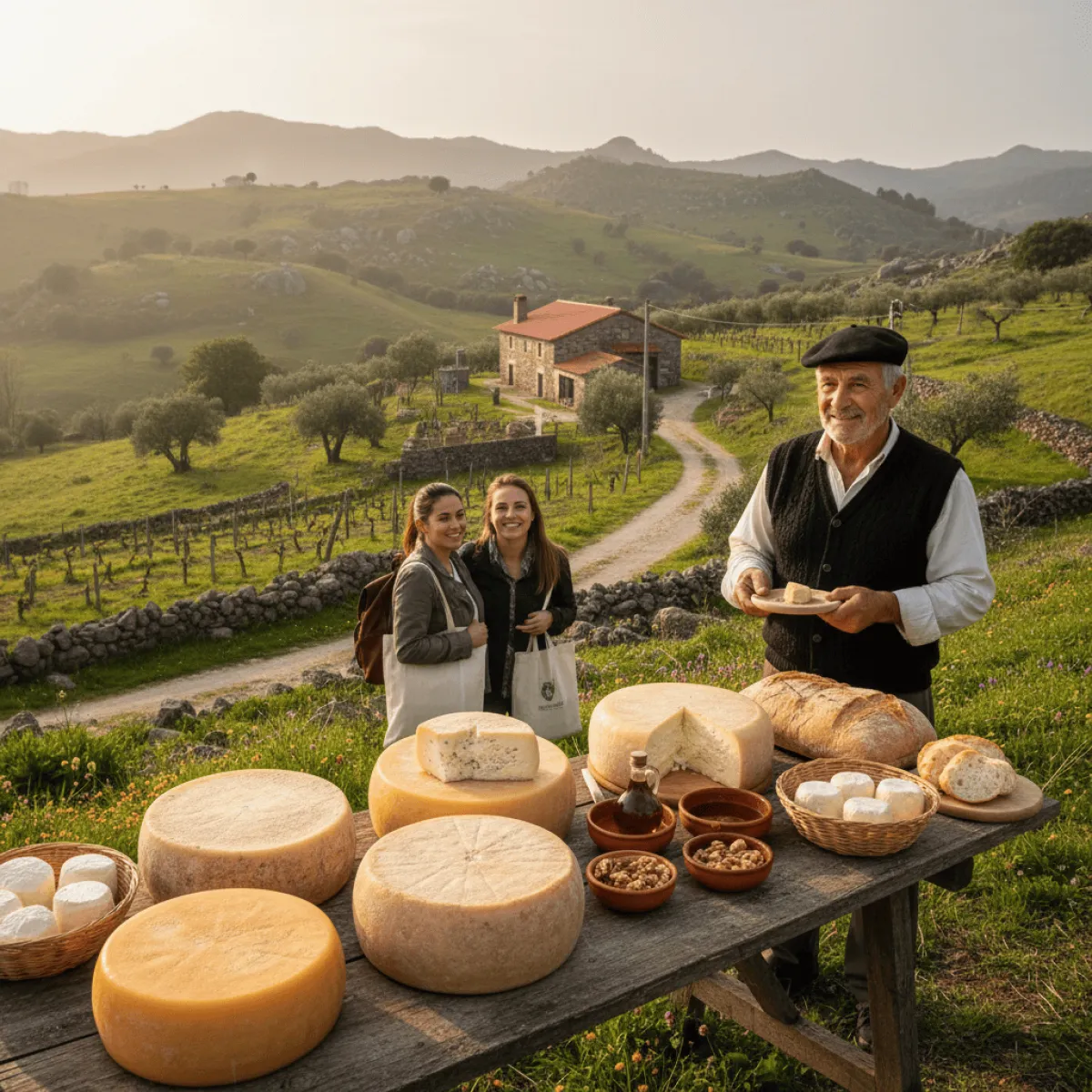
One rule worth fixing before you set foot in Manteigas: real Serra da Estrela cheese never makes it to the supermarket. At least, not the proper DOP-certified one, the kind you eat with a spoon, with its rind cut into a lid, and that smells of bordaleira ewes and thistle. That cheese moves from hand to hand, from shepherd to cheesemaker, from cheesemaker to the customer who shows up at the door with a cloth bag and knows exactly what to ask for. Everything else, those ivory-coloured blocks wrapped in plastic film with a barcode, are friendly imitations. Some of them even meet the denomination. But it isn't the same thing.
I'm writing this after a January morning where the temperature, leaving the Zêzere Valley, was minus two. Fog covered the village to halfway up the slope and the smell of burning wood was coming out of the chimneys earlier than usual. That was the day I finally understood why cheese is made here and nowhere else in the Beira. The altitude, the cold, the alpine flora the sheep graze on from May to October, the freezing water, all of it conspires for flavour. And, of course, the people conspire too, still coagulating raw milk with thistle flower, by hand, no industrial accelerants. It is a stubborn product. That is exactly why it is so good.
What Serra DOP actually is
Let's get the homework out of the way. Serra da Estrela DOP cheese is made only from raw milk of bordaleira Serra da Estrela and churra mondegueira ewes, coagulated with thistle flower (Cynara cardunculus), with no other coagulants. The paste is buttery when young, with that texture that yields to the spoon (the famous spoonable centre) and hardens as it ages, eventually becoming the Velho, sharper and cut with a knife.
Three official versions exist: Queijo Serra da Estrela DOP, with a minimum of 30 days of curing; Velho, with at least 120 days; and the Requeijão, made from the whey. The cheeses weigh between 500g and 1.7kg. If whoever sells you a cheese can't recite these details, be suspicious. And always check it carries the certification stamp from either Estrelacoop or ANCOSE, the two bodies that verify the denomination.
When to come to the Zêzere Valley
Peak production runs from November to May. It makes sense: the ewes are lambing and the milk is at its richest. If you want fresh cheese, under 60 days old, come between January and April. For the Velho, give it time. The good aged cheeses you buy in October or November were made the previous winter. That is why they cost what they cost, usually between 30 and 45 euros a kilo straight from the producer, climbing to 50 or 60 for Velho over six months.
The Manteigas municipal market: ground zero
If you only have one morning, start here. The Manteigas municipal market is small, without any architectural charm, and opens early. On Saturday mornings it fills with cheesemakers who come down from the surrounding hamlets, cheeses wrapped in cloth in one hand and the certification booklet in the other. It isn't a romantic village fair and doesn't need to be. It is a working market, where what's left from the week's orders is sold, and where anyone serious about cheese turns up at 8:30, not at eleven.
The rule is simple: ask to taste. Any serious cheesemaker will open a cheese in front of you, cut a thin slice from the paste, and hand you the spoon. If the paste yields slightly to the touch without falling apart, and has that characteristic smell, slightly sharp with a hazelnut undertone, you're on the right track. If it's acidic, oily, or smells sour, move on. There's always another stand next door.
Don't expect cards to work everywhere. Bring cash. Fifty euros is enough to leave with a 700g cheese, fresh requeijão for the next morning's breakfast, and still have change for a coffee at Café Caramelo, which is where everyone ends up after the market, warming their hands on the counter.
Producers worth the detour
Beyond the market, what really deserves your time is a producer visit. In Manteigas and the rural parishes around (Sameiro, Vale de Amoreira, Sezinho), there are small farms that sell at the door. Some have a sign, others don't even bother. Three principles to find a good one.
- Look for the physical DOP seal. Every certified cheese has a numbered label with the producer's name, the production date, and a serial number. Without it, you might be buying a perfectly fine cheese, but it isn't DOP.
- Ask how many sheep they have. The best cheeses come from small flocks, between 80 and 200 ewes, where the shepherd knows the animals one by one. If the answer is "a few thousand", they're buying milk from third parties and transforming it. Legitimate, but a different league.
- Smell the cheese room. If they let you in (and many will, if you call ahead), the smell should be of freshly coagulated milk, whey, salt. Not industrial disinfectant.
I'd recommend booking the visit by phone the day before. Most cheese rooms are open in the morning, between 7am and noon, because that's when the morning milking is processed. From three in the afternoon onwards, they salt and turn the cheeses, and there's more time to talk. Sundays, in most cases, forget it. Even God gets a day off.
The prices, no detours
To prepare you mentally: a Serra DOP aged 30 to 60 days, at the producer's door, runs between 28 and 38 euros a kilo. Velho, six months or older, goes up to 50 to 70. Fresh Requeijão usually costs 6 to 10 euros a small piece, depending on size. In a Lisbon or Porto gourmet shop, multiply by 1.5 or 2. In Manteigas, two good half-kilo cheeses and a jar of local pumpkin jam come out under fifty euros. I've taken home worse souvenirs for more money.
How to eat a Serra cheese properly
The ideal accompaniment is simple and stubborn, like the cheese itself. Dark rye bread, sliced thick. A Dão red, preferably five or six years old, or a Beira Interior red if you want to stay in the region. Pumpkin or tomato jam, homemade, the kind sold in jars at the market and where you can immediately tell if too much sugar went in. Walnuts, if from the mountains, always. No industrial crackers or French preserves, please.
If you're staying in the village, the most logical place to set up an evening cheese board is Casa da Vila. It has a kitchen, a fireplace, and the right light for that slow ritual of cutting the cheese lid carefully, scraping the paste with a wooden spoon, and working your way through it bit by bit, without destroying it. Eating Serra cheese in a hurry is a regional crime.
What to do between one cheese room and the next
Manteigas is not only cheese. The Zêzere Valley, glacial and as symmetrical as any in Portugal, deserves half a day on foot. If you want to actually understand the landscape rather than just photograph it, it's worth doing a guided glacial valley hike with Estrela Outdoor. They explain the geology, the fauna and, above all, the pastoralism, which is still the engine of this landscape. No sheep, no cheese. No shepherds, no sheep. And without maintained pastoral trails, no high-altitude meadows for the flocks to graze.
For those willing to stretch this to two days, the classic circuit climbs from the village to Torre, at 1993 metres, and drops down the south face to the area of the old snow wells. I've written about that route in the snow wells trail guide, with stops, timings, and what to avoid on fresh-snow days. It is not a comfortable tourist route. It is the mountain, no makeup.
Buying and taking it home: the dull part
Serra DOP doesn't like long journeys. The paste is alive, it keeps evolving, and if it sits outside refrigeration too long it starts fermenting in unwelcome ways. A few practical rules, learned through mistakes.
- Buy on the last day. If you're spending three days in the region, buy the cheese on day three, not day one. The producers know this and don't take offence.
- Cool bag in the car. In summer especially, bring an insulated bag with ice packs. In winter the opposite problem: never place it next to seat heaters.
- In the fridge, but out of the bag. At home, wrap the cheese in damp cotton cloth, inside a ventilated plastic box, in the vegetable drawer. A sealed plastic bag is certain humidity death.
- Eat within one to three weeks. Beyond that it either over-cures or spoils. It isn't parmesan, it doesn't age for three years.
If you're catching a flight, declare it. Portuguese customs don't care, but outside the EU there are dairy rules. For the United States, for instance, raw-milk cheese under 60 days is technically banned. Either buy Velho or eat it before boarding.
Pairing Manteigas with the rest of the Beira
Manteigas works very well as a base and cheese stop, but it isn't the only reason to stay two or three days in the region. If you have the time, take a swing through the schist villages south of Covilhã in a one-day road trip: the tone shifts completely, you leave the granite of the mountain for the warm schist of the foothills. And, in March and April, it's absolutely worth dropping down to Fundão to see the cherry blossoms on the Gardunha. It's the best face the Beira shows in spring, with colour that neither cheese nor mountain can match.
The angle, in the end
Serra da Estrela DOP cheese is, perhaps, the most stubborn product in Portugal. The producers are few, the sheep are few, the method refuses to modernise, and every winter they fear that the son or daughter won't take over the business. Buying direct, talking to whoever coagulates the milk at five in the morning, is the small gesture that makes a difference to this product's survival. And there's a bonus for those who take the trouble: cheese tastes better when you know where it comes from. In Manteigas, in January, with fog in the valley and smoke leaving the cheese-room chimney, that line stops being sentimental. It becomes edible geography.