Rainy Day Caldas da Rainha: Indoor Spots Worth It
In Caldas da Rainha, a rainy day is the excuse to finally understand the town. From the Fado room at the Malhoa Museum to the rule of pastel-rei over bean pastry, here's the route that replaces the beach with something better.
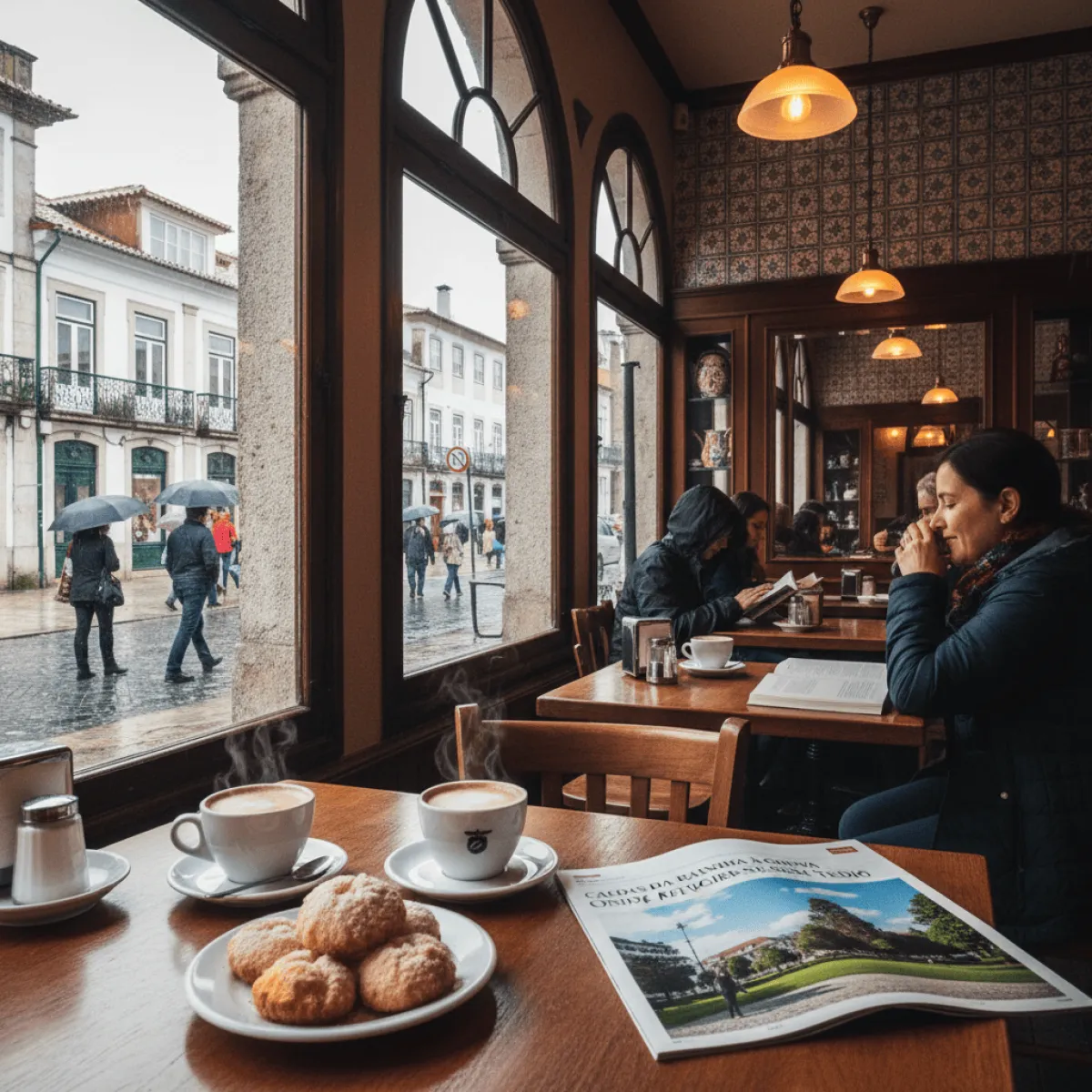
There's a specific moment in Caldas da Rainha that happens whenever the sky closes in. It's 8:30am, rain starts hammering the canvas awnings over the fruit market at Praça da República, and the tourists who had planned a beach day at Foz do Arelho stand staring at their phones as if the screen will offer an answer. It won't. The answer is in this guide, and it starts with an unpopular truth: rainy days in Caldas da Rainha can be better than sunny ones.
I say this without irony. The city was built around a thermal hospital from the 15th century. Its best creatures, from Bordalo Pinheiro's ceramics to its bean pastries, were born indoors. Sunshine in Caldas is an excuse to flee to the lagoon; rain is the excuse to finally understand the town.
The three-hour rule
Before we go further, a practical rule I learned the hard way: never dedicate more than three hours to any single indoor stop in Caldas. The scale of the town doesn't justify it, and the pleasure lies in hopping between cafés, museums, and ateliers. Plan blocks of two to three hours, separated by short coffee stops (€0.80 to €1.20, never more, and be suspicious if it is) and the greyest days transform quickly.
Another thing: bring closed shoes, not fancy waterproofs. Caldas has Portuguese pavement that turns treacherous when wet, dangerous for any rubber sole. The slipperiest streets are Rua de Camões and the descent of Rua das Montras, particularly in front of the pastry shop windows, where the pavement shines more than the cakes.
Start at the José Malhoa Museum (and do it properly)
The José Malhoa Museum, in Parque D. Carlos I, is the obvious starting point. It sits inside the park, which means you'll catch rain between the gate and the door, and that's part of the ritual. Don't rush. The park in the rain, ducks paddling along the canals and cypresses dripping, is half the experience.
Inside, ignore the instinct to try to see everything. Go straight to the room of late 19th-century Portuguese naturalist painters. "O Fado" is the centrepiece, and it deserves the fifteen minutes the headphones will try to steal from you. Instead of an audio guide, sit on the bench facing it and observe the feet of the figures. Everything is there. The rest of the museum, Leopoldo de Almeida sculpture, Caldas ceramics, can be done in forty minutes.
If you want to do this seriously, the right move is to fold this visit into a museum marathon through Caldas da Rainha that links the Malhoa to the Ceramics Museum and the São Rafael House-Museum. It's a whole day, but the rain is asking for a whole day anyway.
The São Rafael House-Museum: the part no one visits
Here's my unpopular opinion of the day: the São Rafael House-Museum is better than the Ceramics Museum. I know I'll offend someone. But the Bordalo Pinheiro collection installed in the old manor, with rooms staged as though the family still lived there, makes more sense for understanding the Caldas aesthetic than any sanitised vitrine.
Go upstairs. The set of plates with sardines, lettuces, and sulking cats is a crash course in Portuguese humour. Bordalo, I insist, was a political cartoonist before he was a ceramicist, and that's evident in every piece. Then exit through the covered garden, if the rain allows, and notice the broken greenhouse out back: someone should have restored it twenty years ago, no one did.
Break: where to eat lunch when it's pouring
Lunch is where most guides fall apart. I'll be direct. On a rainy day, avoid the restaurants on Praça da Fruta with outdoor terraces. They live off the terrace, and service inside, on a wet busy day, falls apart.
The rule I follow: look for traditional eating houses with no decorative ambition. Soup, prato do dia, bread. In Caldas this costs between €8 and €12, house wine included or at least not outrageous. Ask for caldo verde if it's on the menu, always, and ask for it as a starter before any fish dish. If there's cabrito or ensopado de borrego, prefer the ensopado: it's harder to do badly.
For dessert, here's a detail you learn in Caldas: the bean pastry is not the king pastry. The pastel-rei is a local creation, dense, made with chila jam and almond, with a chila topping. Order both a pastel-rei and a pastel de feijão, compare, and prepare to never want the bean one again. Each costs less than €2 at an honest pastry shop on Rua das Montras.
The market and the vase game
The Praça da Fruta market runs in the mornings, and on rainy days it empties earlier. Go between 9 and 11am. It has a metal roof that protects reasonably well, and the ceramic stalls, especially the Bordalian imitation ones, are where the best haggling in Caldas happens.
The game is simple: the marked price is never the final price. A small vase tagged at €15 leaves for €10 if you buy two. I'm not suggesting disrespect; I'm describing a well-established practice. The vendors expect bargaining; whoever pays the marked price is usually a foreign tourist, and the vendors know it.
That said, distinguish between mass-produced ceramics from Alcobaça and authentic Caldas pieces. The clues: weight (real Caldas is heavy), glaze sheen (real Caldas has irregularities), and price (a legitimate Bordalian sardine never costs less than €25; anything below that is beach-house décor).
Afternoon: cafés worth the rain
The historic cafés of Caldas fall into two categories. Those that serve good cakes and bad coffee, and those that serve good coffee and commercial cakes. I don't know one that does both well, and I'm suspicious of anyone who claims otherwise.
My method: I have coffee at one and the cake at the other, and cross the street between them. In Caldas this is literally possible. The main pastry shops are less than a hundred metres apart on Rua das Montras and Rua de Camões.
If the afternoon stretches, there's an underrated alternative: take a book to the foyer of the Centro Cultural e Congressos. It has sofas, heating, a clean bathroom, and no one minds if you sit there for an hour without buying anything. It's the badly kept secret of the working population of Caldas needing somewhere warm between meetings.
When the rain eases: the viewpoint interval
Rain in Caldas is rarely constant. There are almost always forty-minute windows of grey sky without precipitation, and these windows must be used. Not for strolling the city, which stays wet, but for climbing the viewpoints, which become more spectacular with low cloud.
The best for this is Miradouro de Santa Catarina, which looks down over town. On dry days it's merely pretty; on rainy days, with the mist rising from the park, it becomes something else. It's less than ten minutes from the centre by car.
If you have time and the sky gives a longer break, head to Miradouro da Foz do Arelho over the Óbidos lagoon. The view of the lagoon in the rain is one of the best things in central Portugal, and there are always half a dozen birds moving across it. By the way, if you're a serious bird watcher, there's a full bird-watching guide for the Óbidos lagoon worth reading before the visit.
The third viewpoint, Miradouro de Salir do Porto, is the least visited and overlooks the giant sand dune. On rainy days people forget it entirely, which means you'll have it to yourself. I prefer it that way.
Open ateliers and what no one tells you
Caldas has an art school, ESAD, and that means ceramic ateliers scattered through town. Many accept visits, but you need to know which. The rule I adopted: if the atelier has a polished shop window for tourists, it's a shop; if it has a half-open door with sacks of clay by the entrance, it's a real atelier.
Ask at the front desk of the Ceramics Museum which ateliers are open to visitors that week. The information changes, artists travel, but there are always two or three available. A guided visit by a ceramicist costs between €5 and €10 per person, lasts about an hour, and is the most valuable thing you'll do in Caldas. More valuable than any museum.
For the rest of the day: bookshops, chapels, and the cinema
You have time left. Three suggestions:
- The chapel of Senhor dos Passos, in the centre, is almost always open. It's not architecturally remarkable, but it has a silence that resets the head after a morning of ceramics and colour. Five minutes inside is enough.
- The Centro Cultural bookshop has a decent Portuguese literature section. Look for authors connected to Caldas and Estremadura. If you've never read Raul Brandão, take "Os Pescadores"; it's the right book for a rainy day in central Portugal.
- The Centro Cultural cinema runs film cycles. Check the programme on arrival. Tickets are in the €4 to €5 range, cheaper than a coffee in Lisbon.
If the rain lasts more than one day
It happens. In Caldas, two straight days of rain are an excuse to leave town and try covered excursions. There are three options, all less than an hour away.
One is Coimbra, and if the Queima das Fitas happens to be running, the rain stops mattering because the programme changes entirely. The second is Fátima, which on a rainy day becomes less touristy and more reflective; if you take it seriously, consult the honest guide to the May 13th pilgrimage. The third is to stay put and do short walks in the surroundings, which I cover in a guide to spring walks around Caldas, and which work surprisingly well even with rubber boots and a poncho.
End of day: the best part
What I always tell friends who visit me on rainy days in Caldas is this: the best part is the end of the day. Around 6pm, with the light dropping and the streets shining, a café will be open, fado will be playing in a small bar on Rua Almirante Cândido dos Reis, and people will be coming off work and filling the counters.
Sit down. Order an imperial beer, €1.20 if the place is honest, €1.50 if it isn't. Watch the rain through the glass. In Caldas da Rainha, this is what you do on a bad day. And it is, I suspect, what you should be doing on any day.