Pinhão: The Geometry of Schist and the Heritage of Time in the Douro
Discover the historical heritage of Pinhão, from its century-old iron bridge to the narrative tiles of the station. An editorial guide to the architecture of wine and the soul of the Douro.
The Topography of the Sacred: Pinhão as the Axis of the Wine World
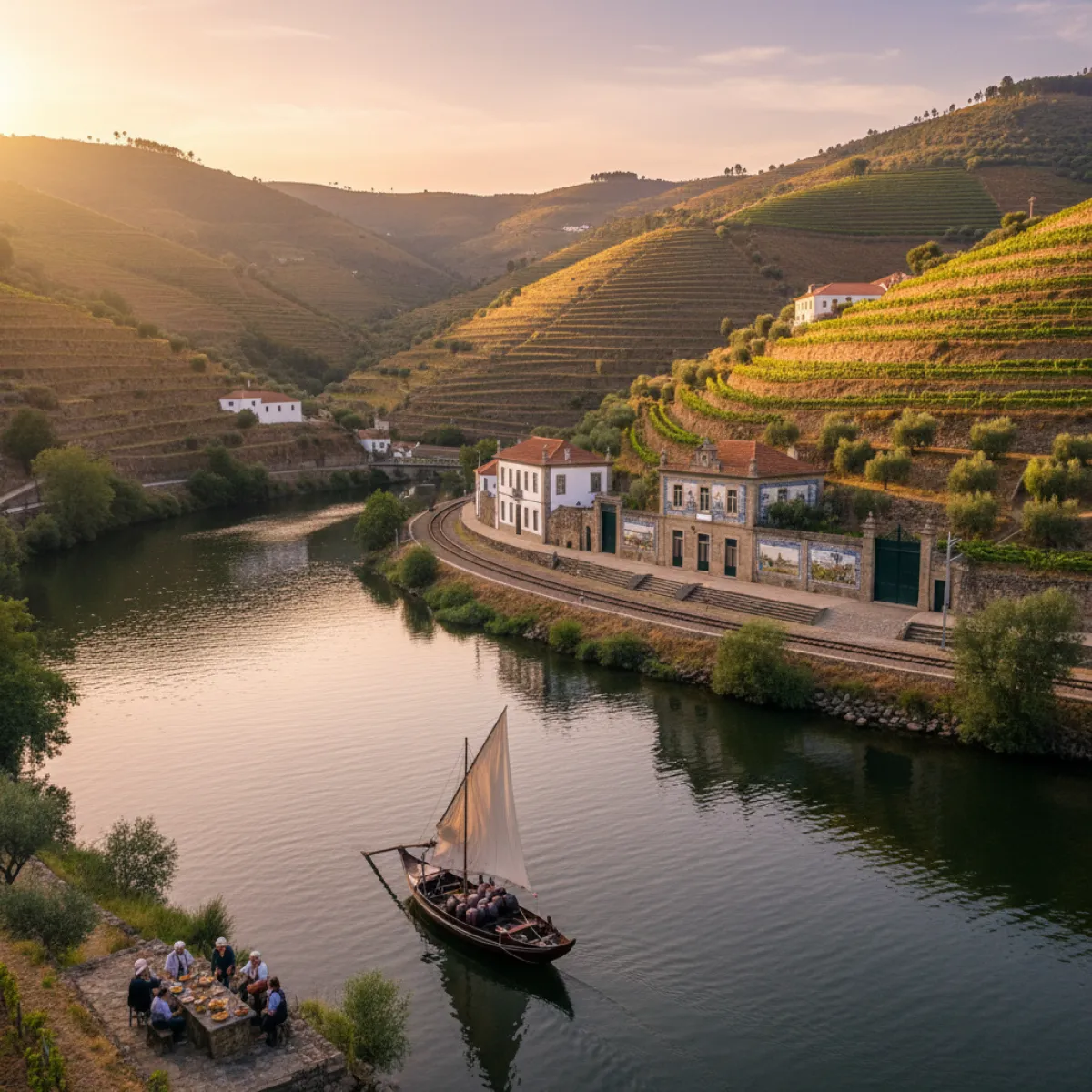
There is a specific moment, descending the slope from Casal de Loivos, when Pinhão ceases to be a mere village on a map and becomes a geological amphitheater. In the Douro, the landscape is not a backdrop; it is a human construction atop a schist foundation dating back to prehistoric eras. Here, the Douro River and the Pinhão River meet in an embrace that defined the economy and aesthetics of an entire region. For the traveler seeking more than a photogenic surface, Pinhão demands a slow, almost meditative observation of how iron, tile, and stone have shaped a national identity.
Pinhão is not visited for its size, but for its historical density. It was here that the logistical center of Port Wine was established, the convergence point where the production of the great quintas was prepared for the treacherous journey down to Vila Nova de Gaia. This village, wedged between mountains that hold a static heat in summer and dress in dense fog in winter, is the ultimate example of Transmontane resilience. Walking its streets, one realizes that every structure, from the bridge to the station, was designed with a functional purpose that, over time, acquired a monumental aura.
The Railway Station: An Open-Air Art Gallery
No analysis of Pinhão’s heritage can begin anywhere other than its railway station. Opened in 1880, the Douro Line brought modernity to a valley that had hitherto lived in isolation. However, it is the artistic intervention of 1937 that elevates this building to the status of a monument. The 24 tile panels, produced at the legendary Sant'Anna Factory in Lisbon and designed by J. Oliveira, are a lesson in visual ethnography. This is not mere decoration; it is a historical record of the harvest, wine transport, and the region's landscapes before the construction of dams that tamed the river.
As you observe the panels, note the technical precision in the representation of the terraces (socalcos). The tiles capture the fatigue of the men carrying wicker baskets and the imposing nature of the oxen pulling the wine carts. It is a fascinating contrast with the iron structure of the station’s roof, an example of 19th-century industrial architecture that still serves its original purpose today. For the history enthusiast, the station is an invitation to understand Portugal’s transition from an agrarian society to a nation seeking its place in the age of steam.
Iron Engineering: The Pinhão Bridge
A few meters from the station, the Pinhão Bridge stands as a symbol of connectivity. Completed in 1906, its metallic structure is often associated with the school of Gustave Eiffel, though its design is a testament to the competence of Portuguese engineering of the era. The bridge replaced the old ferry crossing, definitively altering the village’s social dynamics. Today, crossing it on foot is a sensory experience: the sound of metal under car tires, the structure’s reflection in the Douro’s green waters, and the panoramic view of surrounding estates like Quinta das Carvalhas or Quinta do Bomfim.
The iron of the bridge and the schist of the mountains create a unique chromatic dialogue. While the schist absorbs light, the iron seems to cut the horizon. It is at this point that the traveler understands the duality of the Douro: the hardness of the land and the flexibility of human engineering. For those traveling at a leisurely pace, we recommend stopping halfway across the bridge in the late afternoon, when the Douro light, an almost solid gold, hits the white facades of the quintas, creating a contrast that no lens can fully capture.
Liquid Memory: The Rabelo Boat and the River
The river was, for centuries, the only road to Pinhão. Before the railway, the transport of Port Wine depended exclusively on rabelo boats, flat-bottomed vessels with square sails, capable of navigating treacherous currents and the rapids of the Cachão da Valeira. Today, the rabelos seen in Pinhão are mostly replicas intended for leisure, but the construction techniques and knowledge of the currents remain alive. For those wishing to deepen this connection, the Rabelo Boat Workshop: Learning Ancient Navigation on the Douro offers a technical and historical perspective that transcends a simple boat tour, allowing one to understand the physics of navigation in a river that was once untamable.
Pinhão’s fluvial heritage is intrinsically linked to its gastronomy and economy. The river didn't just bring wealth through wine; it also provided river fish, which for decades was the staple of the local diet. Today, when dining at one of the village's establishments, such as Cozinha da Clara or LBV 79, the traveler should seek these traditional flavors, paired with a Douro red of firm structure, where the mineral notes of the schist soil are evident.
The Transition to Granite: From Pinhão to Lamego
While Pinhão is the kingdom of schist, its history cannot be decoupled from the neighboring region of Lamego, where granite takes the architectural lead. This geological transition is fundamental to understanding Northern Portugal's diversity. If Pinhão is the land of hard labor in the vineyards, Lamego is the city of nobility and Baroque spirituality. Many estate owners in Pinhão maintained their winter residences in Lamego, creating a cultural bridge between the valley and the heights.
This connection is particularly evident when exploring the region during the off-season. Discovering Lamego in Winter: The Geometry of Comfort and the Silence of Granite is a necessary complement to the Douro experience. While winter in Pinhão brings a melancholic stillness to the river, in Lamego, the cold, monumental stone offers a different kind of introspection. It is in this alternation between riverine stasis and urban solidity that one finds the true luxury of the Portuguese interior, an experience we detail in The Inland Coast: River Escapes and the Luxury of Stillness in Lamego. This area also resonates with a unique acoustic heritage, explored in our guide on The Resonance of Granite: Fado and the Sonic Identity of Lamego.
Logistics and Planning: The Practical Guide
Visiting Pinhão requires a strategy of time. The harvest season (September/October) is vibrant but chaotic. For the traveler who prefers analysis and silence, May or June offers a perfect balance of temperature and light. Access should ideally be made by train from Porto's São Bento station. The three-hour journey on the Douro Line is itself a national monument. The ticket cost is marginal (around €15) compared to the aesthetic value of the experience.
- Budget: For a premium experience, consider a budget of €250 per day, including a stay at one of the historic quintas, high-end meals, and Vintage wine tastings.
- What to order: Do not ignore high-altitude Douro white wines, which offer a surprising freshness to contrast with the intensity of the reds. In Pinhão, ask for the oven-roasted kid (cabrito), a dish that defines the Transmontane Sunday.
- Local Transport: In Pinhão, your best transport is your legs. The village is small, and every architectural detail, from doorframes to water fountains, merits attention. For longer distances between quintas, opt for local taxis, whose drivers know the narrow, winding roads better than anyone.
Conclusion: The Permanence of Heritage
Pinhão is not a quick-stop destination. It is a place that requires us to sit on the riverbank and watch the current. Heritage here is not just in the listed buildings, but in how the landscape was sculpted to serve excellence. Upon leaving the village, the traveler carries the image of engineering that respected the earth and art that celebrated labor. In the Douro, time flows differently, and Pinhão is the place where that difference is most tangible.
