Penafiel Before Rome: Hill Forts in the Sousa Valley
Thirty-five kilometres from Porto, the Citânia de Sanfins is the largest Iron Age fortified town in northwest Iberia, with 150 circular houses still legible in stone. An honest guide to visiting the hill forts of the Sousa Valley, ending with Vinho Verde in the gardens of Quinta da Aveleda.
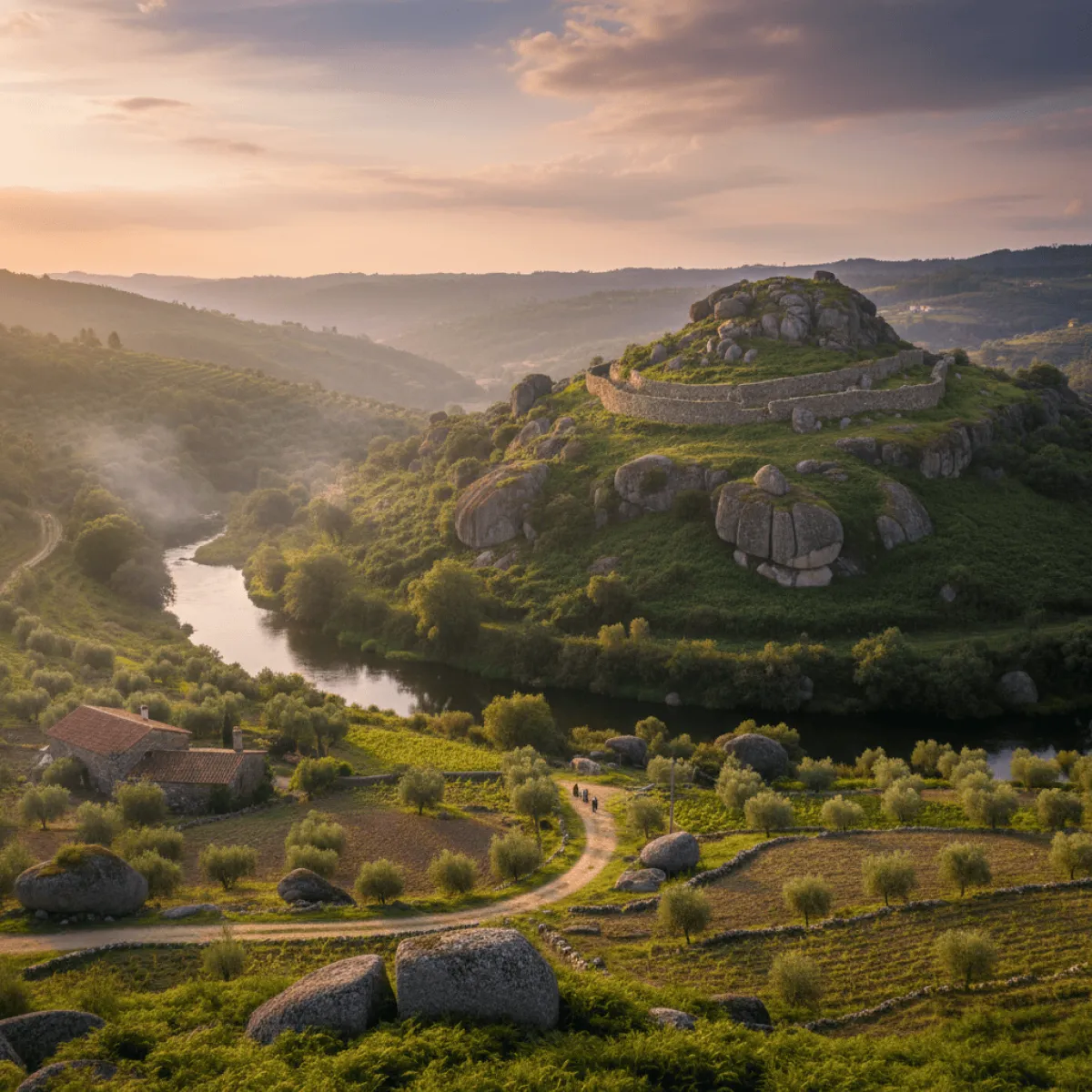
There is a version of Penafiel that fits in two lines of a travel guide: Vinho Verde, Romanesque churches, Quinta da Aveleda. All of it is correct, and that alone is a decent reason to visit. But if you climb the 382 metres to the top of Monte do Pilar, in Sanfins de Ferreira, you find a Penafiel that is two and a half thousand years old and that most visitors never hear about: the largest Iron Age fortified town in the northwest of the Iberian Peninsula. This is not a romantic ruin covered in ivy. It is an entire town in stone, with streets, triple walls, and around 150 circular houses whose foundations still read like an architect's plan.
The Citânia de Sanfins makes no apologies. It was first excavated in 1944 by the archaeologist Mário Cardozo, and since then it has slowly revealed fragments of a civilisation that existed here long before Rome arrived to take charge. What history textbooks dismissively call "indigenous peoples" were, in fact, competent urbanists: they organised neighbourhoods, separated functions, built internal roads, and had their own culture mixing Celtic influences with Atlantic traditions. This article is about how to see all that for yourself, without tourist traps, on a reasonably lazy weekend based out of Penafiel.
Getting there (and why a car is the only realistic option)
Penafiel sits 35 km east of Porto on the A4, about 30 minutes without traffic. There is a CP train from São Bento to Penafiel station, and it is a pretty ride through the Sousa Valley, but from there you are on your own: the Citânia de Sanfins is 15 km from central Penafiel and public transport into Paços de Ferreira is sparse and useless for visitors. If you are coming from Porto without a car, rent one or join an organised day trip from Porto, which usually combines the hill fort with a couple of other stops.
Practical advice: make the Citânia your first stop of the day. It opens early, it is exposed to the sun all day, and in July or August, anything past noon turns walking among the circular houses into an act of mild self-harm. By contrast, in winter and on misty days, the site looks magnificent, with the surrounding hills appearing and disappearing through low clouds.
Citânia de Sanfins: what to see and what to skip
Entry costs a few euros (check locally, prices have shifted in recent years) and includes the Archaeological Museum of Citânia de Sanfins, in the former manor house of Sanfins de Ferreira just next door. Do not make the mistake most visitors make: heading straight to the ruins and skipping the museum. Visit the museum first, especially the scale model of the settlement and the replica of the Guerreiro de Sanfins, the famous granite warrior statue found at the site in 1944. The original lives at the National Museum of Archaeology in Lisbon, and that is one of the oldest grievances in the north: why is the most important artefact of the Citânia not in Penafiel? The answer involves 1940s museum politics and still irritates local archaeologists.
With the model fresh in your mind, walk up to the settlement. The three concentric walls, the south-facing main gate, the monumental complex at the centre: it all clicks into place once you have seen the reconstruction. Look for two things in particular:
- The "castro bathhouse" in the upper zone, a ritual sauna in stone with a beautifully carved "pedra formosa" featuring geometric motifs. We still do not fully understand its function, but everything points to a place of purification. It is the most elegant piece of architecture in the entire Citânia.
- The eastern residential quarter, where you can best read the internal organisation of the houses: rectangular vestibule, circular main room, central hearth. Houses that were planned, not improvised.
Allow two to three hours to do it properly. Bring water, closed shoes (the ground is uneven and there are gorse bushes), a hat in summer and an extra layer in winter: this is a hilltop, and the wind is honest about itself.
The Hill Fort Route: why Sanfins is not enough
Sanfins is the headline act, but the region has an unusual density of pre-Roman hill forts. The Sousa Valley, across the municipalities of Penafiel, Lousada, Paços de Ferreira and Felgueiras, was extremely densely populated between the sixth century BC and the first century AD, when Romanisation slowly emptied the hill forts and pulled the population down into the villas on the valley floor. The so-called Rota dos Castros do Vale do Sousa connects several of these sites and you can comfortably visit two or three in a single day, although only Sanfins is presented as a fully developed museum site.
The others are worth it for the absence of tourists. The Castro de Monte Mozinho, also in Penafiel (about 12 km from Citânia de Sanfins, on the opposite side of the municipality), is the second major site on the route. It is less curated for visitors, but there is an interpretation centre in the village of Oldrões and a soaring view over the Tâmega valley. Interestingly, Mozinho grew during the Roman period (unlike Sanfins, which declined), and became one of the largest castro towns in the Iberian Peninsula in the final phase of the Iron Age. It is the political and cultural counterpoint to Sanfins, and visiting both on the same day is a practical lesson in what happened when Rome arrived.
What to eat in between
Between sites, you will get hungry. The natural solution is to eat in central Penafiel or Paços de Ferreira, depending on your route. Local specialities are robust: cabrito (roast kid) baked in a wood oven (traditionally a Sunday or family-gathering dish), arroz de cabidela, and anho à moda do Vale do Sousa (lamb cooked in the local style), always served with batata a murro and grelos. For dessert, ask for a slice of bolo de São Martinho, a Penafiel speciality made with sugar, cinnamon and eggs, or cavacas, which you will find in any pastry shop in the historic centre.
Do not overthink this: skip the modern brasseries with stainless steel fronts and go looking for old tascas in the centre, particularly around Rua Direita and the Caetanos area. Ask the taxi driver or your hotel receptionist where they go for lunch when off duty. It is invariably the right answer.
The day after: Quinta da Aveleda and Vinho Verde
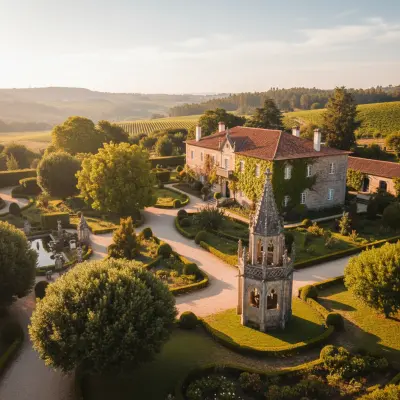
After a day of stone, the contrast of water, gardens and wine makes sense. Quinta da Aveleda sits about 5 km from central Penafiel, is probably the most beautiful wine estate in the Vinho Verde region, and has the rare quality of being equally interesting for wine lovers and for people who simply enjoy gardens. The Guedes family has been here since the nineteenth century, and the romantic gardens with lakes, bridges and giant camellias were designed back then, with a Victorian landscape sensibility adapted to the exuberance of northern Portugal.
The standard visit is pleasant but unremarkable. If you want to turn it into a memorable morning, take your time and book the wine and cheese tasting at Quinta da Aveleda: a selection of the house's whites (the classic Aveleda Fonte, more commercial, and the more serious Quinta da Aveleda and Follies bottles) paired with carefully chosen Portuguese cheeses. It is a paid, pre-booked experience and worth the price if you enjoy the combination.
Important detail: go in the morning. The gardens always look better in oblique light, and the camellias between January and March are almost suspiciously photogenic. For anyone serious about photography, or simply wanting to learn how to look at the Penafiel Romanesque with new eyes, consider the photography tour in Penafiel, which covers Romanesque churches like Paço de Sousa and Boelhe, usually skipped by mass tourism.
The Sousa Romanesque: the natural follow-up to the hill forts
If the hill forts are organised prehistory, the Romanesque is the second great architectural chapter of the region, and it is improbably concentrated in the Sousa Valley. The Monastery of Paço de Sousa, in Penafiel, is one of the most important Romanesque churches in the country, and the burial place of Egas Moniz, tutor to the first king of Portugal, Afonso Henriques. Entry is free, hours are erratic (check locally), and it is particularly beautiful in late afternoon, when the sun hits the main portal sideways.
There is also the Church of São Pedro de Abragão, the Church of Cabeça Santa, and the Monastery of Bustelo, all within a few kilometres of one another. The Romanesque Route, managed regionally, has maps and brochures available at any tourist office. For anyone interested in architecture, this is fertile territory: walls in unpolished granite, capitals with medieval bestiaries, and a general sense that time moves differently here. (No offence to the rule about clichés, but it is literally true when it comes to the liturgical calendar of these villages.)
Where to sleep, where not to sleep
Penafiel town has functional but unremarkable hotels. If you want the trip to feel like a proper experience, opt for rural tourism in the area: there are several quintas and manor houses that take guests, particularly between Penafiel and Amarante. Alternatively, stay in the historic centre of Braga (an hour's drive away) and use Penafiel as a day trip: it is what many informed travellers do, and it works particularly well in late spring, when you can combine the castro circuit with Holy Week in Braga, one of the most theatrical and best preserved religious celebrations in Portugal.
On staying in Paços de Ferreira: it is practical for being close to Sanfins, but the city is industrial (it is the Portuguese capital of furniture manufacturing) and offers little else of interest. If logistics dictate, you will find perfectly comfortable chain hotels there, but do not come looking for local charm.
When to go
May and June are extraordinary months in this part of Portugal: long days, green vineyards (literally), and the Citânia in perfect visiting conditions. September is equally good, with the bonus of harvest at Aveleda. Avoid peak August: relentless heat at the hill forts and secondary roads clogged with local traffic. Winter has its own charm, but expect rain and fog, and bring proper clothing.
The essentials in three points
- Do the museum first, then the ruins. Without the model in your head, the Citânia looks like a picturesque pile of stones. With it, it reads as what it actually was: an organised town.
- Combine Sanfins and Monte Mozinho on the same day. It is the only way to grasp what happened during the castro-Roman transition. One declined, the other thrived. Why?
- Finish the weekend at Aveleda. The contrast between the austere, windswept top of Monte do Pilar and the camellia-and-peacock gardens of Aveleda is the best possible way to close the trip.
Penafiel is not an obvious destination, and that is precisely why it is interesting. It is a town that lives at its own pace, does not chase visitors, and offers anyone who bothers to come a remarkably dense slice of Portuguese history: two and a half thousand years in twenty-five square kilometres. It is the kind of trip that changes how you look at the rest of the north of the country.