A Guide to Braga: Portugal's Quietly Radical Northern City
Braga is Portugal's third-largest city and perhaps its hardest to define: deeply religious and fiercely young, with two thousand years of history and a food scene that puts cities twice its size to shame. This guide covers the essentials, from the Cathedral to Bom Jesus, from frigideiras to pudim Abade de Priscos.
A city that reads in layers
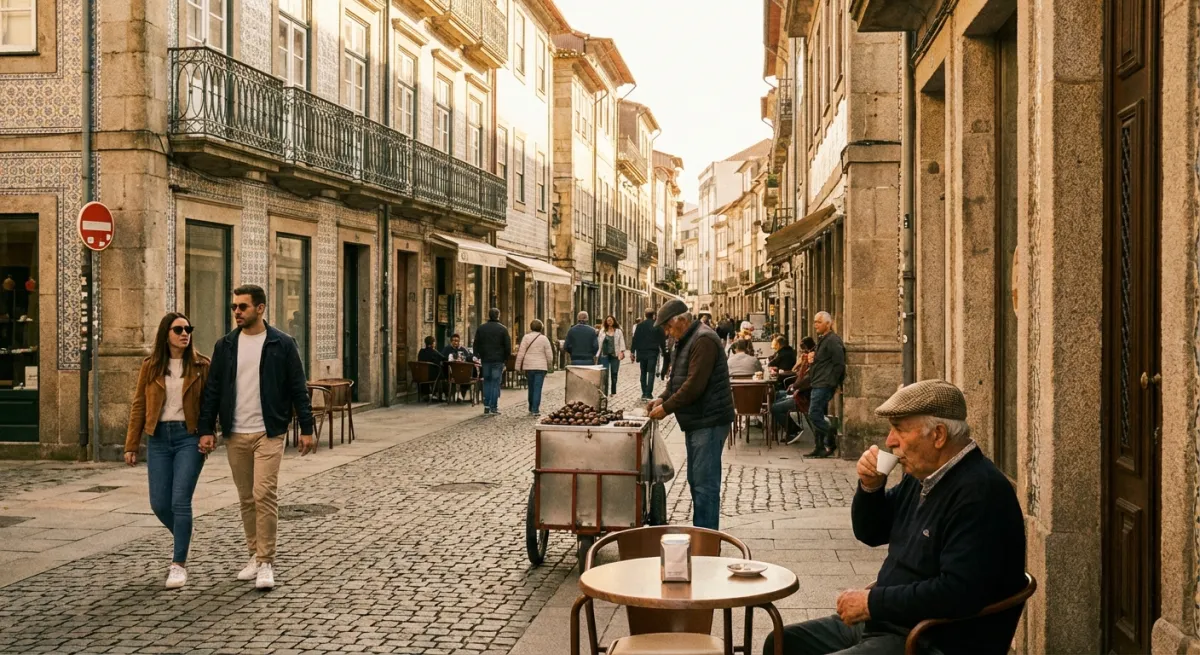
Braga demands a particular kind of attention. Not the hurried attention of someone ticking cities off a list, but the slow, steady gaze of a traveler who sits down at a café terrace on Praça da República in the late afternoon and notices how the noise of university students blends with the tolling of the cathedral bell in a way that only happens here. This is a city with two thousand years of history that never became a museum, instead, it uses that history as a foundation for something unexpectedly contemporary.
Capital of the Minho region, seat of Portugal's oldest archbishopric, the country's third-largest city. The titles accumulate, but none of them captures what makes Braga singular: its ability to be deeply religious and fiercely young at the same time. Here, Holy Week draws crowds to baroque processions that would make Seville blush, and the following month the city fills with electronic music festivals and tech events. This tension, between the sacred and the secular, between the ancient and the new, is what drives Braga forward.
Start with the Cathedral and the old town
Braga's Sé, its cathedral, is the inevitable starting point, and rightly so. Founded in the eleventh century, it is the oldest cathedral in Portugal and a practical lesson in how architectural styles accumulate: Romanesque in structure, Gothic in its additions, Baroque in the gilded woodwork lining the side chapels. Don't just duck in and out. Visit the upper choir, climb to the terrace, the view over the city is the best orientation you'll get, and descend to the Kings' Chapel, where the tombs of Afonso Henriques's parents lie.
A combined ticket for the cathedral, Treasury Museum, and upper choir costs €5, which is reasonable for what you see. Avoid visiting between 11am and 1pm in the summer months, when tour groups concentrate.
From the cathedral forecourt, walk along Rua do Souto, the city's oldest commercial artery, now partly pedestrianized. The shopfronts mix independent clothing stores with traditional goldsmiths and the occasional pastry shop with a queue at the door. Rua do Souto opens onto Praça da República, which locals call simply the Arcada, after the covered gallery on its western edge. This is where the city sits down, literally. Pick a café, Café A Brasileira is the classic, but the smaller cafés on adjacent streets offer better value, and watch.
What to see in the center in half a day
- Jardim de Santa Bárbara, the Renaissance garden tucked against the Archbishop's Palace, with geometric flowerbeds that change color with the seasons. In February, camellias dominate.
- Palácio do Raio, Braga's most photogenic azulejo façade, recently restored. Entry is free, and the interior hosts temporary exhibitions.
- The medieval keep, what remains of the old castle, now integrated into the urban fabric almost unnoticed.
- Igreja da Misericórdia, Renaissance, austere outside, surprising inside. The altarpiece deserves five minutes of contemplation.
Bom Jesus: beyond the postcard
If there is one image associated with Braga that everyone recognizes, it is the baroque stairway of Bom Jesus do Monte, with its 577 zigzagging steps climbing a wooded hillside east of the city. Since 2019, it has been a UNESCO World Heritage Site, a distinction that brought more visitors but didn't fundamentally alter the experience, which remains, above all, physical.
The climb takes between 20 and 30 minutes on foot, depending on pace and stops for photographs. If you'd rather spare your knees, the hydraulic funicular, the oldest on the Iberian Peninsula, operating since 1882, makes the journey in three minutes for €2 (return, €3). The ideal strategy: take the funicular up, walk down, appreciating the Stations of the Cross chapels and the allegorical fountains of the five senses that punctuate the descent.
At the top, beyond the neoclassical church, there's a park with artificial grottoes, a lake with rowboats (€3 for 30 minutes, warm months only), and several viewpoints. The Hotel do Templo, adjacent to the sanctuary, serves respectable lunches with a view, though prices reflect the location, expect €25-35 per person.
The Braga table: where and what to eat
Braga eats well and eats cheaply, two qualities that rarely coexist in European university cities of this size. The Minho tradition here is living matter: bacalhau à Braga (oven-roasted salt cod with smashed potatoes and generous olive oil), sarrabulho (a pork and blood stew that is not for hesitant stomachs), and arroz de pato, duck rice that half the country claims as its own but that here achieves a density and depth of flavor hard to replicate elsewhere.
Lunch
For a weekday lunch, Frigideiras do Cantinho on Praça Velha is an institution. Frigideiras, thin pastry parcels filled with veal and cured ham, are Braga's signature snack, and here they are made as tradition demands, the pastry crisp, the filling generous. One frigideira with a draught beer costs under €5. Don't accept gourmet variations with rocket and brie, the original is enough.
For something more substantial, Cozinha da Sé, a few steps from the cathedral, offers daily specials at €9-11 that would embarrass many a white-tablecloth restaurant. The bacalhau à Braga here is exemplary. Arrive before 12:30pm or after 1:30pm to avoid the lunch rush.
Dinner
Centurium, in the heart of the old town, represents the new Braga kitchen, Minho-rooted dishes with contemporary technique, in a space that combines exposed Roman stone with modern design. The tasting menu (€45, without wine pairing) is the best way to understand what the chef is proposing. Book two days ahead for weekends.
For something more informal but equally memorable, Bem Me Quer in the São Vicente neighborhood serves Minho petiscos, small sharing plates, in a modernized tavern setting. The salt cod fritters and lagareiro-style octopus are excellent. Expect €15-20 per person with house vinho verde.
Pastry and convent sweets
Braga is, arguably, the capital of Portugal's convent pastry tradition, a claim that Évora and Aveiro will contest, but that the evidence supports. The nuns of Braga's convents bequeathed a repertoire of egg-and-sugar-based sweets that survives intact. Look for pudim Abade de Priscos (a dense flan made with lard and Port wine), fidalguinhos, and charutos de ovos. Pastelaria Casa das Bananas on Rua do Souto is the right choice for a first foray into this sugary universe.
Beyond the obvious: the neighborhoods and the periphery
Braga's historic center can be walked comfortably in a few hours, but the city rewards those who venture further.
The São Vicente neighborhood, north of the center, is where many of the students and young professionals who animate Braga actually live. The streets are narrower, the buildings lower, and by late afternoon the terraces fill up. This is where much of the natural wine bars and independent design shops that have emerged in recent years concentrate.
Braga's railway station, designed by architect Santiago Calatrava and inaugurated in 2004, deserves a visit even without a train ticket. The white concrete and glass structure is one of the boldest pieces of contemporary architecture in northern Portugal. It is also, conveniently, the departure point for those planning day trips from Porto, or, in reverse, for anyone arriving from Porto on the urban line (50 minutes, under €4).
The Sanctuary of Sameiro, a few kilometers from Bom Jesus, is Portugal's second-largest Marian sanctuary after Fátima. Less visited than Bom Jesus, it offers a panoramic view of the Cávado valley that justifies the detour, especially in the late afternoon when the golden light transforms the granite.
Braga after dark
Braga's nightlife is directly correlated with the academic calendar of the University of Minho. During term time (October through June, with breaks), the area between Praça da República and Rua de São Marcos pulses until 3am, with prices that would make any Lisbonite weep, a craft beer for €3, a gin and tonic for €5.
Spirito, on Rua do Anjo, is a cocktail bar with an original menu and considered atmosphere, the opposite of the student dive. The bartender Nuno makes a Negroni with Portuguese vermouth that is worth the experience. Next door, Maus Hábitos (no relation to its Porto namesake) combines craft beer with understated DJ sets on Fridays and Saturdays.
For live music, Gnration, a cultural center housed in a former military barracks, programs concerts, exhibitions, and performances that put Braga on the European cultural map in a way the city's size would not predict.
Practical information
Getting there
By train from Porto-São Bento or Porto-Campanhã: urban line, departures every 30-60 minutes, 50-minute journey, ticket around €3.50. This is the most practical and scenic way to arrive. By car, the A3 motorway connects Porto to Braga in 40 minutes without traffic; parking in the center is difficult but possible in the underground car parks on Avenida da Liberdade (€0.80/hour) or at the Municipal Market.
When to go
Braga works year-round, but the best months are May-June (Holy Week if Easter falls then, São João de Braga on June 24th, mild temperatures) and September-October (city alive with returning students, without the August heat that in the Minho can exceed 35°C). Winter is rainy but temperate, it rarely drops below 5°C, and has the advantage of finding the city crowd-free.
How long to stay
Two full days are the minimum to absorb Braga properly, one day for the historic center and the food, another for Bom Jesus, Sameiro, and the peripheral neighborhoods. With three days, you can add an excursion to Guimarães (25 minutes by train) or Peneda-Gerês National Park (45 minutes by car).
Daily budget
- Budget: €50-70 (hostel or guesthouse, lunch and dinner at local tascas, public transport)
- Mid-range: €100-140 (3-4 star hotel, one upscale meal per day, monument entry fees)
- Comfortable: €180-250 (boutique hotel, destination restaurants, taxis, gastronomic experiences)
A final note
Braga does not compete with Lisbon or Porto for the international traveler's attention, and perhaps that is its greatest strength. It is a city that exists for itself, for its students, its devotees, its shopkeepers, for those who were born there and those who chose to stay. The attentive visitor catches a city in motion, with an identity so defined it needs no superlative. Go without grand expectations. Return with the certainty that northern Portugal has more than one capital.
