Montalegre: Smoked Meats, Witches, and the Raw Barroso Winter
Forget the Algarve in January. In Montalegre, winter is celebrated with oak smoke, witch-burning rituals, and a 'cozido' that defies any diet. This is a raw Portugal, where survival has been elevated to a culinary art form.
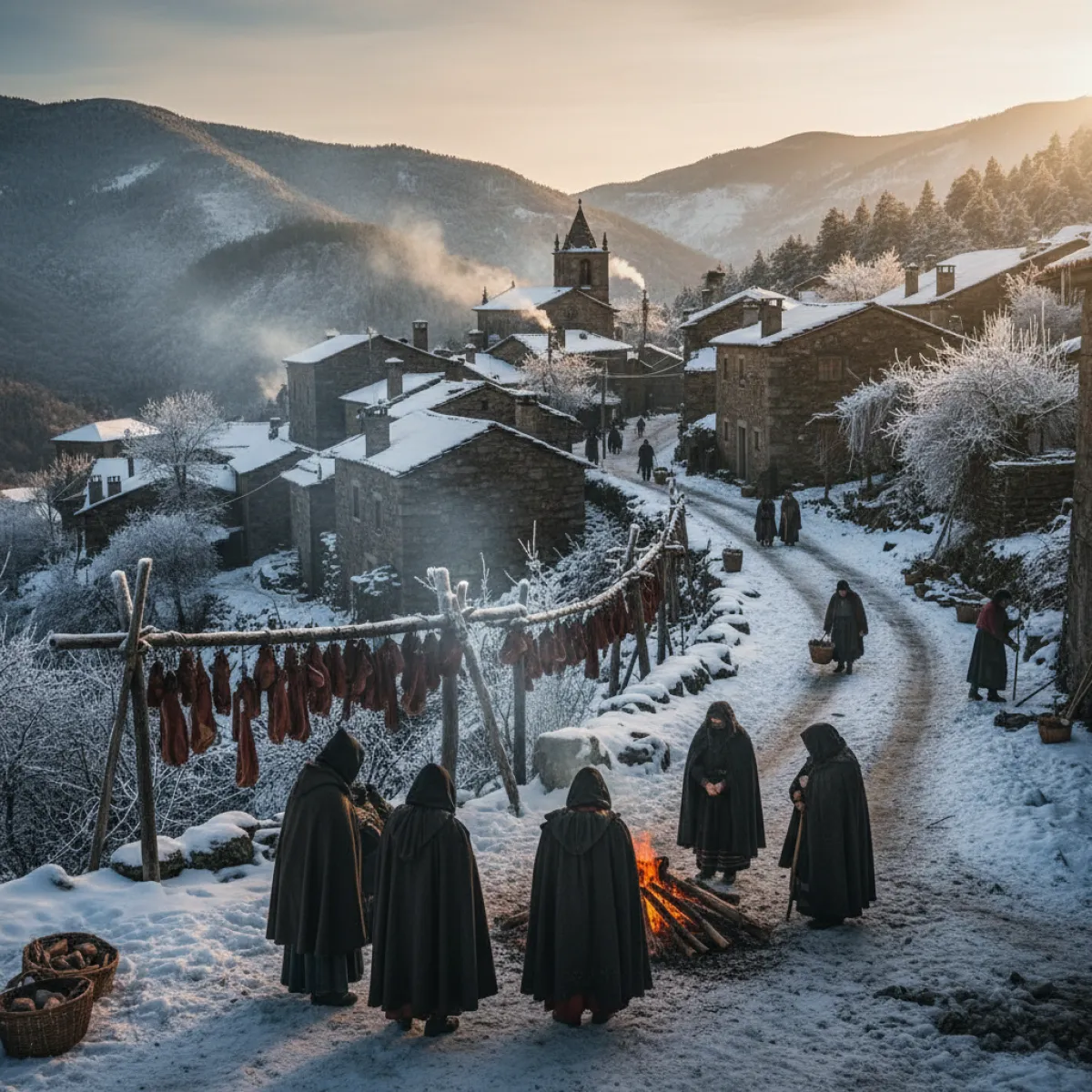
Winter as a State of Mind
Forget the romanticized notion of a European winter with fluffy snow and hot chocolate by a cozy fire. In Montalegre, winter is serious business, a war of attrition against granite and the biting wind that sweeps down from the Larouco mountains. Here, at 1,000 meters above sea level, the cold isn't an inconvenience; it’s the foundation of an entire culture. It’s what dries the ham, cures the sausages, and justifies the industrial amounts of aguardente served in the village taverns.
Traveling to the Barroso region between January and March requires a certain degree of geographical masochism, but the reward is access to the most authentic, unfiltered Portugal left. Don’t come looking for minimalist luxury or tasting menus featuring legume foams. Come for the oak smoke that permeates your clothes in five minutes and the raw hospitality of people who know that without a good fire and a heavy table, no one survives these parts. If the isolation feels like too much, you can always retreat to the ancient thermal springs of Chaves to thaw your bones, but know that the true character of this region lies up here, where the air is thin and the pig is king.
The Sacred Science of the Fumeiro
In Montalegre, the pig isn't just an animal; it’s a unit of measurement for wealth and survival. The Feira do Fumeiro (Smoked Meat Fair), usually held in late January, is the event that dictates the local calendar. But make no mistake: the fair is just the culmination of months of domestic labor. In regional kitchens, the ceilings are permanently populated by salpicões, alheiras, and honey sausages, suspended over oak embers. Smoke here isn't a seasoning; it’s an essential preservative.
Unlike Mirandela’s culinary resilience and its famous poultry-based alheiras, the smoked meats of Montalegre focus on the density of the Bísaro pork. Order the salpicão, but the real one, the one that resists the knife and reveals whole chunks of loin marinated in garlic and wine. And if you see something called 'chouriça de sangue' or 'bucho', don’t ask difficult questions, just eat. The bucho is perhaps the highlight of local gastronomy: a pig’s stomach stuffed with pieces of head meat and ribs, boiled for hours until it falls apart.
Cozido à Barrosã: A User’s Manual
The Cozido à Barrosã is definitive proof that minimalism was a historical mistake. In a Cozido worthy of the name in Montalegre, the cabbage and local potatoes are merely extras. The protagonists are the ear, the snout, the pig’s trotter, and, of course, the boiled ham. The secret lies in the quality of the fat, which should be translucent and melt upon contact with your fork. If a restaurant serves you meat that looks like it was bought at a Lisbon supermarket, stand up and leave. Places like Paço do Conde or Costa do Vizir typically treat the product with the respect it deserves.
Witches, Queimadas, and Father Fontes
Montalegre has capitalized on its isolation by turning ancient superstitions into a global brand. 'Friday the 13th' is now a massive event attracting thousands to the village, with the castle serving as a backdrop for light and fire shows. It might seem overly touristy, and largely, it is, but the roots of this phenomenon are deep. Father António Lourenço Fontes, the visionary behind the Vilar de Perdizes Folk Medicine Congress, is responsible for rescuing Barroso's pride from the clutches of oblivion.
The highlight of any mystical celebration in Montalegre is the Queimada Galega. It’s a concoction of aguardente, sugar, lemon peel, and coffee beans, set on fire in a clay pot while an 'Esconjuro' (exorcism) is recited. The blue flame dancing over the liquid is meant to ward off meigas (witches) and the evil eye. It’s a visual spectacle, yes, but the effect of hot aguardente sliding down your throat in the middle of a sub-zero night is the real miracle. If you want to escape the village crowds, look for surrounding hamlets where the tradition is lived out in a less choreographed fashion.
Pitões das Júnias: Where Time Stopped for a Rest
No trip to Montalegre is complete without a climb to Pitões das Júnias. It is one of the highest villages in Portugal and undoubtedly one of the most dramatic. Here, granite houses huddle together to conserve heat, and Barrosã cattle, with their imposing horns and stoic gaze, wander freely through narrow streets. It’s a place that makes The Silence of Montesinho feel like a bustling metropolis.
Take the trail down to the ruins of the Santa Maria das Júnias Monastery. Tucked away at the bottom of a valley, far from everything and everyone, the Romanesque and Gothic ruins seem to be slowly reclaimed by nature. The energy of the place is heavy, dense, almost palpable. Right next to it, the Pitões waterfall provides the perfect background noise for those who need a reminder that the world still turns. Back in the village, stop at Taberna do Lugarno. Order a board of goat cheese and cured ham, accompanied by a rough regional red wine. It’s the only effective antidote for the melancholy that Pitões invariably provokes.
Practical Guide for the Resilient Traveler
Getting There
Coming from Porto, the fastest route is via the A24 to Chaves and then following the N103. The N103 is a stunning road, but on days with frost or snow, it requires extreme caution. If you enjoy driving, the curves skirting the Alto Rabagão and Venda Nova dams are a guilty pleasure, provided your car has good tires.
Where to Eat
Avoid restaurants with tourist menus written in five languages outside. In Montalegre, the simpler the entrance, the better the food. A Cozido à Barrosã should cost between €25 and €35 per person in a top-quality spot, but you’ll find generous portions in taverns for much less. Don’t leave without trying the heather honey, it’s dark, strong, and tastes of the mountain.
When to Go
The Smoked Meat Fair (January) is for those wanting to buy top-tier meat. Friday the 13th is for those who love a party and crowds. But if you truly want to feel Barroso, go on a random Tuesday in February. The silence of the village, broken only by cowbells and chimney smoke, is a transformative experience.
The Verdict
Montalegre is not for those seeking easy comfort or saturated Instagram photos. It is a monochromatic destination, granite grey, earth brown, frost white. But it is one of the few places where the relationship between man and land hasn't been entirely mediated by mass tourism. Come hungry, bring warm clothes, and be prepared for the brutal honesty of a people who have no time for superficial pleasantries. One doesn't just visit Barroso; one survives it. And in the end, that’s what makes you want to go back.
