Mogadouro: The Miranda Donkey Route on the Plateau
Three days in Mogadouro between the Miranda donkey, kayaking on the Sabor Lakes, and a posta mirandesa that justifies five hours behind the wheel. Honest wines, stone houses with real hosts, and a plateau the brochures never noticed.
Let's start with the awkward part: Mogadouro is not on the way to anywhere. It sits on a plateau ninety minutes from Bragança, three hours from Vila Real, five from Porto if the traffic through Amarante behaves. That is precisely why it is worth the drive. Anyone who arrives here has chosen to, and the reward is a corner of Portugal where the Miranda donkey still has personal names, where Mirandese is spoken in villages further east, and where dinner usually ends with an unlabelled bottle appearing on the table.
This is not the polished Trás-os-Montes of tourism brochures. It is the municipality where AEPGA, the Association for the Study and Protection of the Donkey Breed, has spent more than two decades rescuing an animal that almost vanished. It is the Spanish border country where smugglers once carried coffee and fabric along paths we now hike with backpacks and GPS, pretending we discovered something. And above all it is a place to spend three good days, eat too much, sleep in a stone house, and drive home half convinced that Lisbon might be a bit overrated.
Why now, why here
The best window for Mogadouro is between May and early October, dodging the August peak when emigrants come home and prices in town quietly rise. May and June give you a green plateau before the sun bakes it; September brings the grape harvest, almond trees about to deliver gold, and nights cool enough to justify a sweater under the shirt. January and February can bring snow, which is wonderful for photos and bad for secondary roads if you do not brake with feeling.
Anyone who has never been east of Bragança underestimates the distances. Mogadouro to Miranda do Douro is fifty kilometres that feel like eighty, because the road weaves between almond groves and century-old olive trees. Always book more time than Google suggests. And if you arrive late in June, head straight to a viewpoint: we covered that in our guide to Mogadouro sunset viewpoints for June, and it still holds up.
The donkey that is not just a donkey
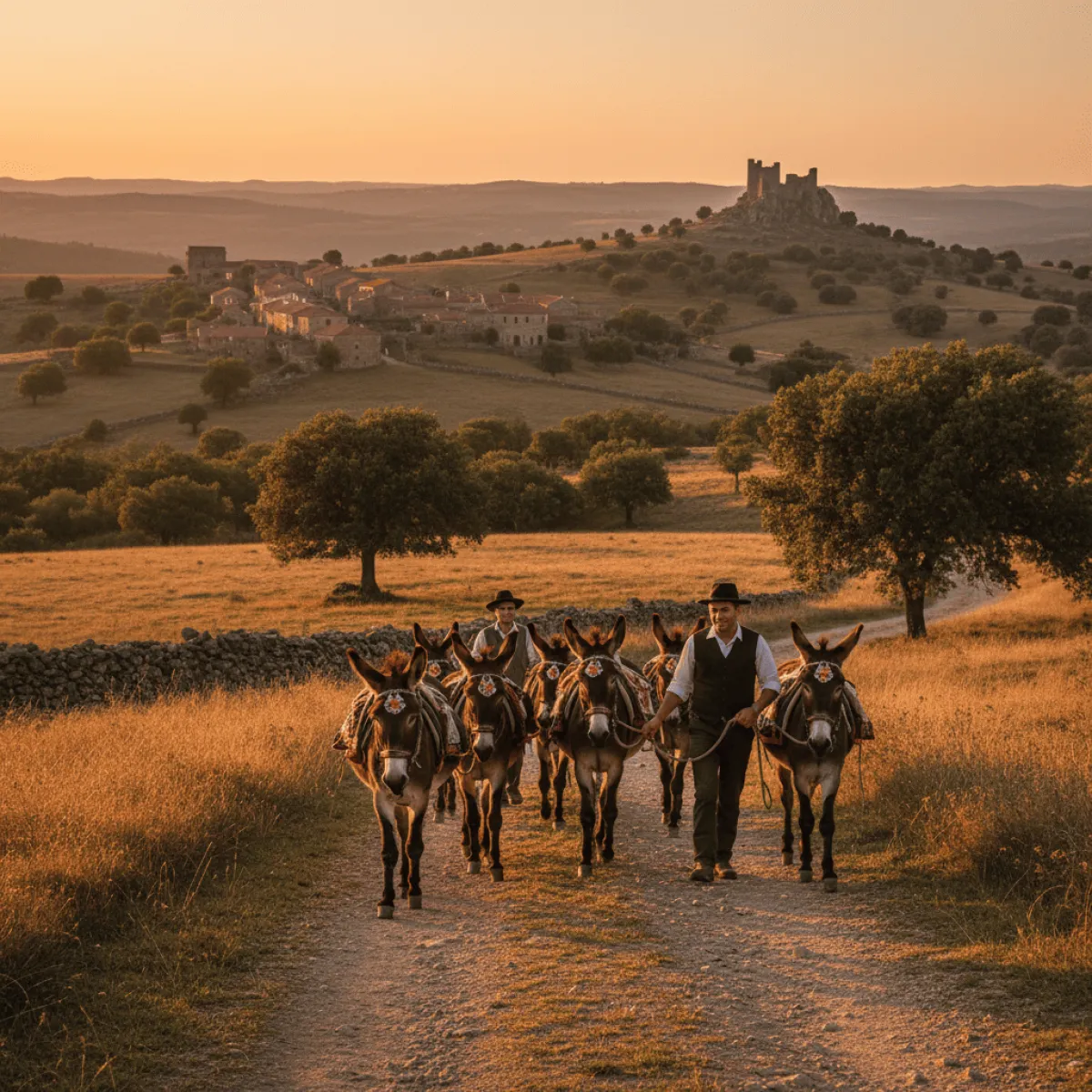
The Miranda donkey is the only Portuguese donkey breed officially recognised, with its own studbook. It is large, shaggy, patient, and looks at you with the polite indifference of an animal that has watched three centuries of agitated Portuguese come and go. For decades it carried wood, wine and children to school. When the tractor retired it, it almost ended.
AEPGA, headquartered in Atenor (technically Miranda do Douro municipality, but twenty minutes from Mogadouro), runs visits and donkey-walking experiences that are, without irony, among the most complete and least cynical things you can do in rural Portugal. This is not a theme-park encounter. It is a slow walk with a real animal, on real paths, with people who know what they are talking about. Check schedules locally and book several days ahead, especially at weekends. If you are travelling with kids, this is worth ten aquariums.
What to ask when you arrive
- How many Miranda donkeys are left (the answer changes yearly and is always interesting)
- Whether there are foals to meet (spring and early summer usually deliver)
- Which trail fits the time you have; some are two hours, some half a day
Eating in Mogadouro without falling for the trap
The town has half a dozen decent restaurants and two or three genuinely good ones. The rule is simple: if the menu has photos and is translated into four languages, walk another hundred metres. Look for places where the tables are full of people talking to each other instead of staring at phones; look for short menus, handwritten, and be suspicious of any place that promises "regional specialities" without naming them.
What you actually eat in this corner: posta mirandesa (steak from the Mirandesa cattle breed, grilled plain, sea salt and olive oil), butelo com cascas (a sausage stuffed with ribs, bones and dried beans, served with cabbage; winter dish, dense, glorious), folar transmontano in its savoury version (loaded with cured ham, chouriço and linguiça, more meat than bread), alheira in versions that bear no relation to supermarket sausage, and roast kid from a wood oven when the calendar allows.
For drinks, order the house wine before asking for the list. In Mogadouro the house wine usually comes from a small estate twenty kilometres away, it is red, it is honest, and it costs under eight euros for the bottle. If you want to play more seriously, ask for wines from the Douro Superior sub-region, which begins just south of here and still has small producers doing remarkable things at civilised prices.
Where to sleep, without hesitation
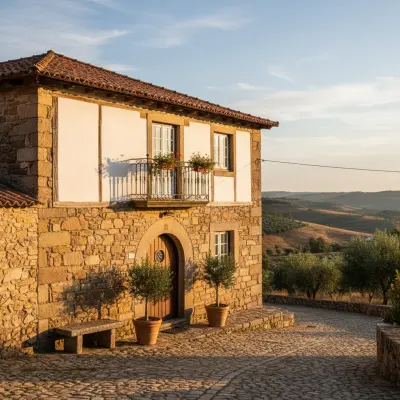
Mogadouro has no big hotels, which is a blessing. What it has are stone houses restored with judgement, run by people who are at reception because it is their home. Two stand out.
The first is Casa do Gi, a stone house carefully restored: few rooms, breakfast with proper local products, and the kind of host who tells you where to eat and, more importantly, where not to. For anyone visiting AEPGA or walking the trails, it is the perfect base: quiet, discreet, minutes from the centre.
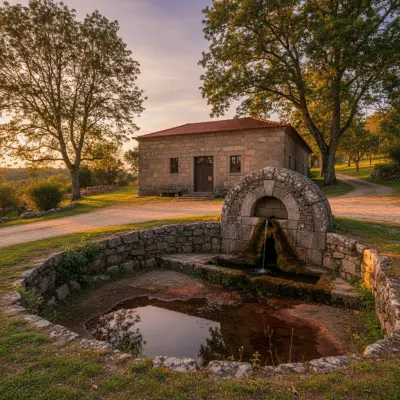
The second is Casa das Águas Férreas, a more isolated rural guesthouse, ideal for anyone who wants the plateau at the door and is willing to drive five minutes to dinner in town. The nights are silent in a way that is hard to explain to city dwellers; at dawn you hear turtle doves and, with luck, foxes crossing between the olive trees.
For either, book ahead in May, June and September. People who find Mogadouro tend to come back, and they tend to tell others.
Day 1: town, castle, late dinner
Arrive late morning, drop the bags, and walk up to Mogadouro castle. What remains is modest, mostly the keep and parts of the wall, but the panoramic view earns the climb. It is Templar in origin, then Christian, then forgotten, then partially recovered. From the top the geography makes sense: the town at a crossroads, the plateau rolling east toward Spain, and the Sabor and Douro valleys opening west and south.
Eat a light lunch, because dinner will be serious. In the afternoon, walk the old town: the Mother Church, the pillory, the narrow streets where doors still stand open in midday and where you can buy cheeses that justify the detour. Late in the day, pick a viewpoint: Carrascalinho is easy and reachable by car; others ask for a short walk and pay better dividends.
Day 2: water, kayak, and the Sabor nobody expected
The geographic secret of Mogadouro is that it is closer to water than it looks, despite feeling stranded mid-plateau. The reservoirs of the Sabor Lakes, created by the Baixo Sabor dam, turned a rugged valley into a sequence of green mirrors where you can paddle for hours and cross no more than three other boats.
A kayaking session on Lagos do Sabor from Mogadouro is the obvious investment for the day. By June the water is already pleasant, but always carry a dry change of clothes: the wind that picks up across the plateau in mid-afternoon can catch you off guard. Local operators provide life jackets, gear and instructions; anyone who has never paddled before walks away convinced they learned something useful for life.
For the return, take the slow road. Stop at any high point and give it ten minutes of just looking. This is the kind of pause that turns a trip into a memory.
Day 3: the east, the language, the cheese
Save the third day for the border. Leave early (eight in the morning is fine) and drive to Miranda do Douro. The road crosses Sendim, home of pauliteiros dancing and Terrincho cheese, and ends at the cliffs of the Douro Internacional. Visit the cathedral, walk the walls, and step off the usual route into Constantim or Picote, villages where Mirandese is not folklore for fairs: it is a living language.
Mirandese, officially recognised as Portugal's second language since 1999, survived because nobody paid attention to this region for six centuries. It is spoken by fewer than ten thousand people and, against expectations, is healthier today than thirty years ago, with schools, newspapers and serious poets. Buy a bilingual book if you find one; it is one of the best souvenirs available.
If you have time: Montalegre as contrast
Mogadouro is a dry plateau of almond trees, olive groves, summer heat and enormous skies. Montalegre is the other extreme of Trás-os-Montes: high mountain, wet granite, Barrosão cattle, and snow seven months a year (almost). If you are planning a longer northern loop, combining the two is the smartest move.
For its less obvious side, our guide on Montalegre beyond Barroso, between castle, castro and mountain kitchen avoids the Friday the 13th circuit and shows what remains once tabloid tourism leaves. And if you visit off-season, in mist and silence, the winter photography itinerary across the Montalegre plateau is good company. Two lands, two climates, two tempos: together they give the best portrait of this corner of the country.
The essentials, no disguises
- Getting there: from Lisbon, A1 to Coimbra, then IP2 / A23 or IP3 up to Vila Real and A4 / IP4 to Bragança, then south to Mogadouro. Five hours with breaks. From Porto, A4 / IP4 to Bragança and south, around two and a half hours. Without a car it is hard: buses exist but on schedules built for locals, not visitors.
- Rough costs: dinner for two at a good local restaurant, 35 to 55 euros with house wine; double room in a rural guesthouse, 75 to 110 euros with breakfast; half-day kayak trip, around 30 to 45 euros per person (check locally).
- What to pack: walking shoes that handle loose gravel, a rain shell even in June (the plateau changes its mind quickly), and cash for fairs, cheeses and old grocery stores.
- What not to do: do not try to eat pizza, do not order sushi, do not arrive in a hurry.
Mogadouro is not done quickly and is not done by accident. It is done slowly, with patience for secondary roads, with appetite by mid-afternoon, with more willingness to listen than to talk. Anyone who understands that takes home one of the best Portuguese weeks they will have in the coming years. Anyone who does not can always go back to the beach.