Évora's Megalithic Circuit: Almendres and Beyond
The Cromeleque dos Almendres is 2,000 years older than Stonehenge, free to visit, and you'll likely have it to yourself. Here's how to do the full megalithic circuit from Évora in one day, no guide required.
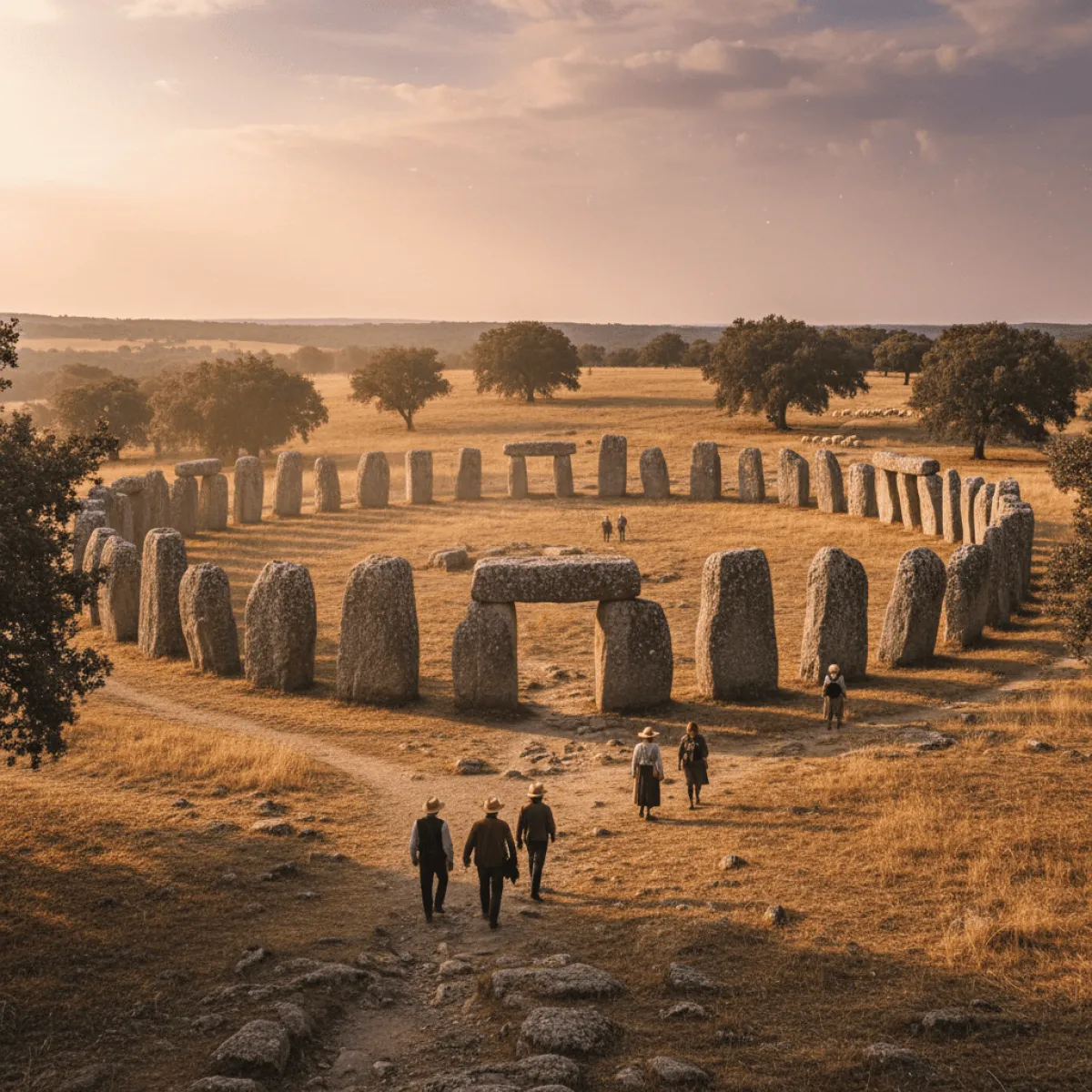
Leave Évora on the Valverde road at 7:30 in the morning. Fifteen kilometres later the tarmac runs out and you're on a dirt track lined with cork oaks. When the car rattles over the final kilometre of loose stones, and when you finally see the 95 monoliths emerging from the morning mist between the olive trees, two things hit you at once. First, you're alone. Second, these people knew what they were doing 7,000 years ago.
The Cromeleque dos Almendres is the largest megalithic complex in the Iberian Peninsula and arguably one of the three most important Neolithic sites in Europe. Stonehenge, with all its marketing and 30-pound entrance fees, is 2,000 years younger. Here there's no ticket office, no fences, no tour bus parking (yet). There's a sun-bleached information panel, a wooden box for voluntary donations, and the stones. That's it.
This article isn't about the Cromeleque alone. It's about how to do the full megalithic circuit in a day, without a rushed schedule, without an obligatory guide, and get back to Évora in time for dinner with the feeling of having seen something most visitors miss entirely.
Why go now (and not in August)
Let's be direct: the Alentejo in July and August is unbearable from 11am onwards. The megalithic monuments are all in open ground, with no meaningful shade. Granite easily hits 50°C in the midday sun. You'll read about the famous "Alentejo light" in every guidebook, and it's real, but if you go in August what you'll remember most is your own sweat and the sound of your shoes asking for shade.
The ideal window is October to May. February and March come with an unexpected bonus: poppies start appearing between the monoliths, and the red against grey granite is one of the most underrated images in the country. In June, go at sunrise or after 5:30pm. Whatever the season, take two litres of water per person, a hat, and closed shoes (snakes do live in these fields, they usually flee, but it's not worth pushing your luck in sandals).
The right order for the circuit
Most visitors get this wrong. They drive straight to the Cromeleque dos Almendres, take photos, head back to Évora, have lunch, and call it a day. They've missed half the story.
The order I recommend is chronological and geographic, which works for both reasons: start at the Menir dos Almendres, then the Cromeleque dos Almendres, then the Anta Grande do Zambujeiro, and finish at the Cromeleque de Portela de Mogos or the Cromeleque do Vale Maria do Meio if you want sites that are practically deserted.
1. Menir dos Almendres (15 minutes)
Before reaching the main cromlech, there's a marked right turn for the menhir. Park and walk 200 metres along a path between holm oaks. The menhir stands about 4.5 metres tall, alone in a small clearing, with subtle engravings on its upper section. See this first, because it's aligned with the cromlech 1.4 km away along the summer solstice axis. When you later reach Almendres and look back, the engineering clicks into place.
2. Cromeleque dos Almendres (1 hour)
No schedule, no ticket, no fence. You can touch the stones (please do so with respect, this is 7,000 years old). Some bear engravings: concentric circles, croziers, small cupmarks. The clearest ones are on the eastern stones, especially in the outer row. Set aside time to walk around the outside of the enclosure, because that's where you see the elliptical shape and how it sits in the terrain.
Practical note: Wi-Fi and mobile data range from weak to non-existent here. Download an offline map before leaving Évora. Google Maps sometimes sends visitors down a side road that ends at a private gate. The correct access is via the Valverde road, from Guadalupe village.
3. Anta Grande do Zambujeiro (45 minutes)
The largest dolmen in the Iberian Peninsula. The burial chamber is roughly 6 metres tall, with eight granite uprights and a capstone partially removed during a controversial 1960s excavation. Today a protective roof structure covers it, which ruins the photographs but saves the stone. Access is by a dirt road from Valverde; it's normally open and free, but check locally because it has been closed for restoration work for long stretches in the past.
Bring a small torch or use your phone: the chamber interior is dark even at midday, and it's in there, in silence, fingers tracing the original chisel marks, that the scale of this place finally registers.
How to get there (without overthinking it)
The circuit doesn't work on public transport. No buses run to Almendres, no taxis sit waiting. Realistic options:
- Own or rental car: the best choice. Expect 25 km from Évora and around an hour of total driving for the full circuit. The last kilometre to the Cromeleque is dirt road, but any city car handles it if you go slowly.
- Organised tour from Évora: several local operators run half-day or full-day trips with a guide. Budget 35€ to 70€ per person. Worth it if you don't want to drive or if you'd rather have archaeological context narrated by someone who actually knows the material.
- Gravel bike: viable and brilliant in March or October, but requires reasonable fitness and a lot of water. It's about 50 km total round trip including the circuit.
To better understand the barrocal landscape you'll cross, consider booking a wildflower workshop with Catarina Ferreira before or after, which teaches you to identify the exact plants growing between these monoliths. It completely changes how you read the ground after that.
Where to eat before heading back
There are two schools. The first is a picnic: pick up Monsaraz bread, Évora cheese, presunto, olives and a bottle of Esporão Reserva red before leaving the city, and eat under a cork oak halfway through the circuit. Costs 20€ for two and is the best meal of your week.
The second is to stop in Guadalupe or Valverde on the way back. Guadalupe has one or two simple village tascas serving lamb stew and migas with pork ribs at village prices (around 12€ to 15€ per person, house wine included). Don't look for English menus, don't look for design: look for the work vans parked outside at noon. Where the farmworkers eat, you'll eat well.
The rest of the day in Évora
Aim to be back in town by 4pm, with time for a shower and a short nap. Évora in late afternoon, once the cruise-ship coach groups leave, is a different city. This is when to visit the Museu Nacional Frei Manuel do Cenáculo, housed in the former episcopal palace next to the cathedral. The archaeological collection on the lower floor is the perfect complement to your morning: Neolithic and Chalcolithic artefacts from exactly the period of the cromlechs, with explanatory panels you don't get in the field.
If you prefer a walked, narrated approach to the city rather than a museum visit, this Évora walking experience connects the Roman, medieval and modern layers of the town in roughly three hours and covers things you'd walk past obliviously on your own.
Where to sleep
Évora has beautiful expensive hotels and historic pousadas with pools. All of that is easy to find and well documented. For travellers wanting affordable without being a downgrade, the Old Évora Hostel is a solid pick, with private rooms if you don't fancy a dormitory, a location inside the city walls, and staff who actually know how to help organise transport to the megalithic sites.
And after dinner?
Évora isn't Lisbon, isn't Porto, closes early. But if you want a drink and somewhere to stay awake past 11pm, Praxis Club is one of the reference points of local nightlife, especially on nights when the university is in term. Don't expect a Lisbon megaclub: expect an honest place, frequented by students and locals, mixed music, prices that are still reasonable.
Extending the trip into the northern Alentejo
If you have three or four days, it's well worth pairing Évora with Portalegre, around 100 km north. It's a different scale, a different urban density, different food, and almost no tourists. We've put together three guides that help you make the most of the time there: a weekend guide that skips the tourist traps, a walking route through the neighbourhoods worth the effort, and a list of where locals actually eat.
Small common-sense rules (which plenty of visitors ignore)
- Don't climb the monoliths. Not because the stone is fragile, but because you can fall and you're 15 km from the nearest village with patchy mobile coverage.
- Don't take anything from the ground, including small "souvenir" stones. Sounds obvious to write, but the national heritage office documents dozens of incidents a year.
- Take your rubbish with you. There are no bins, and the Alentejo wind sends everything into the surrounding fields.
- If you're in a group, keep your voices down. I'm not asking for religious reverence, just respect for the silence that's part of the place.
- On spring weekends, arrive before 9am or after 4pm if you want photographs without people. This isn't the secret it was five years ago.
The unavoidable question: is it really worth it?
Depends what you came for. If Évora for you means the Roman Temple, the Chapel of Bones, and one evening of black-pork dinner, the megalithic circuit isn't compulsory, it's a bonus. If you care about archaeology, about vast landscapes, about feeling you're in a genuinely ancient place rather than a tourist replica, this is one of the best half-day trips you can do in mainland Portugal.
Almendres won't stay this way forever. There are plans, discussed for years, for a formal interpretation centre, a ticket office, marked paths. When that happens, the experience changes. For now, you can still get there at eight in the morning, lay a hand on a stone 7,000 years old, and hear nothing but the wind. Make the most of it.