Estremoz on Foot: The Marble That Built a Town
In Estremoz, the marble that becomes statues in Carrara is the step where you sit to empty your shoes. A walk through the upper town, from the Alentejo's biggest square to the Tower of the Three Crowns, with stops for sericaia and honest timing tips.
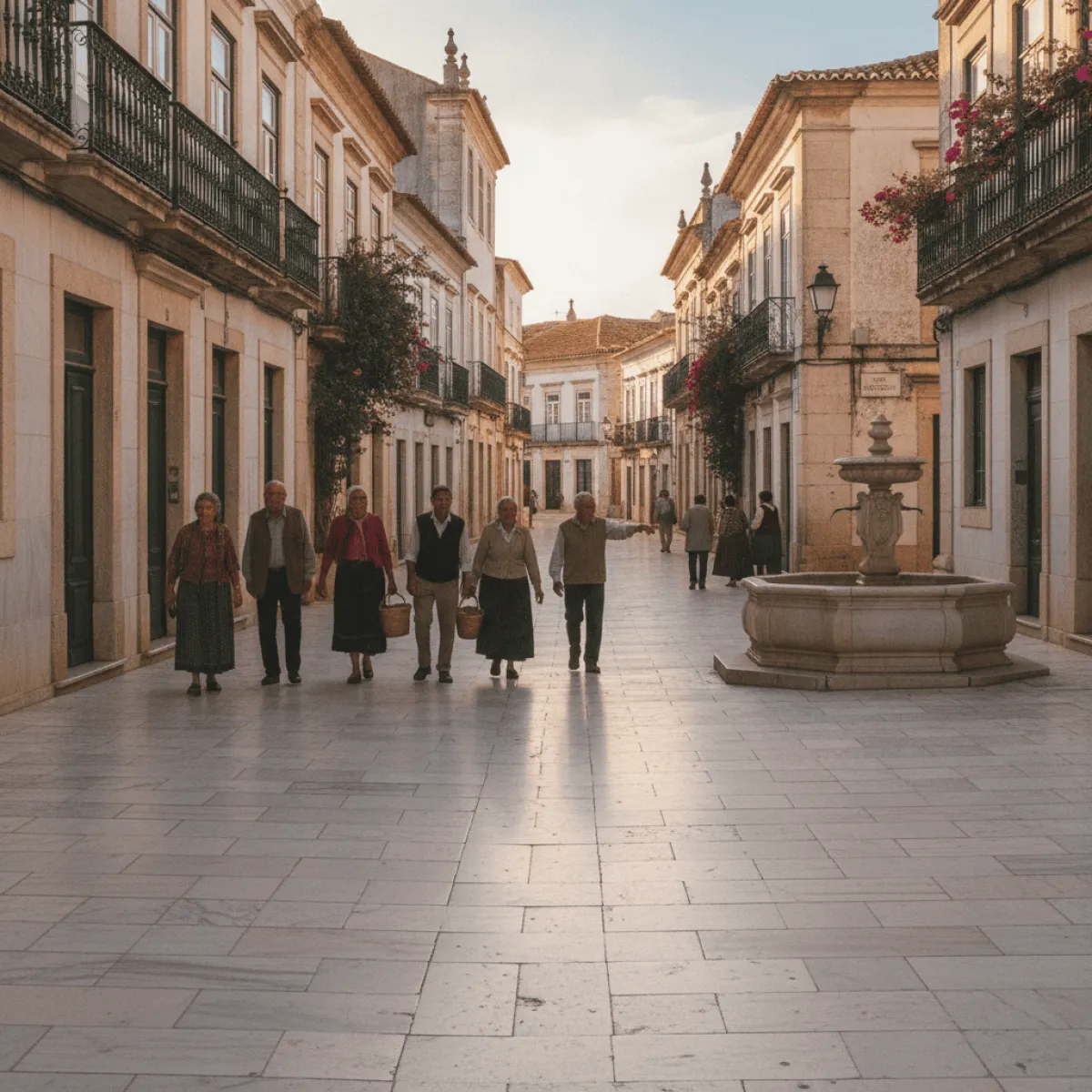
Here is something nobody warns you about Estremoz: the town is literally built from the material that made it famous. I am not talking about clad facades or a decorative slab here and there. I mean doorsteps, stairs, garden benches, public washbasins, all of it carved from the same white and rose-pink marble that supplies half the world. In Carrara they turn this stone into statues for millionaires. In Estremoz they turn it into the step where you sit down to shake the sand out of your shoes. That casual disregard for what should be luxury is exactly what makes a walk through the upper town feel different from any other walled village in the Alentejo.
Let me be blunt: Estremoz is not a place you do by car. The historic centre is a tilted maze of narrow lanes where the GPS gives up and you end up reversing down an alley with two centimetres of clearance on each side. Park down below, in the main square, and walk up. It is a twenty-minute climb that earns every drop of sweat, especially in late afternoon, when the light hits sideways and the marble facades turn the colour of honey.
Start at the bottom: Rossio Marquês de Pombal
The logical starting point is the largest square in the Alentejo, the Rossio Marquês de Pombal. On Saturday mornings it becomes one of the most honest markets in the country: producers selling cheese, cured sausage, plants, hardware, and the famous bonecos de Estremoz, the hand-painted clay figures that UNESCO listed as Intangible Cultural Heritage in 2017. Do not buy the first one you see. Walk the whole square, compare, and look for figures with finer glazing and faces that actually have an expression. The best ones still come from the hands of women who learned the craft from their mothers.
In the middle of the square sits the Lago do Gadanha, with a figure of Neptune holding a scythe (yes, the god of the sea wielding a harvest tool, nobody really explains why). Make it your orientation point. From here, turn your back on the shops and aim uphill, towards the tower that dominates the entire hill.
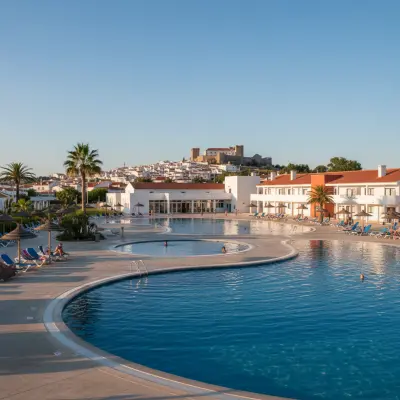
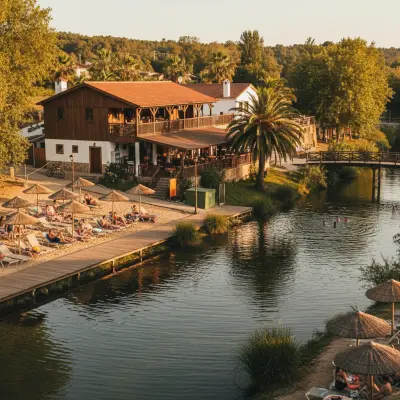
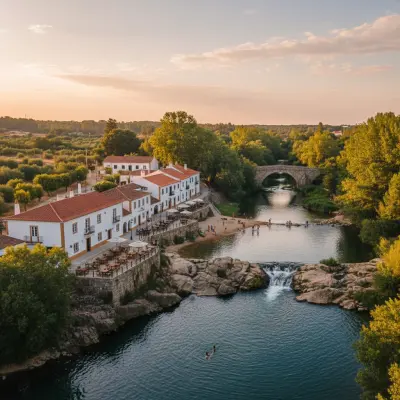
If you come in summer and the Alentejo heat melts you before you even start the climb, here is the honest tip: the town knows how to cool you down. The municipal swimming complex rescues the hottest afternoon, and anyone who prefers real open water has the river beaches nearby, like the Fronteira river beach or the quieter Azenhas d'El Rei river beach. Save those for after the walk, because the architecture does not wait and the afternoon sun is marble's best friend.
The climb: from medieval gates to the upper town
The ascent follows streets that still trace the medieval plan. Notice the whitewashed houses with painted borders around doors and windows, almost always ochre-yellow or blue. This is not invented tourist decoration: tradition holds that the pigmented paint kept insects and bad luck away, and it stuck. As you climb you keep crossing the old line of the walls. Estremoz had two defensive rings, the medieval one up top around the castle, and a seventeenth-century star fort built during the Restoration Wars, when this was a frontier fortress keeping a wary eye on the Spain that lay half an hour away.
When you finally pass the arch and step into the upper town, the noise falls away. It is another world. On a Sunday morning, the only thing you hear in the streets around the castle is the echo of your own footsteps on stone and maybe a dog barking two blocks below. Up here there is almost no commerce, almost no traffic, and the houses huddle against each other as if hunting for shade.
The Tower of the Three Crowns, the stone heart
At the very top stands the reason for all of it: the keep, known as the Torre das Três Coroas, the Tower of the Three Crowns. It rises around 27 metres, dates from the late thirteenth and early fourteenth century, and was built from local marble. The name comes from the three kings said to have contributed to its construction, Afonso III, Dinis and Afonso IV. It is one of the most beautiful medieval towers in Portugal, for one simple reason: the stone. While most of the country's towers are grim grey granite, this one glows. Walk up to it and run your hand along the wall. You can feel the veins in the marble, the pink blotches, the coolness of the stone even on a forty-degree day.
Right beside it sits the Pousada Rainha Santa Isabel, installed in the old royal palace and castle. Even if you do not stay, go in. The courtyard and halls are open to anyone who wants a look, and the terrace has one of the finest views in the Alentejo: the plain stretching to the horizon, white villages scattered across it, and on clear days the Serra de Ossa in the distance. Have a coffee at the pousada bar and pay for the privilege of sitting inside a thirteenth-century castle. It is not expensive for what it offers, but check prices on the spot.
The chapel worth the detour
A few metres from the tower stands the Chapel of Queen Saint Isabel, built where the queen is said to have died in 1336. The interior is lined with eighteenth-century tiles telling her life story, including the famous miracle of the roses, when the bread she was secretly carrying to the poor turned into flowers the moment her husband caught her. Opening hours are irregular and it is not always unlocked, so check locally before climbing up just for this. When it is open, it is one of the most expressive tiled interiors in the region.
Santa Maria and the museum nobody tells you to visit
On the same upper square you find the Church of Santa Maria, with its sober facade, and right there the old building that now holds part of the town's collection of tiles and folk ceramics. Before it is a town of marble, Estremoz is a town of clay: the utilitarian pottery, the jugs, the water pitchers and the painted figures all belong to the same tradition. If one thing sets Estremoz apart from the other pretty Alentejo villages, it is precisely this double identity, noble stone and humble clay, side by side, building the same town.
Afterwards, head down Rua da Frandina and let yourself get lost. This is where the upper town shows its domestic side: laundry strung between windows, pots of basil on marble doorsteps, cats asleep in the sun. There is no monument, no plaque, and that is exactly why it is worth it. This is the Estremoz that locals actually live in every day.
What to eat on the way down
All this walking sharpens the appetite, and the Alentejo never disappoints. Find a traditional eatery in the lower town and order the obvious: an açorda alentejana with pennyroyal and a poached egg, migas with pork, or, in winter, an ensopado de borrego, a lamb stew you eat with bread floating in it. For dessert there is only one rule: sericaia with ameixa d'Elvas. It is a kind of cinnamon-dusted set custard, served with a candied Elvas plum on the side. Order it even if you are full. To go with it, a regional red, made seriously here and at a civilised price.
A practical word on timing: the Alentejo eats lunch early and dinner early. If you roll into a tavern at 2:30pm expecting lunch, there is a good chance the kitchen has already closed. Stop walking around half past noon if you want to eat in peace.
How to extend the trip
If a single day feels too short, and it will, the region offers plenty more. Anyone who likes to ride has dream terrain here, with the plain unrolling along empty roads and white villages on the horizon; the experience of cycling the Alentejo out of Estremoz shows you the rural side that no walk through the upper town can reach.
And if Alentejo towns explored on foot have got under your skin, head up to the Alto Alentejo. Portalegre, leaning against the Serra de São Mamede, is the natural counterpoint to Estremoz and has a completely different character, greener, cooler, more mountainous. Before you go, read our guide to exploring Portalegre on foot, neighbourhood by neighbourhood, find out where the locals actually eat, and plan everything with our itinerary for a weekend without the tourist traps. Two towns, two materials, marble and mountain, and an Alentejo that turns out to be far more varied than the golden-plain postcard.
Practical details
- When to go: spring and autumn are unbeatable. In summer, do the upper-town walk early morning or late afternoon and reserve the middle of the day for the pool or a river beach.
- Market: Saturday morning in the Rossio. Arrive early, ideally before 10am, before the best stuff is gone.
- Footwear: closed shoes with grippy soles. The cobbles and polished marble get slick, especially in the rain.
- Time: allow at least two to three hours for the upper-town circuit at a relaxed pace, more if you go into the museums.
- Cost: the climb and the streets are free; museum and chapel entries are token amounts. Confirm hours and prices locally, as they shift with the season.
Estremoz will not dazzle you with one giant monument or queues of tour buses. Its charm lies elsewhere: in the way an entire town was built from the noblest stone there is, and treats it with complete nonchalance. Climb the hill, run your hand over the tower, sit on the marble step. You will understand.