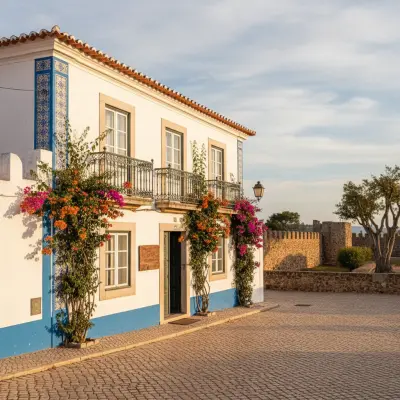
Elvas at the Table: Regional Dishes and Where to Find Them
The plums have held EU protected status since 2003, the sericaia arrives cracked like a dry desert, and the açorda demands enough coriander to bury a small wedding. An honest guide to eating in Elvas, dish by dish, with frank warnings about what to skip.
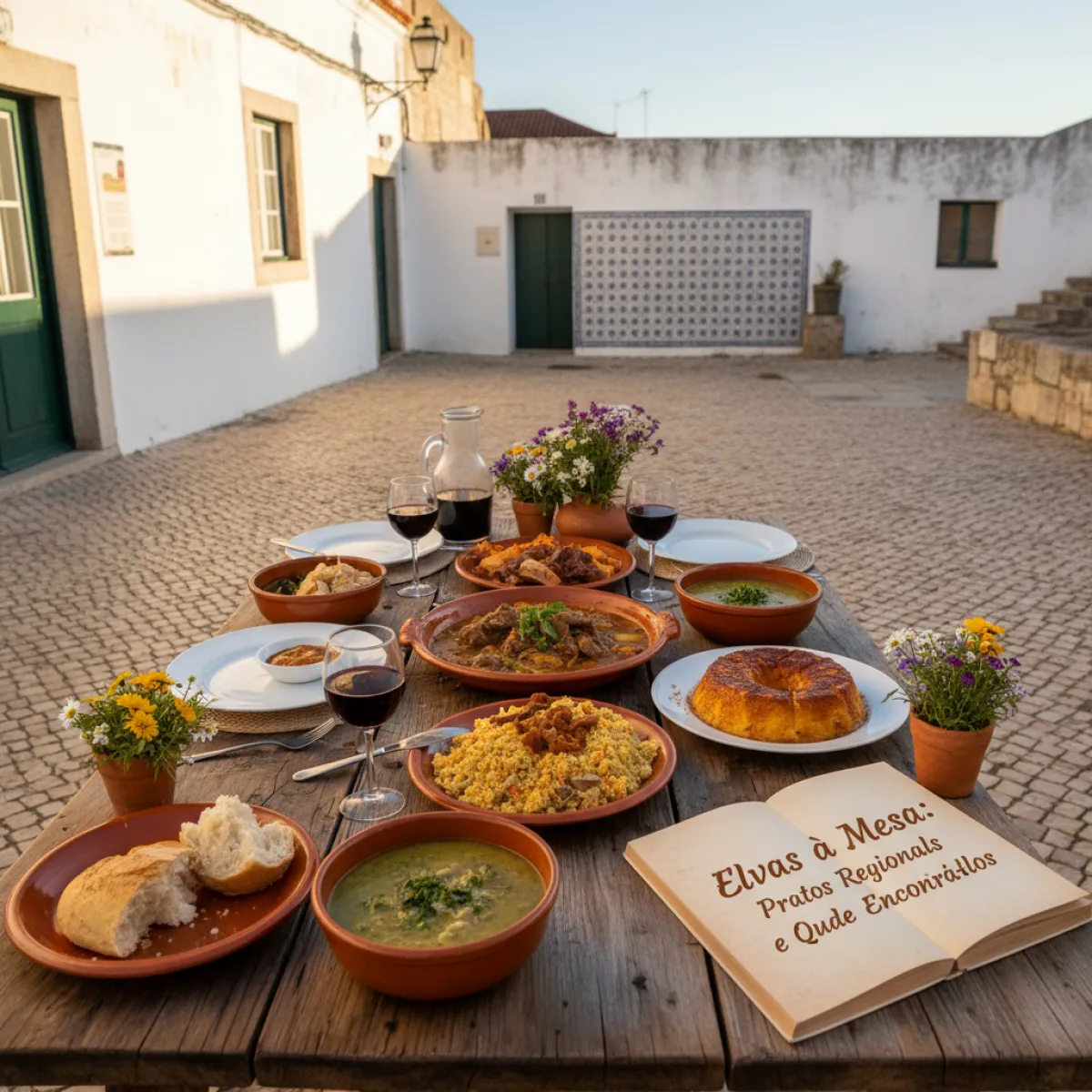
There is something you need to understand about Elvas before you sit down to eat: this is a border town, and borders do strange things to food. Here, fifteen kilometres from Badajoz, Alentejo cooking takes on Spanish accents without losing its own. The olive oil is thicker, the bread darker, and the sweets, those sweets, are a municipal obsession that has European certification. This is not an exaggeration. The plums of Elvas have held Protected Geographical Indication status since 2003, which means that sticky, sweet, slightly tart thing you will find in any serious bakery in town is not just a sweet: it is heritage.
This is not a list of restaurants. It is a map of what to eat in Elvas, dish by dish, with honest pointers on where to find each one done properly, and frank warnings about what to avoid. You will leave hungry. Consider yourself warned.
The plums of Elvas: start at the end
Yes, we are starting with dessert, because in Elvas dessert is not the end, it is the beginning of everything. Ameixas d'Elvas are a specific variety called Rainha Cláudia Verde, picked while still slightly green, blanched, pitted by hand (yes, by hand) and crystallised in a thick sugar syrup. The result is a translucent jade-coloured sphere with a texture somewhere between firm jelly and a very sweet olive. They look and taste like nothing else you have eaten.
You will find them in wooden boxes in the bakeries on Rua de Olivença and Praça da República. A small box runs about 8 to 12 euros, depending on the size grade. Buy one. Eat two on the bench facing the Amoreira aqueduct. It will be more memorable than any expensive lunch. Practical note: the best plums are from the current year's harvest, sold between September and December. Outside that window they are still good, but they lose the bright acidity that justifies the fuss.
Sericaia with plum: the obligatory pairing
If the plums are the solo star, sericaia is the solo star that prefers performing as a duo. This is the most Alentejano of all Alentejo desserts: an egg pudding with a cracked surface like a dry desert, dusted with cinnamon and served with a syrup-soaked Elvas plum in the centre. It is the dessert that closes any serious meal in the region, and in Elvas it is practically impossible to refuse.
Sericaia is made with eggs, milk, sugar, flour and cinnamon, and its trick is in the baking: it goes into the oven in spoonfuls, creating that pattern of concentric cracks that looks like abstract art. Good sericaia is firm on top, almost melting inside. If it arrives dry like a supermarket yoghurt cake, send it back. That is not sericaia, that is fraud.
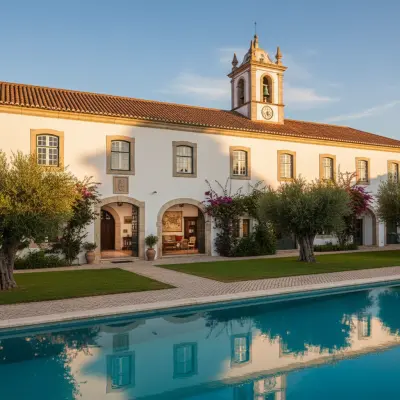
Where to eat it? Most of the restaurants in the historic centre have their version. The restaurant at the Vila Galé Collection Elvas, set inside a 17th-century former convent, serves a sericaia that respects the canon, with the bonus that you can have lunch in a genuinely beautiful cloister without having to fake enthusiasm for the décor. Mains run about 18 to 28 euros, which is reasonable for the setting.
Açorda alentejana: the decisive test
Açorda alentejana is the dish that separates tourists from travellers. If you have never had it, prepare yourself for a soup that looks simple and is in fact pure technique. Hard Alentejo bread, garlic crushed in a mortar with coarse salt, fresh coriander in obscene quantities, extra virgin olive oil (the good kind, the one that burns slightly in the throat), boiling water and a poached egg on top. Nothing else. That is all. And that is everything.
The secret is the coriander. There has to be enough coriander to bury a small wedding. If you are allergic to the flavour (some people genuinely are, on a genetic level), order something else. If you have never tried it, brace yourself: the aromatic impact is considerable.
A decent açorda in Elvas costs between 6 and 10 euros and works perfectly as a single-course lunch with bread and Nisa cheese to start. Be aware: many places serve modernised versions with cod or prawns. Those are different dishes, equally good, but they are not the classic açorda. If you want the real thing, ask for it explicitly: "the classic one, with the poached egg".
Migas: the dense cousin
Where açorda is wet and aromatic, migas are dense and rich. Alentejo bread again, but this time crumbled and bound with lard, garlic, and usually served alongside fried pork, ribs, or pork belly. It is the winter dish par excellence, food for someone who has worked the fields all day and needs fuel for the next.
Wild asparagus migas, in season from February to April, are a finer version, made with wild asparagus picked from the surrounding hills. This is the dish to seek out if you are in Elvas in spring. If you see asparagus migas on the menu outside that window, be suspicious: they are either frozen or cultivated, and either way they lose half the interest.
Pork and the Alentejo obsession with black
Black Iberian pork is a religion with strict rules in Alentejo. The breed is native, fed on acorns in the cork oak pastures, and its meat is dark, marbled with fat that melts on the tongue, and tastes like nothing you can buy in a normal supermarket.
In Elvas, look for carne de porco à alentejana, the unlikely fusion dish that marries the hills and the sea: cubes of black pork marinated in red pepper paste, flash-fried, and served with clams opened in white wine and small fried potato cubes. Sounds odd? It is. Does it work? Astonishingly well. The sweetness of the clam counters the fat of the pork, the pepper paste binds the two, and the potatoes mop up everything. Expect to pay 14 to 20 euros at a decent place.
Another option is grilled secretos, simple, with flaky salt and olive oil. If the secreto comes properly cooked, pink inside, with crisp fat outside, it is one of the best pieces of meat you will eat in Portugal. If it comes dry, apologise for ordering it there and move on.
Cheeses: Nisa, Serpa, and the Spanish frontier
Before the main, or instead of it, ask for a cheese board. In Elvas, this is a small paradise. Nisa cheese, DOP, made 60 kilometres away, is raw sheep's milk, semi-cured, with a crumbly texture and a buttery, fresh-grass flavour. Serpa, further south, is properly buttery, almost liquid in the centre, eaten with a spoon when it is at its peak. And since we are a step away from Spain, you will also find some Extremaduran cheeses such as Torta del Casar, which is basically Serpa cheese in Spanish form, equally liquid and equally good.
A board for two costs 12 to 18 euros, with bread and pumpkin jam or quince paste on the side. Pair it with young, fresh white wine from Alentejo rather than the heavy red everyone recommends. Creamy cheeses ask for acidity, not tannin.
Where to eat: three options and a strategy
The historic centre of Elvas, inside the walls, has many restaurants. Not all of them are good. The general rule is: if there is a tourist menu in four languages displayed on the street, walk away. If the menu is handwritten on a chalkboard, sit down.
For a proper white-tablecloth meal
The Vila Galé Collection Elvas has the most polished restaurant in town, set in a former convent of São Paulo. The kitchen respects the classics without making caricatures of them, and the room, with vaulted ceilings and original tile work, is worth the trip even if you are not staying. Book for Sunday lunch, which is when the oven is running properly and the convent sweets show up in force.
For sleeping and eating in a rural setting
Heading out of Elvas towards Vila Fernando, you will find Alojamento Escola do Fado, a former primary school tastefully converted. Here, more than at a conventional restaurant, you will eat what is actually cooked in deep Alentejo: pot dishes, stews, game when it is in season. Pair the stay with the night of fado at the old school of Vila Fernando, which is precisely the kind of experience that justifies the trip: real food, live music, no fake sets built for tourists.
For closing the night with music
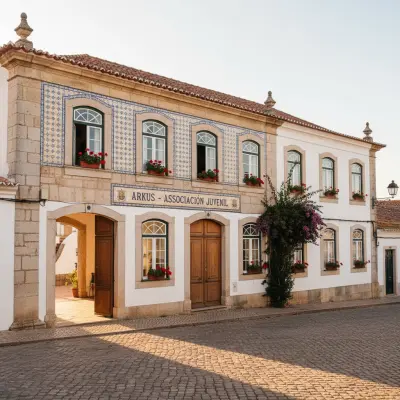
After dinner, if you want to extend the evening with fado in an intimate setting, Arkus Associação Juvenil hosts evenings with local fadistas and guests. You will not eat much there, it is more a cultural association than a restaurant, but it is a good second act for a night that started at the table.
Wines: what to order and what to avoid
Alentejo is the largest wine region in Portugal by volume and one of the most inconsistent in quality. The rule is simple: ask for wines from the Borba, Reguengos or Portalegre sub-regions, and avoid the big-brand reds that fill supermarket shelves, because they tend to be too heavy for regional cooking.
For açorda, a fresh Antão Vaz. For migas and black pork, a light red made from Aragonez or Castelão, with low tannin. For cheeses, as said: white, young, acidic. Wines from Portalegre, the northernmost and highest sub-region, are the most elegant in Alentejo and increasingly recognised. If you want to explore that region in more depth, it is worth combining the trip with a weekend in Portalegre without the tourist traps, or a day walking the neighbourhoods of Portalegre, or simply following the guide on where locals actually eat in Portalegre.
What NOT to do in Elvas
- Do not order bacalhau à Brás. It is on the menus, yes, but it is a Lisbon dish, not Alentejo, and in Elvas it tends to be a pale version of the original.
- Do not show up at 1pm sharp at a restaurant inside the walls without a reservation. The good ones fill up quickly on weekends.
- Do not order house wine in a bottle: order it by the jug. It is cheaper, comes from the same place, and nobody will judge you.
- Do not leave without buying plums to take home. They keep for weeks in the original packaging and they are the most local gift you can offer to whoever stayed behind.
When to go, what to spend
The best time for a food trip to Elvas is between October and December, when the pig slaughter happens, the plums are in season, and stews appear on menus. Avoid August: it is hot, many restaurants close for the holidays, and the city falls between empty and overrun by passing tourists.
For a serious lunch, plan on 25 to 40 euros per person, with wine. For a simple dinner at a tasca, 15 to 25 euros will do. For a comfortable night in the historic centre, hotels run between 80 and 150 euros per night in mid-season.
Eating in Elvas is not a checklist experience. It is a small city with a cuisine that has more depth than first appears, and that rewards anyone who sits down slowly and asks the waiter questions. The Wednesday lunchtime açorda can be better than any sophisticated Sunday plate. That is the point. Eat where the locals eat, order what is in season, and do not waste time chasing dishes that are better done elsewhere. In Elvas, what is in Elvas is what counts.