Covilhã: From Textile Ruins to World-Class Street Art
Covilhã is no longer just a gateway to the ski slopes. Today, its old textile factories serve as a canvas for the world's best street artists, from Bordalo II's trash animals to VHILS's chiseled faces. Discover how the WOOL festival breathed new life into the 'Portuguese Manchester.'
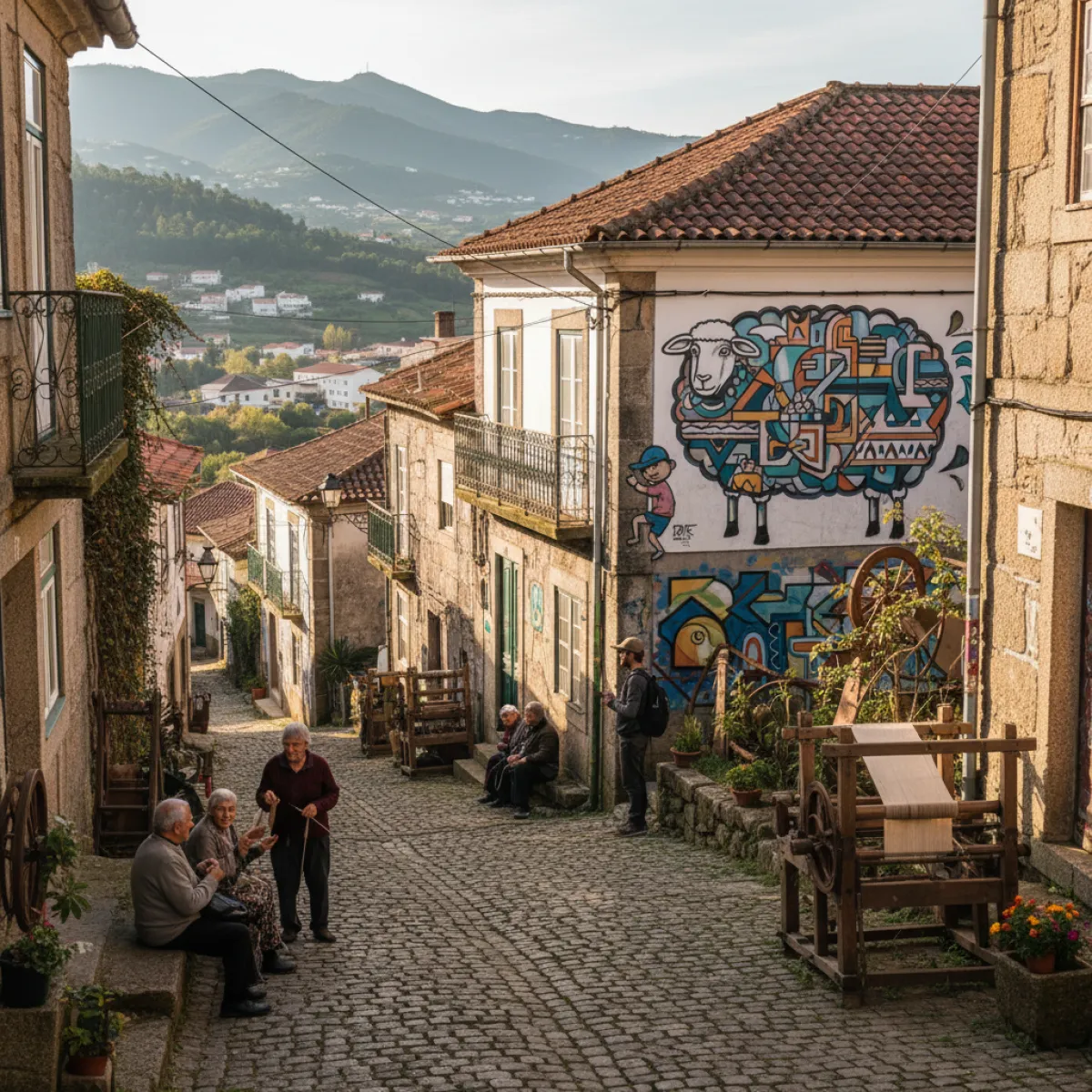
The Verticality of the Portuguese Manchester
Forget Serra da Estrela for a second. Yes, the snow is charming and the cheese is non-negotiable, but Covilhã is far more than a weekend dormitory for skiers. This is a city of vertiginous climbs, a granite amphitheater where buildings seem to balance on each other's shoulders. For decades, the sound defining these slopes wasn't the wind, but the rhythmic clatter of looms. The "Portuguese Manchester" lived by thread and wool, but when the factories shuttered, what remained were industrial skeletons and grey walls. Until the spray cans arrived.
The WOOL festival (Covilhã Art Festival), launched in 2011, wasn't just an attempt to decorate the town. It was an act of resuscitation. Today, walking through Covilhã is a visual treasure hunt that forces you to look up, down, and into alleys that most guidebooks ignore. This isn't amateur graffiti; we’re talking about names who exhibit in London and New York using Beira’s granite as their canvas.
The Essential Route: Where Wool Meets Ink
If you really want to understand what's happening here, I highly recommend the Wool and Walls: A Guided Tour of Covilhã's Industrial Heritage and Mural Art experience. It’s the best way to connect the dots between the labor-intensive past and the artistic present without getting hopelessly lost in the labyrinth of the historic center's stairways.
Start in the Ribeira da Goldra area. Here, the scale of the pieces is monumental. One of the absolute standouts is Bordalo II’s owl, crafted entirely from trash, discarded plastics, car bumpers, and hoses that gain a three-dimensional life on a wall that previously said nothing. It’s social criticism wrapped in color, right next to the streams where wool used to be washed.
As you climb toward the Historic Center, and prepare your legs, or use the public elevators if your pride allows, look for Rua Direita. This is where the contrast becomes most evident. Between sash windows and elderly locals peering through curtains, murals emerge, like Pantónio’s fluid creatures that seem to swim across the granite, or Tamara Alves’ delicate work, bringing an organic sensibility to this harsh landscape.
Pieces You Cannot Miss
- VHILS on Rua do Ranito: Alexandre Farto used his signature drilling technique to carve the face of a former textile worker. This piece isn't just on the wall; it’s carved into the very structure of the building.
- Add Fuel near Santa Maria Church: Diogo Machado reinterprets traditional Portuguese tiles with a contemporary illustration twist. From a distance, it looks like classic ceramic; up close, it reveals a world of modern geometric detail.
- Bordalo II: Beyond the owl, look for the wolf. Using industrial waste from the city itself to create these creatures is a piece of poetic irony that perfectly summarizes modern Covilhã.
Gastronomic Survival: The Pastel de Molho
Walking Covilhã builds an appetite, and frankly, if you come here and eat a chain burger, you are failing as a traveler. The local hero is the Pastel de Molho. Imagine a puff pastry filled with braised beef, which is then submerged in a broth of saffron, vinegar, and parsley. Is it weird? Maybe. Is it comforting? Absolutely. Head to A Tentadora in Praça do Município. It’s a historic café with wooden counters where time seems to have slowed down. Order a pastel and don’t ask about the calories; you’ll burn them all on the next climb to the castle.
For dinner, if you want something more robust, find Montiel. Order the kid (goat) or the roasted veal. The service is old-school, efficient and no-frills, and the local Beira Interior wine holds up well against the heavy dishes.
Logistics and Inclines
Covilhã is not a city for strollers or rolling suitcases. It’s a city for hiking boots and backpacks. The network of elevators (Elevador da Goldra, Elevador do Parque, and the Santo André Funicular) is free and essential for connecting the lower town to the upper town without reaching the top needing an oxygen tank.
If you’re driving, park in one of the lower lots and use your legs. If you arrive by train, the station is in the flat part of town, but prepare for the vertical shock as soon as you leave the platform. The best time to visit is between March and May or in October. In summer, the heat is dry and merciless; in winter, the fog can hide half the murals you came to see.
Beyond the City: Blossoms and Modernism
If you have a couple of extra days, Covilhã is the perfect base for exploring the surroundings. A few kilometers away, Fundão offers a different spectacle. If your visit coincides with spring, check our guide The Ephemeral Bloom: A Guide to Seeing Cherry Blossoms in Fundão. It’s a visual experience that rivals Covilhã’s street art, but in shades of white and pink.
For the architecture-obsessed, it’s worth crossing the mountain to Seia. Forget the bread museums for a second and focus on the built heritage. We have a guide on Modernism in the Mountains: The Architectural Legacy of Cottinelli Telmo in Seia that reveals a side of this region few tourists ever see: the influence of 20th-century aesthetic movements in the heart of the Beira mountains.
And if, after all that granite and elevation, you miss the sea, remember that Portugal is small. In a few hours, you can be at the coast, perhaps following the tips from our Surfing Portugal in March: The Best Beaches and Conditions. It’s the perfect contrast: from the spray of paint cans to the spray of Atlantic waves.
The Final Verdict
Covilhã is not a pretty city in the conventional, postcard-and-flower-boxes sense. It is raw, scarred by industry, and possesses a gravity-defying incline. But it is precisely this rawness that makes it the ideal stage for street art. The murals here aren’t cosmetic; they are dialogues with history. Come for the art, stay for the pastel de molho, and don’t forget to look back as you climb, the view over the Cova da Beira valley is the only mural that no artist has yet managed to top.
