Coimbra's Student Cafés: Where to Sit Like a Local
Café Santa Cruz occupies a Manueline chapel since 1923, Briosa has been selling arrufadas since 1955, and Penta on Rua da Sofia feeds half the Arts faculty. A guide to the cafés where Coimbra actually sits down, with what to order and when to go.
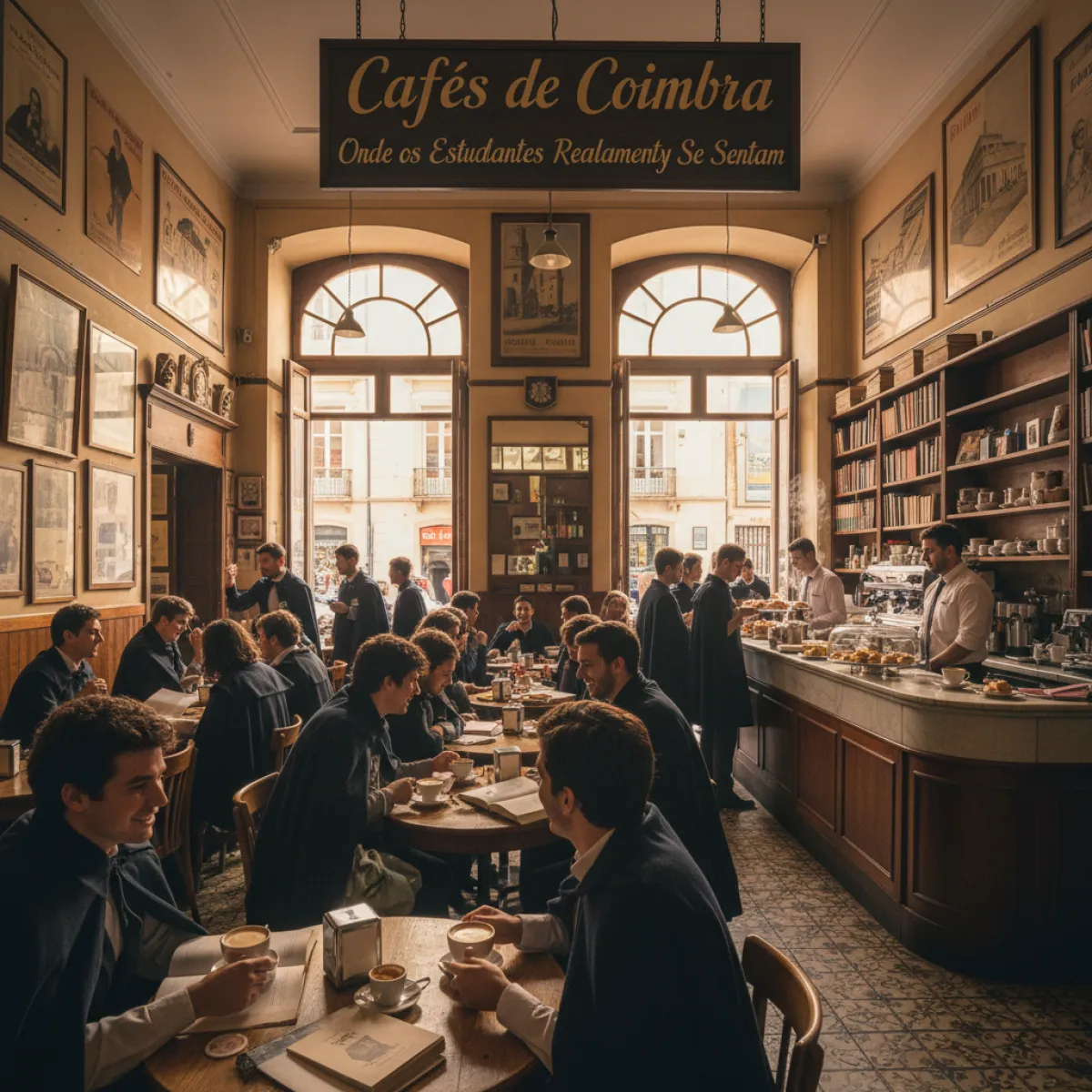
Here's something no travel guide properly explains about Coimbra: academic life in this city doesn't happen in classrooms. It happens in cafés. It's at the marble tables of Café Santa Cruz where theses get debated, serenades get rehearsed, and somebody decides who's buying the next round of espressos. It's at the counter of Pastelaria Briosa where you eat the arrufada that fuels another all-night study session. If you want to understand Coimbra, don't start at the University, start with the coffee cup in front of you.
Café Santa Cruz: The Church Where Coffee Is the Religion
Let's get the obvious one out of the way first: Café Santa Cruz is probably the most beautiful café in Portugal. That's not hyperbole. Opened in 1923, it occupies a former chapel attached to the Church of Santa Cruz in Praça 8 de Maio, and it still has the original Manueline vaulted ceilings, stained glass windows, and stone walls. Sitting here is sitting inside five hundred years of history, but with decent coffee and custard tarts in front of you.
That said, Santa Cruz today is more tourist destination than student hangout. The old guard of academics who spent afternoons here arguing about politics and poetry have largely been replaced by visitors with cameras. That doesn't mean it's not worth going, it absolutely is. But go in the morning, before ten, when the space still breathes and the tourists are at the hotel eating their buffet breakfast. Order a bica (espresso) and a pastel de Santa Clara, the signature crescent-shaped pastry filled with egg custard and almonds, born at the Santa Clara-a-Velha Monastery. If you're lucky, you'll catch a live Coimbra fado session, which happen regularly, and if fado sparks your curiosity, consider a night of fado at À Capella, another converted religious space with fewer crowds and more authenticity.
Pastelaria Briosa: The Queen of Arrufadas
If Santa Cruz is the café everyone photographs, Briosa is the pastry shop every local in Coimbra knows by name. Sitting at Largo da Portagem since 1955, this is where the city comes for serious convent pastry. The display case reads like a catalogue of what the region's convents invented over centuries: arrufadas de Coimbra, pastéis de Santa Clara, castanhas de ovos, suspiros.
The arrufada deserves its own paragraph. It looks like an unassuming sweet bread, but it's the most distinctly Coimbra thing you can eat, born at the Convent of Sant'Ana, once hawked by street sellers through the Baixa and at the Old Train Station. It's fluffy, buttery, lightly sweetened, and perfect at eight in the morning with a galão (milky coffee). It's not sophisticated, it's not photogenic, but it's honest. And Briosa makes some of the best in the city.
Practical tip: the space itself isn't large, and it fills up easily on weekends. Go on a weekday, order at the counter, and if possible take a box of mixed convent pastries for the road. It's the best souvenir you can bring from Coimbra, far better than a miniature of the University tower.
Pastelaria Penta: The Student Favourite on Rua da Sofia
Rua da Sofia is a UNESCO World Heritage street, and also one of the busiest arteries of daily student life in Coimbra. At numbers 65 and 67, Pastelaria Penta has held its ground for over thirty years, and it's the kind of place where you can tell immediately that everyone walking in already knows what they're ordering.
Penta doesn't have Manueline ceilings or stained glass. What it has is pastéis de Tentúgal that shatter at the touch, properly ridged queijadas, and bolas de Berlim (Portuguese doughnuts) that serve as emergency lunch for half the Arts faculty. The couple who runs the place has managed, over the years, to maintain traditional pastry quality without being stuck in the past, you'll find salmon toast and contemporary options alongside the convent recipes.
It's the café you go to without thinking, the one that's on the way between the bus stop and the lecture hall. In Coimbra, that's the highest compliment you can pay a pastry shop.
Rua Ferreira Borges and the Ghost of Brasileira
Any conversation about historic Coimbra cafés has to mention Rua Ferreira Borges, even if with a touch of nostalgia. This street, one of the prettiest in the Baixa, was for decades the nerve centre of Coimbra's café culture. Café Brasileira, opened in 1921, was a gathering point for writers, intellectuals and students with dangerous ideas, in the good sense. The original café space no longer operates as it once did, and the street has reinvented itself with new shops and venues, but the atmosphere of an urban promenade remains.
Walk down Ferreira Borges in the late afternoon and you'll feel the natural rhythm of Coimbra: students in their black capes heading to a rehearsal, women with shopping bags, the occasional lost tourist trying to find the Old Cathedral. This is where the commercial Baixa transitions into the climb up to the university quarter, and it's worth stopping at one of the cafés that now occupy the street, even if none have quite the aura of the old Brasileira.
Café Montanha: The Terrace by the River
At Largo da Portagem, right by the river, Café Montanha has been a fixture since 1988. It's not as old or monumental as Santa Cruz, but it has something no other historic café in Coimbra can offer: a sprawling terrace overlooking the Mondego River and the Santa Clara Bridge.
Montanha is more of an all-rounder, café, pastry shop, pizzeria, light meals, and that's exactly why it works as a student meeting point. At lunch, people order the house codfish or a steak. By late afternoon, the terrace fills with espressos and draught beer. It's the café for when you don't want ceremony, when the goal is simply to sit, watch the river, and let time do its thing.
After your coffee, consider the short walk to Miradouro do Vale do Inferno, which offers a completely different perspective of the city, green, quiet, and blissfully crowd-free.
What to Order: A Quick Guide to Coimbra's Convent Pastries
Coimbra's convent pastry tradition is one of the richest in Portugal, and it helps to know what you're eating:
- Arrufada de Coimbra: Sweet convent bread from the Convent of Sant'Ana. Simple, comforting, best in the morning.
- Pastel de Santa Clara: Crescent-shaped thin pastry filled with egg custard and almond. The city's most iconic sweet.
- Pastéis de Tentúgal: Paper-thin flaky pastry with egg filling. Originally from the nearby town of Tentúgal, sold across the region.
- Queijadas: Small pastry cakes with seven ridges, made with fresh cheese, egg yolks, milk and sugar. Some say the ones from Pereira are the best.
- Crúzios: Almond and egg petit fours, inspired by the Crúzio friars of the Santa Cruz Monastery.
Don't try to eat everything in one day. Spread it across your stay. Convent sugar is generous and the human body has limits.
Beyond the Café: What Else to Do in Coimbra
If the cafés show you a different side of Coimbra, lean into that energy. The Alta university quarter has been gaining new life thanks to the street art murals reshaping the Alta, worth walking up with your eyes on the walls rather than the pavement. For those planning a longer trip through central Portugal, our week-long itinerary through the heart of the country passes through Coimbra and other cities that deserve the same kind of slow exploration.
And if you want a day trip out of the city, the Condeixa area has surprises, including an olive oil tasting experience at Passeite that's as educational as it is delicious.
Practical Notes
The Baixa cafés are all within a ten-minute walk of each other, from Largo da Portagem to Praça 8 de Maio, through Rua Ferreira Borges and Rua da Sofia. It's a natural loop, and you can easily visit three or four in a single morning stroll.
An espresso runs €0.70 to €1.00 at most of these spots. Convent pastries vary but rarely top €2-3 each. A full breakfast at a historic Coimbra café, coffee, juice, pastry, comes to roughly €4-5, which, given the setting, feels almost absurdly cheap.
Most of these cafés open early, around 7:30-8:00am, and close in the late afternoon or early evening. Check locally for exact hours, which vary by season.
Coimbra is, above all, a city meant to be lived slowly. And there's no better place to practise that slowness than sitting in a café with centuries of conversation soaked into its walls.