Coimbra's Hidden Galleries and the Street Art Circuit
Between the Old Cathedral and the University, the walls of Coimbra's Alta tell stories the traditional guides miss. A practical route through the street art and independent galleries of a city quietly reinventing itself.
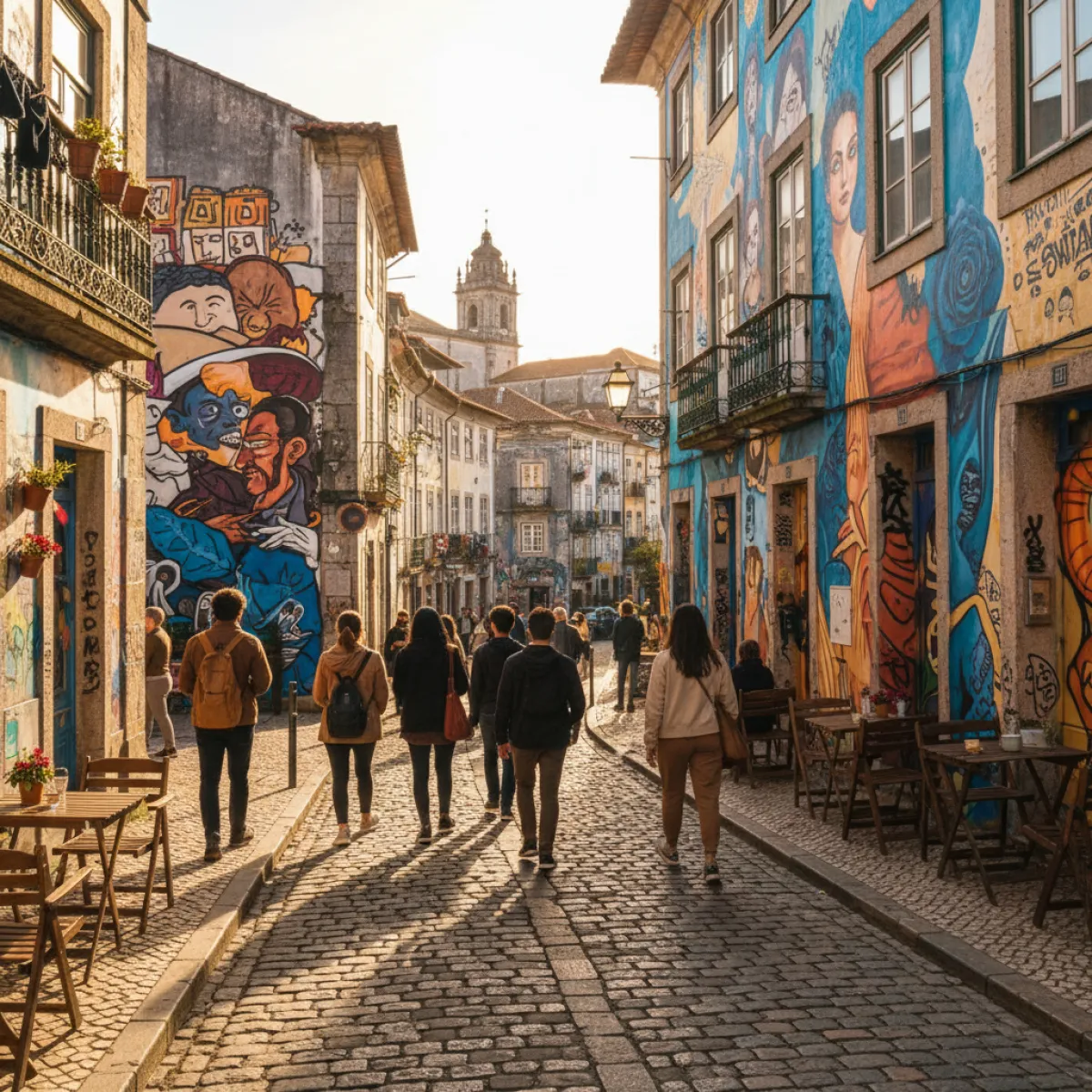
Coimbra doesn't advertise its art scene. For most visitors, it's the university city, the fado city, the city of black capes and academic traditions. And fair enough, those things are real and worth experiencing. But in the last decade, something else has been growing in the cracks of the old town: a street art and gallery scene that's quietly become one of the most interesting in central Portugal.
The Alta: Paint on Medieval Stone
If you've read our guide to the murals reshaping Coimbra's Alta, you already know the basics. But reading about it and walking through it are different things entirely. On a weekday morning, when the students are still in bed and the tourist buses haven't arrived, the Alta belongs to you and the art.
The concentration of murals between the Old Cathedral and the University happened for a reason. The Alta was in decline for years: abandoned houses, crumbling facades, an aging population. Artists moved into the void. Festivals like Cenas brought painters from Portugal and abroad to fill blank walls with enormous pieces. It wasn't beautification. It was cultural occupation of spaces the city had forgotten about.
Start at Largo da Sé Velha and walk uphill. Every turn reveals something new. Giant portraits staring down from three-storey walls. Abstract bursts of colour against limestone. The key is to take your time. Give it an hour or two. Get lost. The Alta rewards aimlessness.
Galleries That Don't Make the Tourist Maps
Street art is the visible layer, but Coimbra has a network of small galleries that operates almost under the radar. Don't expect white-cube spaces with velvet ropes. Here, galleries occupy ground floors of old buildings, basements with low ceilings, former grocery shops and workshops.
Sala da Nora on Rua Ferreira Borges is a reasonable starting point. It's a municipal exhibition space with free entry that regularly shows local artists worth seeing. It's in the lower town, steps from the Arco de Almedina, which makes it easy to combine with the mural circuit uphill.
Then there's the CAPC (Círculo de Artes Plásticas de Coimbra), arguably the city's most important art institution outside the university. Founded in 1958, it has an impressive exhibition history and a permanent collection that deserves attention. Its address alone tells you something about Coimbra: it's in the Pátio da Inquisição. Contemporary art in a space called the Inquisition Courtyard. You can't make this up.
For photography fans, the University of Coimbra's Science Museum occasionally stages exhibitions that cross art and science in surprising ways. Check locally for current shows and hours.
Rua Ferreira Borges and the Downtown Cultural Corridor
Coimbra's Baixa (lower town) has been visibly revitalising. Rua Ferreira Borges, connecting Largo da Portagem to the Arco de Almedina, has several contemporary craft and Portuguese design shops that function almost as micro-galleries. These aren't fridge-magnet shops. They sell author ceramics, prints by local artists, handmade textiles.
In Coimbra, books and art have always been intertwined. Browse the independent bookshops dotted along the lower streets. They're part of the same cultural ecosystem.
Beyond Paint: The Culture That Feeds the Scene
Street art doesn't exist in isolation. Coimbra has a cultural infrastructure that supports this scene, largely thanks to the university and the student population that guarantees both an audience and energy.
If you're here in the evening, try a night of fado at À Capella. This might seem out of place in a street art article, but hear me out. Coimbra's fado and its street art share the same impulse: the need to mark public space with something personal. And À Capella, set inside a 14th-century chapel, is itself a kind of gallery: music happening inside walls that have witnessed centuries.
After the fado, if you want a different perspective on the city, walk up to Miradouro do Vale do Inferno. From there you can see the Alta lit up at night, the murals disappearing into shadow, the university silhouetted against the sky. It's a good place to process everything you've seen.
Practical Itinerary: One Day of Art in Coimbra
Let me be direct. If you have one day and want to focus it on art, here's how:
- Morning (9am-noon): Start in the Alta. Walk up through the Arco de Almedina, follow Rua do Quebra Costas, explore the side streets up to the university. Have our murals guide on your phone. Breakfast on the way: any café on Rua Ferreira Borges will do a decent galão and a torrada mista for under €3.
- Lunch (12:30-2pm): Head down to the Baixa. The Largo da Portagem area has honest options. Look for a menu do dia (soup, main, coffee) for €8-10. If you want something more considered, try near the Pátio da Inquisição.
- Afternoon (2:30-5pm): Galleries. CAPC first, then walk down Rua Ferreira Borges and duck into every shop-gallery that catches your eye. If you have time, check Sala da Nora.
- Late afternoon (5-7pm): Go back up. The late afternoon light in the Alta is completely different from the morning. The same murals take on new depth. Finish at Miradouro do Vale do Inferno for sunset.
- Evening: Fado at À Capella. Non-negotiable.
Going Further
Coimbra works well as a base for the Centro region. If art and culture are your thing, the contrast between Coimbra's urban scene and the surrounding landscapes is striking.
Under an hour away, you can do an olive oil experience at Passeite in Condeixa, which is as artisanal and meticulous as any artwork you'll see in the city. It's creativity of a different kind: the sort that turns olives into a product that tells the story of the land.
If you're planning a longer trip through central Portugal, our week-long itinerary through the heart of the country includes Coimbra and gives you context for understanding how the city fits into the region. And for those who like mixing art with walking, there are interesting trails around Caldas da Rainha that prove Portuguese creativity isn't confined to cities.
What Makes Coimbra Different
I've seen street art in Lisbon (obviously), Porto (excellent), Loulé, Estarreja, Viseu. Coimbra's version has something the others don't: tension. There's a productive tension between the old city and the new art, between academic tradition and the irreverence of painted walls, between fado and graffiti. Neither side dominates. And it's that tension that makes Coimbra's circuit genuinely interesting, not just another collection of photogenic murals for Instagram.
Next time someone tells you Coimbra is just university and fado, tell them about the walls. They tell a different story.