Caminha at Dusk: Wine and Petiscos in Minho
In Caminha, the night starts at 6:30pm, when Spanish day-trippers head back to A Guarda and the town hands itself over to petiscos. A serious itinerary, from the first alvarinho to the last bagaço, without drama and with realistic prices.
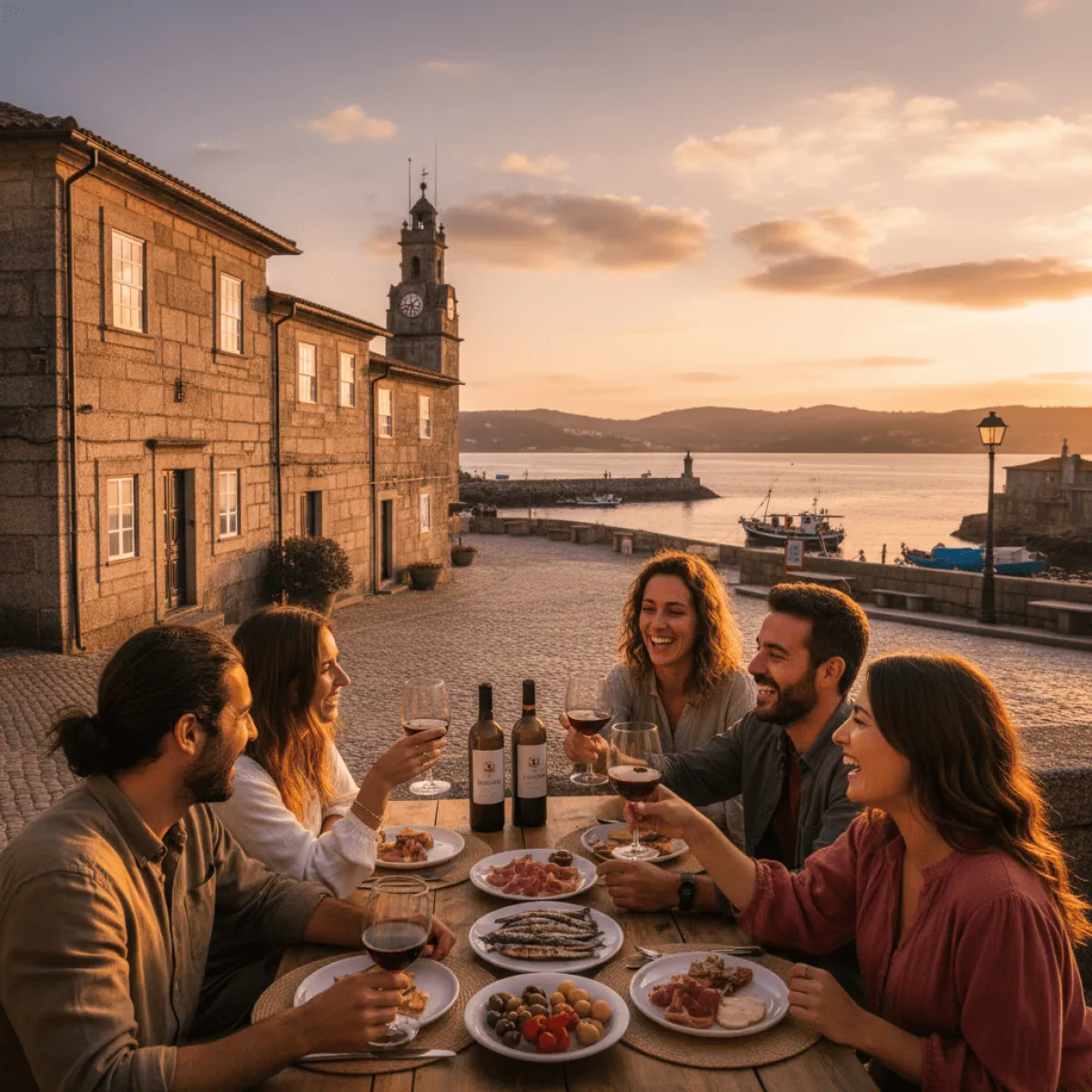
Caminha has a trick most Portuguese towns never quite master: it knows how to wait for sunset. During the day, Spanish day-trippers cross the ferry from A Guarda, buy bread on the main square, photograph the clock tower, and head back across the estuary. By 6:30pm the stage clears. That is when Caminha gets interesting for anyone serious about food.
This guide is for travellers who arrive in late afternoon with moderate hunger, real thirst, and the willingness to stay until the last glass of alvarinho. It is not a Michelin route, not a fado pilgrimage. It is a petiscos itinerary, and petiscos have their own rules: eat slowly, share everything, order more than you can finish, and never, under any circumstances, ask for the bill before the second espresso.
Before the first glass: the geography of appetite
Caminha sits between two rivers. The Minho separates it from Spain, the Coura empties out here before disappearing into the estuary. This double water defines the larder: lamprey in February and March, shad in spring, eel year-round, wild sea bass when the ocean cooperates. Add the cured meats from the inland Minho, the Castro Laboreiro cheeses from the mountains, the alvarinho green wine that here is taken seriously (we are 30 minutes from Monção, the world capital of the grape), and you have a terroir that justifies the trip just to eat dinner.
Before any culinary planning, sort out where you are sleeping. Drinking well in Caminha and then trying to drive back to Viana or Valença is bad maths. The town has honest, well-located accommodation: Litos AL Alojamento Local works for travellers who want to be in the historic centre, three minutes on foot from most places in this guide. For something cosier, Donna Nega Alojamento Local serves the kind of breakfast that rewards last night's excess. And if you are travelling solo or as a young couple on a tight budget, Arca Nova Guest House & Hostel solves the price-to-location equation without much drama.
When to come (and when not to)
From May to September, Caminha fills up, especially on weekends. In August, the Festa de Nossa Senhora d'Agonia floods the region with crowds and restaurants need bookings. The trick is midweek, off-peak, ideally April to June or September to October: the weather holds, the light is better, and the owners of the small taverns have time to talk. Many places close on Sunday nights. Monday is the general day off across the region. Check locally.
6:30pm: the aperitif that is not called an aperitif
The Portuguese do not really do aperitivo hour the Italian way. But in Caminha, with the light dropping over the estuary and fishermen pulling in nets, the impulse to order a cold glass of white with something to nibble is practically physiological. The rule: start light. You will need room for the rest of the night.
Young alvarinho is the obvious opening move. Look for producers from Monção and Melgaço, ask for a glass (rarely above 3 to 4 euros), and pair with whatever is on offer: regional ham, soft buttery cheese, a few decent olives. If the place has freshly fried codfish patties (pataniscas), order a small portion to share. If they have moelas, even better: chicken gizzards stewed in tomato sauce with cornbread for dipping is one of the great inventions of the Portuguese tavern, and the Minho takes them seriously.
Do not ask for the wine list with sommelier airs. Ask what the house white is, taste it, and if you like it carry on. If you do not, ask for another. Minho tavern owners respect people who know what they want more than people who pretend to know everything.
8:00pm: the serious petiscos table
This is where the night gets decided. The difference between a memorable food night in Caminha and a merely pleasant one is the order in which you ask for things and the courage to skip the main course. Petiscos are served centre-table, shared, and the game is to build a sequence that goes from light to intense without exhausting either palate or stomach.
What to order, in order of arrival
- Caldo verde. If you see homemade caldo verde (the powdered version is detectable), order a small bowl to start. It is the Minho's poor man's appetiser, but done properly, with finely shredded kale and a slice of dark chouriço, it is a statement of intent.
- Octopus, lagareiro or salad style. Octopus is a Minho constant. Cold in saladinha (with onion, parsley, vinegar and olive oil) is lighter. Lagareiro style, with smashed potatoes and bathed in olive oil from nearby hills, is half a main. Choose by appetite.
- Bacalhau à Brás or pataniscas. Do not leave the Minho without eating well-cooked salt cod. Pataniscas are more petisco, à Brás is more committed. One portion shared between two is plenty.
- Sarrabulho or rojões. If you want to get to the bone of Minho cooking, order arroz de sarrabulho or rojões à minhota. Not light food, but real food. In Caminha you find them in homemade versions in the older taverns.
- Lamprey (February and March). If you are here in season, and you like strong flavours, lamprey à bordalesa is an experience. It is not for everyone. Those who like it, like it forever.
What to drink with it
Alvarinho remains the safe bet. For richer dishes (rojões, sarrabulho), ask for a robust red green wine, or a lighter Douro red. Minho locals drink the red green wine cold, in clay mugs, and they are right to do so. Do not be alarmed if it arrives at the table in a ceramic jug: that is tradition, not a lack of class.
Average price for a petiscos dinner in Caminha, wine included, shared between two: 25 to 40 euros per person. In more touristy spots on the waterfront it can climb, in neighbourhood taverns it can drop below 20. Check locally, but the value-for-money equation here is among the best in the country.
10:30pm: the digestif and the second act
After dinner, there are two schools. The first is coffee and bagaço: short espresso, house grappa (warning, some of these are for the brave), idle talk on a terrace overlooking the Minho. The second is the walk: down to the riverfront, the sound of the water, the lights of A Guarda across the way, and back for one last cold beer in a bar with music kept low.
Homemade bagaço is a Minho institution. Ask if the house has its own aguardente. Many do, and they range from excellent to challenging. If you prefer something more conventional, a Beirão liqueur, a ginjinha, or a tawny Port closes the night with style.
The morning after: how to recover
A petiscos night demands a next day with a plan. The good news: Caminha is surrounded by antidotes to excess.
The best cure is the estuary. A morning kayaking the Minho estuary between Portugal and Spain sorts out in two hours what three coffees cannot. The water is calm, the landscape disorientating (being between two countries with no visible border has its charm), and the physical effort is compatible with someone who slept badly and ate too much.
If you would rather stay on land, the rest of the Minho offers obvious extensions. Barcelos sits 50 minutes by car and is worth a visit. If you come in May, our honest guide to the Festa das Cruzes in Barcelos covers one of the largest religious festivals in the north. If you travel with children, our honest family guide to Barcelos sorts a morning without drama. And for hunters of decent coffee, our café-by-café order guide for Barcelos shows where to drink coffee seriously, which in a country of mediocre tourist espressos is a public service.
Mistakes to avoid
- Do not eat too early. Before 7:30pm many kitchens are still warming up. Book for 8:00 or 8:30pm and use the earlier window for the aperitif.
- Do not order a main course in a petiscos dinner. It breaks the rhythm. Petiscos is petiscos: shared, in sequence.
- Do not refuse the house wine on principle. In many Minho taverns, the bulk white is the most honest product on the menu. Taste before pulling a face.
- Do not drive. Already said, worth repeating. Caminha is small, walk. If you must leave, there is a local taxi.
- Do not leave Caminha without trying lamprey (in season). It is controversial, heavy, divisive. It is also one of the oldest and most specific traditions of the river. If your nerve allows, try it.
The closing argument
Caminha is not Lisbon, nor Porto, nor even Viana do Castelo. It is a town of eight thousand people leaning on the border, with more history than monuments, more tradition than stars, and more good cooks than critics willing to recognise them. On a well-handled night, with the right wine, the right petiscos, and the patience to eat at the house's pace, you understand why so many Minhotos quietly insist that nowhere else in the country eats better than here.
They might be right. They might not. The honest way to find out is to come, sit down, ask for a glass of alvarinho, and let the night handle the rest.