Braga: Holy Week Between Incense and Meat-Filled Folar
Forget the chocolate bunnies; in Braga, Easter is lived between the smoke of kerosene torches and the aroma of meat-filled folar. Discover how the city transforms into a medieval theater where the sacred and the profane share the same table.
The Sacred Theater of Braga
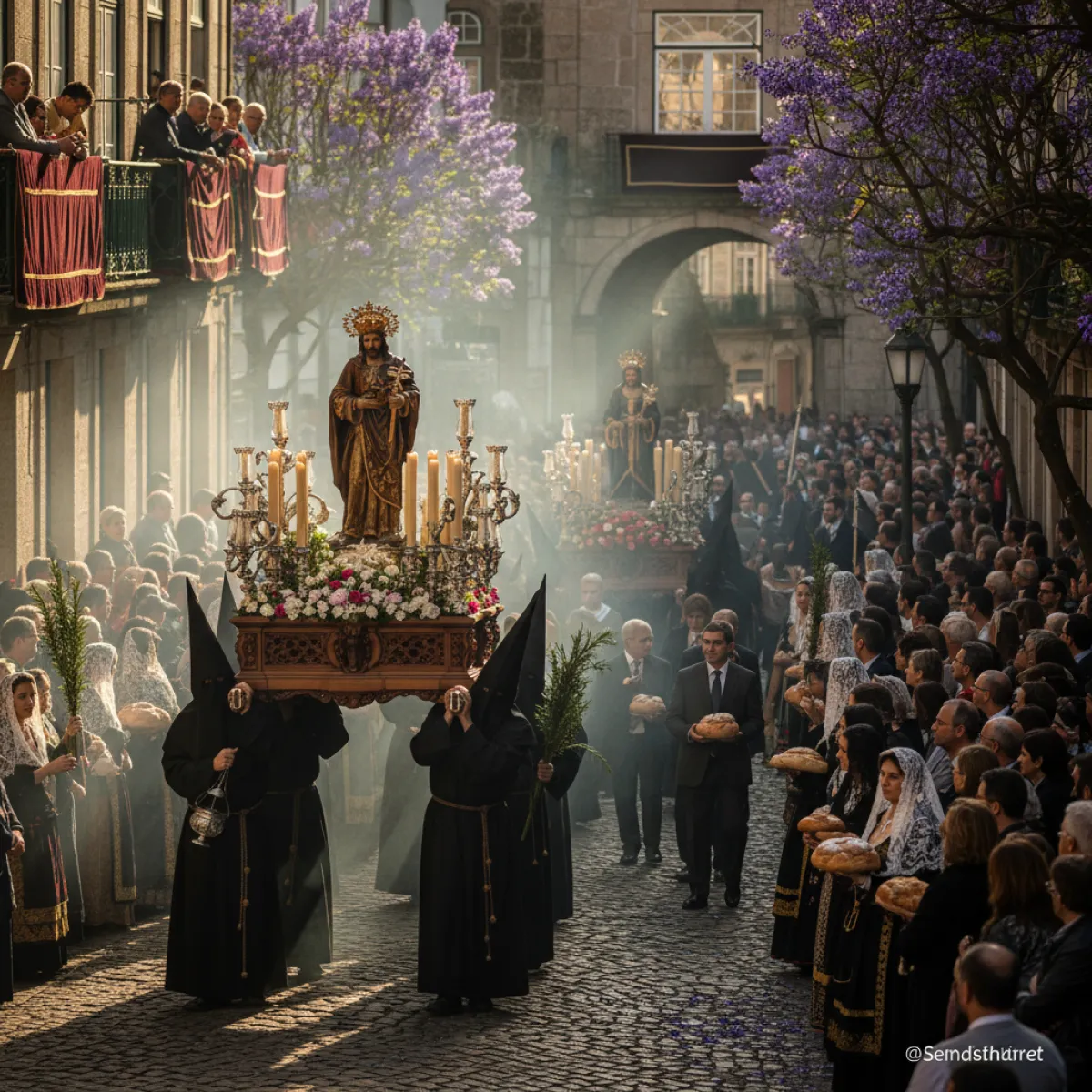
Forget the idea of a sanitized Easter filled with chocolate bunnies and pastel-colored eggs. In Braga, Holy Week (Semana Santa) is a visceral affair. It is a collective performance that occupies the streets with an intensity that few cities in Europe can still muster. It’s not just about religion; it’s about identity, medieval street theater, and, above all, a celebration of survival. If you want to understand what drives Northern Portugal, you have to be here when the city lights go out to make way for the Farricocos.
Many arrive here from Porto, making it one of the Best Day Trips from Porto, but the truth is that Braga demands more than an afternoon. To feel the weight of tradition, you need to watch night fall on Rua do Souto. Here, the contrast is stark: on one side, modern fashion window displays; on the other, barefoot men hooded in black tunics with ropes tied around their waists, carrying 'matracas'. The sound of these wooden rattles, a dry, rhythmic snap that replaces bells as a sign of mourning, is the real sound of Lent in Braga. It’s unsettling, slightly haunting, and utterly fascinating.
The Farricocos and Maundy Thursday
The Ecce Homo Procession is the zenith of the week. The Farricocos, heirs to the ancient public penitents who were pardoned on this night, roam the city carrying 'fogaréus' (torches). There is a rawness to this that mass tourism hasn't managed to domesticate. The scent is a cocktail of melted wax, church incense, and the kerosene smoke from the torches. If you plan to witness this, get there early. The narrow streets of the historic center become impassable. My advice: skip the paid grandstands. The experience is far more powerful at ground level, leaning against a granite wall, feeling the vibration of heavy footsteps on the cobblestones.
Braga is often lazily described as the 'Portuguese Rome.' As we detail in A Guide to Braga: Portugal's Quietly Radical Northern City, the city has a much younger and more irreverent energy than its two hundred altars suggest. During Holy Week, this duality explodes. The churches are open and decorated with a Baroque luxury that borders on the excessive, yet the bars around the Cathedral (Sé) are packed with people drinking cold 'imperiais' and eating 'petiscos.' This coexistence of the sacred and the profane is what makes Easter in Braga genuine.
Folar de Carne: The Antidote to Fasting
After days of (theoretical) abstinence comes the reward. In the North, folar is not the sweet cake with a hard-boiled egg on top that you find in Lisbon. In Braga, folar is all about the meat. It’s a rich, buttery dough packed with salpicão (cured pork loin sausage), presunto (cured ham), chouriço, and sometimes chunks of pork loin. The fat from the meats seeps into the dough during baking, creating something that is as much a full meal as it is a bread.
Don't buy your folar in a supermarket. Head to the traditional bakeries near the Arco da Porta Nova or the streets leading off Praça da República. The quality test is simple: the bread should be heavy, and when cut, it should release that unmistakable aroma of cured meats and woodfire. A decent one-kilo specimen costs about 15 to 20 euros, and it is worth every cent. It is the ultimate comfort food after long vigils in the drafty churches.
Easter Sunday: The Compasso and the Kissing of the Cross
If you find yourself in Braga on Easter Sunday, prepare for the 'Compasso.' Groups of the faithful emerge from the churches with an ornate cross, accompanied by the sound of bells and small fireworks, visiting homes that have flower petals scattered at their doorstep. It’s a tradition that feels like a scene from a neorealist film. The priest enters the house, blesses the family, and everyone kisses the cross. In exchange, a lavish table awaits: Port wine, sponge cake (pão-de-ló), almonds, and, of course, the folar.
To an outsider, it might seem invasive, but it’s a neighborhood ritual. If you see an open door with flower carpets on the sidewalk, know that the social heart of Easter is beating right there. Sunday lunch is almost invariably roast kid (cabrito) cooked in a wood-fired oven, served with roasted potatoes and 'arroz de miúdos' (giblet rice). Restaurants in the Nogueiró area or near Bom Jesus serve excellent versions, but booking weeks in advance is mandatory.
Escaping the Crowds: Picoto and Guimarães
When the density of the processions becomes too much, there are ways to catch your breath. A climb to the Miradouro do Monte do Picoto offers the best perspective over the city. From there, the historic center looks like a chessboard of red roofs and church towers. It’s the ideal spot to grasp the scale of the 'Archbishop’s city' without being trampled by a tour group or a seven-foot-tall religious float.
If you have an extra day, hop on a train or bus to the neighboring city. A Guide to Guimarães: The City Where Portugal Learned to Be Itself explains why this town is the perfect complement. While Braga is about faith and Baroque spectacle, Guimarães is about the foundation and medieval rigor. They are only 25 minutes apart, but they feel like different worlds.
Practical Tips for Holy Week
- Transport: The urban train from Porto-São Bento to Braga is your best bet. Braga station is a 10-minute walk from the Cathedral. Avoid driving; parking in the center is a logistical nightmare during these days.
- Timing: The main processions happen at night (usually starting at 9:30 PM or 10:00 PM). Check the official 'Comissão da Semana Santa de Braga' program, published weeks in advance.
- Clothing: March and April nights in the North can be treacherous. The granite of the churches holds the damp cold. Bring layers and, most importantly, comfortable shoes for the uneven cobblestones.
- Must-try sweets: Beyond the folar, look for 'Tíbias de Braga', an eclair-like pastry filled with sweet cream, and 'Fidalguinhos,' cinnamon biscuits shaped like crossed legs (a centuries-old jab at the 'lazy' nobility).
Easter in Braga isn't for those seeking a silent, isolated spiritual retreat. It’s for those who want to see tradition lived out loud, with the sweat of the float-bearers, the clatter of the matracas, and the intense flavor of cured pork in warm bread. It is raw, it is noisy, and it is undoubtedly the most authentic experience you can have in Northern Portugal at this time of year.