A Guide to Guimarães: The City Where Portugal Learned to Be Itself
Guimarães takes its founding mythology seriously without behaving like a museum. A practical, opinionated guide to the city where Portugal was born, from the castle to the roast kid, by way of contemporary art and the Minho's best tables.
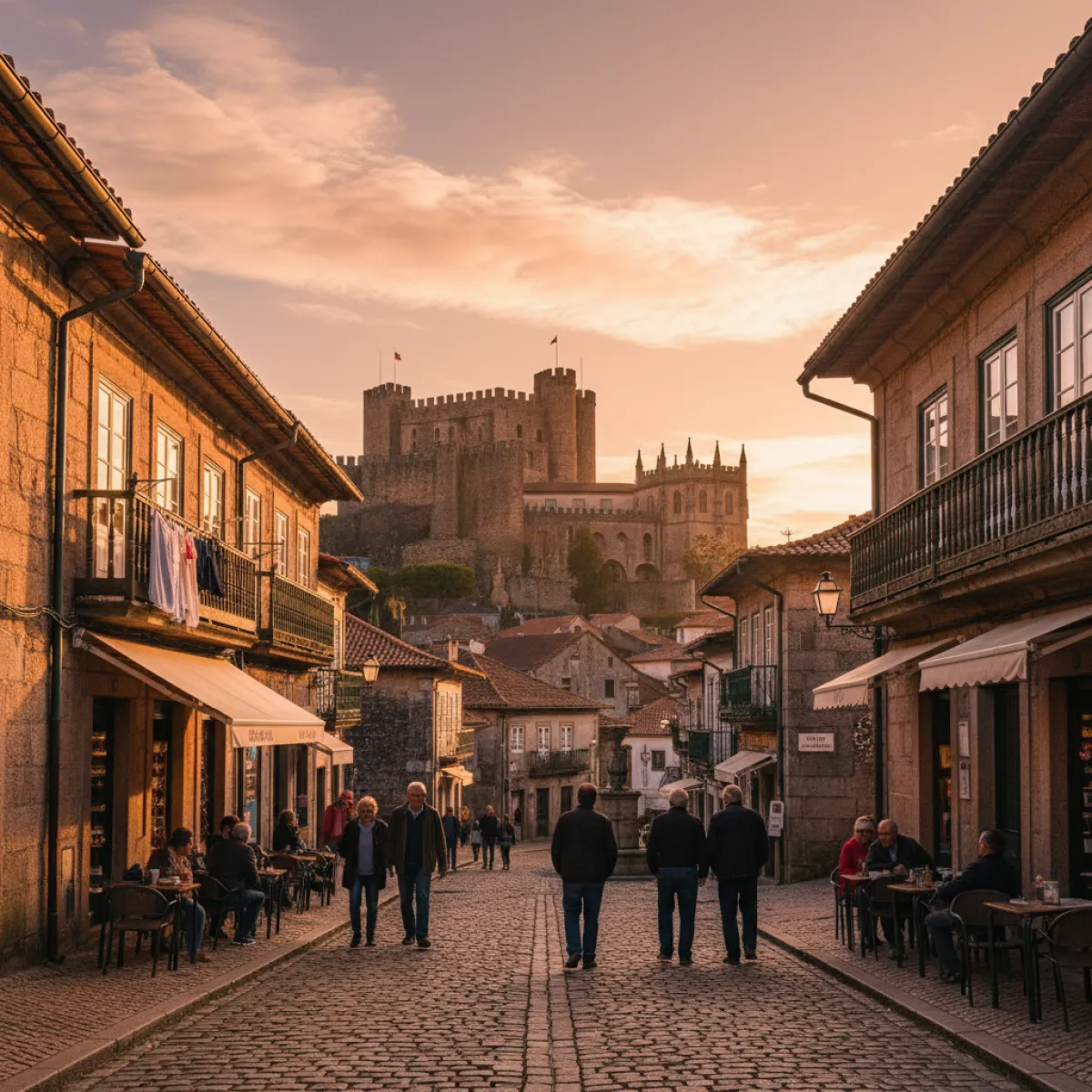
A city that wears its history lightly
The walls of Guimarães castle bear an inscription: "Aqui nasceu Portugal", Portugal was born here. It's the kind of claim that could sound like municipal boosterism, except it happens to be true. This is where Afonso Henriques, the first King of Portugal, was born in the twelfth century, and from where he launched the campaigns that would establish an independent kingdom on the western edge of Iberia. But Guimarães doesn't trade on its founding myth alone. It's a working city of 55,000 people that has spent the past two decades quietly building a case for itself as one of northern Portugal's most compelling destinations.
Less than an hour from Porto, and one of the best day trips from the city, Guimarães rewards those who stay longer than a few hours. Give it two days. Three if you eat slowly and walk everywhere.
The historic centre: granite, iron, and lived-in beauty
Guimarães' historic centre has been a UNESCO World Heritage Site since 2001, but it doesn't feel preserved in amber. People live here. Laundry hangs from medieval balconies, children run through Largo da Oliveira, retirees read newspapers over espresso in Praça de Santiago. The stone is granite, the building material of the Minho, and it gives the city a sober, handsome quality that photographs well in any light.
Start at Largo da Oliveira, the old town's principal square. The olive tree that gives it its name was planted, legend has it, in the fourteenth century as evidence of a miracle. It's still there, sheltered by a Gothic canopy. Around the square, granite buildings with wrought-iron balconies create an ensemble that feels both monumental and domestic.
The Church of Nossa Senhora da Oliveira anchors the north side. The adjoining cloister houses the Museu Alberto Sampaio, one of northern Portugal's most underrated museums. Its collection of medieval sacred silverwork is exceptional, look for the gilded silver triptych that João I reportedly donated after the Battle of Aljubarrota in 1385. Admission: €3. Closed Mondays.
From there, walk up Rua de Santa Maria, the oldest street in Guimarães, laid out in the twelfth century to connect the convent to the castle. The stone archways spanning the street, the carved coats of arms, the Manueline windows appearing unexpectedly, none of this was prettified for tourists. It was restored to keep functioning.
The castle and the Palace of the Dukes
Guimarães Castle was built in the tenth century on the orders of Countess Mumadona Dias. Whether Afonso Henriques was actually born within its walls is a matter of scholarly debate, but the symbolic importance is undeniable. The keep is imposing, the ramparts are in excellent condition, and the view from the top repays the climb. Admission: €2.
Next door, the Palace of the Dukes of Braganza is a fifteenth-century building that looks like a Burgundian château dropped into the Minho. Its steep roofs and cylindrical chimneys are unique in Portugal. The interior was controversially restored under the Salazar regime, the dictator used it as his northern residence, but the Pastrana tapestries and chestnut ceilings are genuinely impressive. Admission: €5. Allow an hour.
Practical note
A combined ticket for the castle and palace costs €6. Arrive before 10am to beat the coach tours. Sunday mornings offer free entry for EU residents.
Contemporary Guimarães: culture capital afterglow
Guimarães' stint as European Capital of Culture in 2012 left permanent infrastructure. The most visible legacy is the Platform of Arts and Creativity, a concrete-and-steel building by Pitagoras Architects that occupies the former municipal market. Inside: contemporary art exhibitions, a design centre, co-working space. Outside: a skin of multicoloured tiles designed by different artists, declaring that this city looks forward as much as back.
The José de Guimarães International Arts Centre (CIAJG), in Largo da Misericórdia, is another 2012 legacy. Dedicated to the work of visual artist José de Guimarães, a native son who spent decades working in Africa and Asia, it occupies a building that pairs a medieval façade with contemporary interiors. The African and pre-Columbian art collections are unexpected and rewarding. Admission: €3.
For industrial heritage enthusiasts, the old tanneries in the Zona de Couros have been converted into a creative campus for the University of Minho. The conversion preserved the tanning vats and brick chimneys, creating a compelling dialogue between industrial heritage and innovation. Free to visit.
Penha: the green escape
Monte da Penha rises to the southeast of the centre and serves as the city's green lung. You can take the cable car, an eight-minute ride with panoramic views over the city and the Ave valley, or drive. At the top: the Sanctuary of Penha, a 1930s Art Deco basilica more interesting for its architectural oddity than its devotional purpose. There are also caves, viewpoints, walking trails through granite boulders, and a campsite.
The cable car costs €7.50 return and runs from 10am to 7pm (reduced hours in winter). Bring a jacket, the Minho wind bites up there.
Where to eat: Minho cooking, taken seriously
The food in Guimarães is Minho food at its most honest. Don't expect reinvention or fine-dining plating, expect impeccable raw materials, generous portions, and an almost religious respect for tradition.
Lunch
- Restaurante São Gião, On the outskirts, in Moreira de Cónegos. The reference address for cabrito assado (roast kid), the totemic dish of the Minho. Order the kid with oven rice and don't improvise. Budget: €18-25 per person.
- Cor de Tangerina, In the historic centre, on Rua de Santa Maria. Market-driven cooking with contemporary inflections, in a small and pleasant space. The menu changes frequently, which is a good sign. Book ahead. Budget: €15-22 per person.
- Buxa, A modern tasca in Largo do Serralho, with well-executed petiscos and a notable selection of vinho verde. Good for a lighter lunch. Order the rojões with papas de sarrabulho. Budget: €12-18 per person.
Dinner
- A Cozinha, The most ambitious restaurant in Guimarães, with a Michelin star. Chef António Loureiro works with local producers and builds tasting menus that reinterpret Minho cooking without betraying it. Tasting menu from €75. Essential to book weeks ahead.
- Histórico by Papaboa, On Largo da Oliveira, with one of the city's best terraces. Confit cod, octopus à lagareiro, duck rice, the classics, done right. Budget: €20-30 per person.
Coffee and sweets
Pastelaria Clarinha on Rua Gil Vicente is an institution. The tortas de Guimarães, a convent sweet of almond and egg rolled in puff pastry, are among the city's best. Order one with a coffee and watch the street. The toucinho do céu, another convent classic, also deserves your attention.
Where to stay
Guimarães doesn't have an oversupply of quality hotels, which makes booking ahead important, especially in high season (June to September) and during the Festas Nicolinas (first week of December).
- Pousada Mosteiro de Guimarães, Set in the former twelfth-century Monastery of Santa Marinha da Costa, with gardens, a cloister, and views over the city. One of Portugal's most beautiful pousadas. Rooms from €120/night.
- Hotel da Oliveira, In the heart of the historic centre, on Largo da Oliveira. Small, well-located, contemporary décor. From €80/night.
- Santa Luzia ArtHotel, A boutique hotel on Praça de São Tiago with design interiors and a perfect location. From €90/night.
Practical information
Getting there
By train: the Porto urban line runs direct services from São Bento or Campanhã to Guimarães, taking about 1 hour 15 minutes. Ticket: approximately €3.25. Trains run hourly, with higher frequency at peak times.
By car: via the A3 then A7, it's about 50 minutes from Porto. Parking in the centre is difficult, but there are underground car parks near Largo do Toural (€1/hour).
When to go
Spring (April to June) is ideal: mild temperatures, gardens in bloom, few tourists. Summer can be hot, Guimarães lacks Porto's Atlantic breeze. Autumn has its merits, particularly for walking on Penha. Winter is cold and damp, but the Festas Nicolinas in December are singular: centuries-old student traditions involving processions, drums, and a collective energy found nowhere else in Portugal.
How long to stay
One day covers the essentials, castle, historic centre, lunch. Two days let you explore Penha, the museums, and have a proper dinner. Three days are ideal if you want to combine Guimarães with Braga, the Minho's other great city, just 25 minutes away by train and a fascinating counterpoint.
Daily budget
For two: accommodation (€80-120), meals (€50-70), admissions and transport (€15-20). Total: €145-210 per day for a couple, without excessive luxury but without cutting corners on pleasure.
What Guimarães is not
Guimarães is not a monumental city in the way Lisbon or Porto are monumental. It doesn't have the scale, the cultural diversity, or the nightlife. What it has is a rare coherence, between history and the present, between granite and concrete, between tradition at the table and innovation in culture. It's a city that knows what it is and doesn't try to be something else. In a country where so many cities are remaking themselves to please outsiders, that self-assurance is worth the train ticket.
Go to Guimarães not to see where Portugal was born, but to understand why this corner of the Minho keeps producing people, food, and ideas that matter.
