Arcos de Valdevez: Granaries, Medieval Bridges and Stone Villages
Twenty-four granite granaries on a communal threshing floor, a 13th-century Romanesque bridge that once bore the weight of retreating armies, and the terraced hillsides of Sistelo that earned a Wonders of Portugal title. Arcos de Valdevez is the Alto Minho unfiltered, but you have to want to get there.
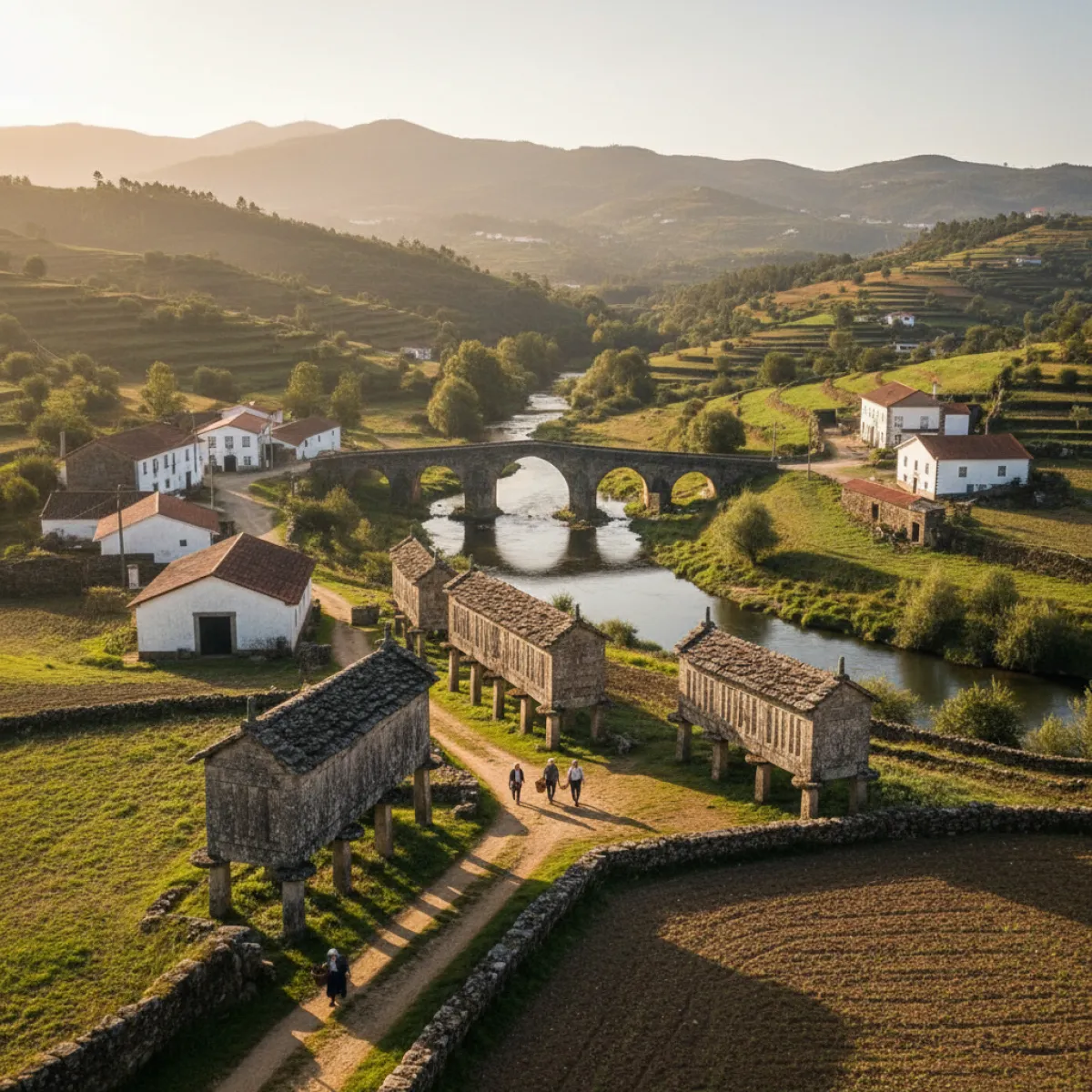
Arcos de Valdevez is not the kind of place you stumble into. It's far enough from everything that you have to actually want to go there, and that, precisely, is what makes it so good. We're in the Alto Minho, deep in the Peneda-Gerês National Park, in a municipality that sprawls across valleys, mountain ranges, and villages where granite is still a building material, not a museum piece.
Come looking for espigueiros (stone granaries), medieval bridges, and terraced hillsides, and you'll leave with much more than you bargained for. This isn't a tick-box itinerary, it's a territory for walking slowly, eating well, and understanding how people lived (and still live) in Portugal's deep North.
The Town Centre: Your Starting Point
The town of Arcos de Valdevez sits on the river Vez, with a compact and pleasant historic centre. Largo da Lapa, by the river, is the natural place to begin any visit. Wednesday mornings bring the weekly market, fruit, vegetables, cheese, honey, cured meats, with vendors who've been there for decades and have zero patience for haggling.
The bridge over the Vez, built between 1876 and 1880, replaced an earlier medieval one. It's not the most photogenic bridge in the municipality, that distinction goes to Vilela, but it orients you. On one side, the commercial centre. On the other, the riverside promenade where locals walk in the late afternoon when the heat fades.
Before leaving town, visit the Paço de Giela. A National Monument since 1910, it combines a 14th-century medieval tower with a 16th-century Manueline residential wing. The municipality invested €1.2 million in its restoration, and today it houses a museum on three floors: municipal archaeology, the monument's own history, and a section on the Recontro de Valdevez, a medieval episode that's a source of fierce local pride. Admission is affordable and it's easily worth an hour of your time.
Ponte de Vilela: The Finest Medieval Bridge
About 10 km from town, the Ponte de Vilela has been a Property of Public Interest since 1990 and is, to my mind, the most beautiful bridge in the municipality. It connects the parishes of Vilela and Aboim and retains its original Romanesque structure: two unequal arches, access ramps, and prismatic cutwaters that slice through the river current.
It appears in the Royal Inquiries of 1258, placing it at least in the first half of the 13th century. In the 17th century, during the Restoration War, the Spanish army retreated across this very bridge, proof it could take the weight of heavy infantry. Today it handles photographers and hikers, which is more peaceful.
The best time to visit is early morning, when low light enters the valley and catches the granite. There's no ticket office, no café nearby, nothing at all, and that's exactly the point. Bring water and a snack.
Espigueiros do Soajo: Guardians of the Corn
If one image defines Arcos de Valdevez in the collective imagination, it's the espigueiros of Soajo. And rightly so. This is a group of 24 granite granaries perched on a rock outcrop that serves as a communal threshing floor. The oldest dates to 1782. The ensemble has been a Property of Public Interest since 1983.
Built to store corn, protecting it from rodents and moisture, the espigueiros are ingenious pieces of rural engineering. Raised off the ground on stone mushroom-shaped supports, with lateral slits for ventilation and crosses on top reflecting the community's deep religiosity. Some are still in use, which is remarkable.
Soajo sits within the Peneda-Gerês National Park. The access road winds but is well-maintained. There's parking by the threshing floor. The village itself deserves a wander, granite houses, a tavern or two serving honest, simple food, and a quiet that city dwellers pay good money to find at wellness retreats.
A note: Lindoso, technically in the neighbouring municipality of Ponte da Barca but very close, holds the largest collection of espigueiros in the Iberian Peninsula, over 50, next to its castle. If you've come to Soajo, extending to Lindoso adds less than half an hour of driving and is absolutely worth the detour.
Sistelo: The Terraces and the "Little Tibet"
Sistelo won the title of one of Portugal's 7 Wonders in the Rural Villages category, and the socalcos, agricultural terraces carved into the mountainside over centuries, are the reason. Seen from the Miradouro dos Socalcos viewpoint, they look like green stairways cut by a giant hand. It's one of those places that genuinely earns the breathtaking label.
But Sistelo isn't just scenery. The village has a handsome parish church, the Largo do Cruzeiro square, and the Casa do Castelo, a small palace with two towers that catches your eye on arrival. In recent years, the Passadiços do Sistelo (wooden walkways) follow the Vez River through dense vegetation, offering an accessible walk of about 7 km (moderate difficulty). For something more demanding, the Trilho das Brandas de Sistelo (8.5 km) climbs to the brandas, seasonal high-altitude pastures, and rewards with extraordinary landscapes.
The Interpretive Centre for Sistelo's Cultural Landscape contextualises everything: the history, the agriculture, the people. I'd recommend visiting it before hitting the trails, it adds another dimension to what you see.
Practical tip: arrive early. Sistelo has become popular, and parking is limited. On summer weekends after 10am, expect to wait.
What to Eat and Drink
This is cabrito (kid goat) country, home to vitela barrosã beef and vinho verde wine. Slow-roasted cabrito is the flagship dish, when done right, the meat falls apart and the offal-based sauce that comes with it is a masterclass in flavour. Arroz de lampreia (lamprey rice) appears in season (January to April) and divides opinion, but those who love it really love it.
The vinho verde from the Lima and Vez sub-region is different from what you'll find further south, often more mineral, drier, with a bright acidity that cuts through the richness of cabrito like a knife through butter. Ask for alvarinho or loureiro from the area; don't accept the generic unlabelled bottle that some restaurants try to push.
Broa (corn bread) is still baked in many villages. When you catch a fresh one, torn by hand with a slice of goat cheese and a drizzle of honey, you understand why the simple things are the best.
How Arcos de Valdevez Fits Into a Wider Trip
Arcos de Valdevez works well as a base for exploring the Alto Minho over 2 to 3 days. You can easily combine it with Ponte de Lima, Portugal's oldest town and the starting point for horseback riding along the Lima River, a wonderful way to experience the landscape differently.
If you extend the trip to Barcelos, there's plenty to fill a day: from figuring out which museums are actually worth your time to tracking down the best coffee in town. Travelling with kids? Our honest Barcelos family guide tells you exactly what works and what's a waste of time.
By car, Arcos de Valdevez is about an hour from Viana do Castelo and ninety minutes from Braga or Porto. The A3 and A27 are the quickest routes. There's no train, you really need a car, preferably one that doesn't complain on mountain roads.
Practical Tips
- Best time to visit: May-June and September-October. Intense greens, pleasant temperatures, fewer crowds. July and August are hot in the valley and crowded on the trails.
- Footwear: Trail shoes or boots. Granite cobbles are slippery when wet, and the Sistelo trails demand grip.
- Fuel: Fill up before heading to mountain villages. There are no petrol stations in Soajo or Sistelo.
- Cash: Bring it. In the more remote villages, ATMs are an urban concept and many taverns are cash-only.
- Timing: Reserve a full day for Soajo + Lindoso and another for Sistelo. Trying to do everything in one day is possible but robs you of the pleasure of actually being there.
The Verdict
Arcos de Valdevez is the kind of municipality that rewards curiosity. There are no big spectacles, no expensive-ticket attractions with queues at the door. What there is: a territory where granite, water, and human labour have created a landscape and architecture that endure without needing to be preserved under glass for tourists.
Come with time, come hungry, and come ready for roads that climb. Arcos de Valdevez handles the rest.
