Angra do Heroísmo: A Local's Guide to the Festival Calendar
Angra do Heroísmo's festival calendar goes far beyond the Sanjoaninas. From February's unique theatrical Carnival to the Holy Ghost Festivals with their 58 painted chapels to October's AngraJazz, here's what's worth your time and when to go.
Here's what most travel guides get wrong about Terceira: they mention the Sanjoaninas, maybe throw in a line about bullfighting, and leave it at that. As if the island runs on a single ten-day festival in June and sleeps through the other 355 days. The truth is that Angra do Heroísmo has one of the densest, most layered festival calendars in Portugal, possibly in all of Southern Europe. You could show up in any month and stumble into something worth seeing.
Let me walk you through it, month by month, with honest opinions about what's actually worth your time.
February: Carnival, But Not the One You're Thinking Of
Forget everything you know about Carnival. On Terceira, there are no samba floats, no Rio-style parades. What you get instead are the Danças, Bailinhos and Comédias: groups of locals who rehearse for months to perform satirical musical theater pieces. We're talking over 50 groups, more than 1,250 people on stage, and over a thousand performances during the four days before Ash Wednesday.
The main venue is the Teatro Angrense in downtown Angra, but groups travel to halls across the island. The bailinhos are political and social satire set to music, imagine a Portuguese variety show written and performed by your neighbors, fishermen, and school teachers. The tradition was recognized as Intangible Cultural Heritage by Portugal's General Directorate of Cultural Heritage, and it's arguably one of the largest popular theater events in the world. Almost nobody outside the Azores knows it exists.
My advice: go to the Teatro Angrense on a Carnival afternoon. Sessions typically start at 4pm. You don't need to understand every word, the rhythm, the irony, and the energy of the room tell you everything.
Spring: The Holy Ghost Festivals
This is the beating core of Terceira's identity. The Festas do Divino Espírito Santo are a tradition dating back to the island's earliest settlers, linked to Franciscan mysticism and Queen Saint Elizabeth of Portugal. They run on the seven Sundays after Easter, which typically means April through late May or early June.
Terceira has 58 Impérios, those brightly painted chapels with distinctive popular architecture that you'll see in every parish. Each Império organizes its own festival, led by a yearly steward called the mordomo. The highlight is the communal distribution of food: sopas do Espírito Santo (bread soaked in spiced meat broth) and massa sovada (sweet bread). The tradition is fundamentally about charity and sharing.
From a food perspective, this is one of the best times to be on Terceira. The sopas do Espírito Santo aren't available in any restaurant, only at the festivals. If you want to go deeper into Terceira's food culture, pair this with a traditional alcatra cooking class, covering the island's other signature dish, slow-cooked for hours in a clay pot.
Practical tip: don't try to plan this precisely. Show up in any Terceira parish on a Holy Ghost Sunday and you'll find a celebration. Ask any local which Império is celebrating next, everyone knows.
May to October: Touradas à Corda
If there's one tradition that divides opinion, it's this one. Rope bullfighting runs from May 1st to October 15th and is one of Terceira's oldest traditions, the first recorded event dates to 1622, organized by the Angra municipality to celebrate the canonization of Saint Francis Xavier and Saint Ignatius of Loyola.
The format: four brave bulls of the Terceira breed run along a street roughly 500 meters long, held by a rope around their necks and controlled by seven to ten shepherds. There is no killing. It's essentially a street run where participants taunt and dodge the bull, a mix of adrenaline and controlled chaos that's hard to explain without witnessing it.
Honest opinion: it's intense and not for everyone. If you have issues with bullfighting events in any form, you won't enjoy it. If you're open to seeing a four-century-old tradition in its original context, it's worth experiencing at least once. Touradas à corda are integrated into parish festivals throughout summer, including during the Sanjoaninas.
June: Sanjoaninas, The Main Event
Now we get to the headline act. The Sanjoaninas are the biggest popular festival in the Azores, centered around St. John's Day (June 24th, the island's patron saint) and lasting roughly ten days. Angra do Heroísmo transforms. The streets of the UNESCO-listed historic center, already beautiful on any random Tuesday in October, fill with stages, food stalls, decorations, and a collective energy that's palpable.
The program includes concerts (national and international acts), an ethnographic parade, arena and rope bullfights, street theater, fireworks, and sports competitions. In 2026, the Sanjoaninas celebrate their 50th anniversary, which means bigger budgets and an even more ambitious program.
Tips for navigating the Sanjoaninas:
- Book accommodation months in advance. The island fills up and prices spike.
- The ethnographic parade is the cultural highlight, don't skip it.
- For eating during the festival, street stalls cover the basics, but for a proper sit-down meal, escape the chaos and head to O Forno, one of Angra's best tables for eating without the rush.
- Nights run late. The party doesn't wind down before 3am.
August: Folk Azores
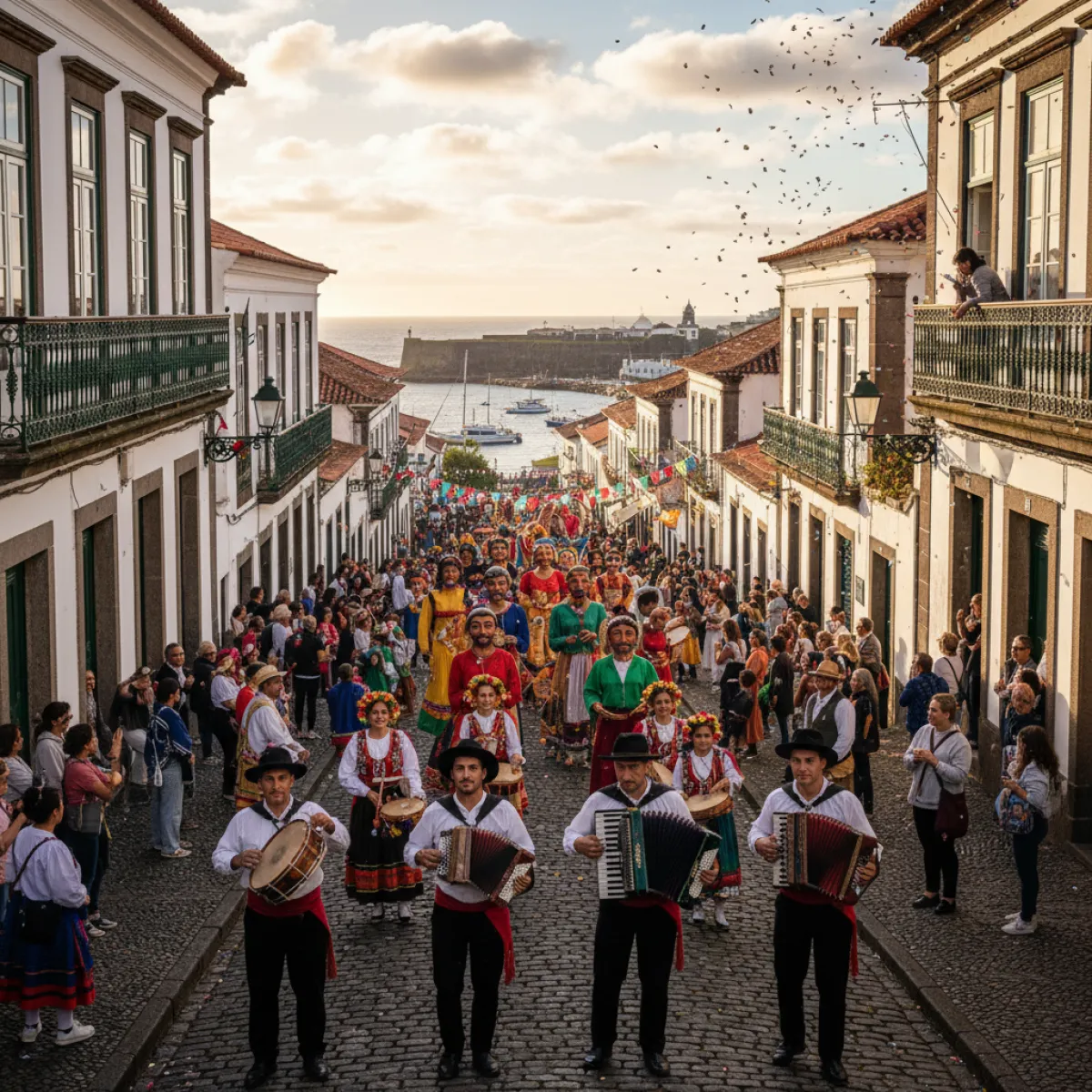
The International Folklore Festival of the Azores takes place in Angra over a week in August and is, quite simply, the largest folklore festival in Europe. Groups from dozens of countries perform on open-air stages and parade through the city streets.
The highlight is the ethnographic parade through downtown Angra, typically on August 15th, bringing all groups together in a procession that can last hours. If folklore interests you at all, this is a rare opportunity. If it doesn't, the street atmosphere and the city's energy that week are worth experiencing regardless.
October: AngraJazz
For anyone who thinks Terceira is only tradition and bulls: AngraJazz has been running since 1999, takes place annually around the October 5th holiday, and consistently delivers a quality jazz program. The scale is small, we're on an island in the middle of the Atlantic, but the curation is serious, and watching live jazz against the backdrop of Angra's historic center is an experience that would hold up in any European city.
It's also a great excuse to visit Terceira outside peak season. In October, flights are cheaper, crowds are thinner, and the weather is still reasonable.
Between Festivals: What to Do Year-Round
Terceira doesn't shut down between events. Any time of year, the island's natural landscape rewards exploration, the birdwatching expedition at Cabo da Praia is one of the best activities for getting off the beaten path.
And if the festivals spark a desire to explore more of the Azores, Horta on Faial is a short flight away. Check out our 24-hour Horta itinerary for a focused visit, or browse the best panoramic viewpoints in the city if you're after the views.
For the food-obsessed, and if you've read this far, you probably are, our gastronomic guide to Ponta Delgada is essential reading before you hop over to São Miguel.
The Practical Summary: When to Go
- February: Carnival (Danças and Bailinhos), culture without crowds
- April–June: Holy Ghost Festivals, the most authentic tradition, food included
- May–October: Touradas à Corda, controversial but historically fascinating
- June (10 days): Sanjoaninas, the big one, book everything early
- August: Folk Azores, international folklore at a surprising scale
- October: AngraJazz, serious jazz, low prices, quiet island
Terceira is, quite possibly, the most festive island in the Azores. Not because it has more events than the others, though it does, but because the festivals here are still made by the people, for the people. There's no Instagram curation, no corporate sponsorship dictating the program. There are neighbors who rehearse theater for months, stewards who spend their savings feeding the parish, and bulls that run down streets where the postman will walk again tomorrow morning. That's the difference.