Amarante's Romantic Bridge and Pastry Route: São Gonçalo to Confeitaria da Ponte
An hour east of Porto, Amarante drapes itself along the Tâmega River with a grace no planner could manufacture. Between its eighteenth-century bridge and a clutch of confeitarias preserving centuries of conventual tradition, this small northern town offers one of Portugal's finest pastry walks, and a matchmaking saint who still draws crowds.
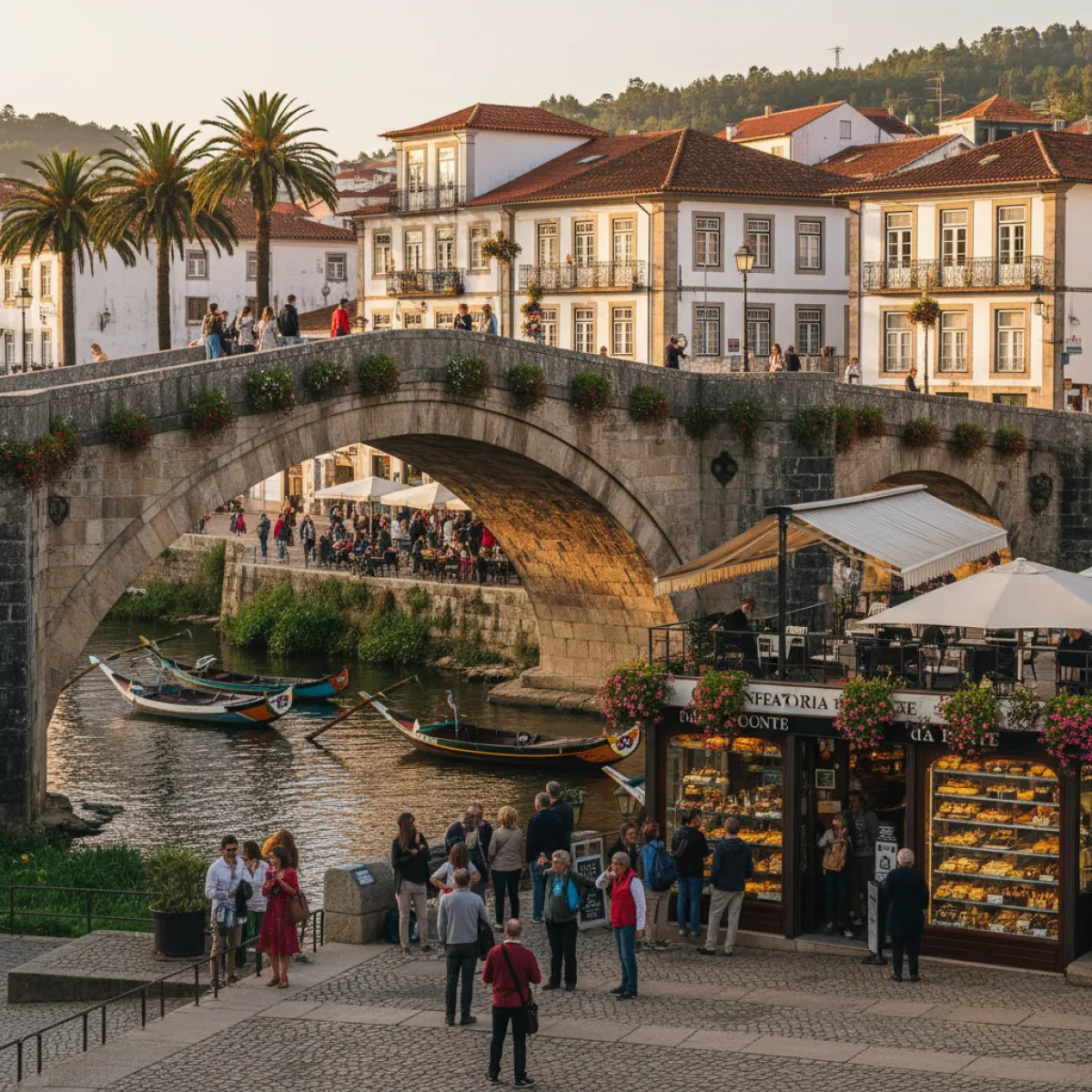
Amarante reveals itself reluctantly. You drive east from Porto on the IP4, just over an hour if the traffic cooperates at the motorway entrance, and for most of the journey, the landscape is pleasant but unremarkable: rolling hills, eucalyptus plantations, the occasional village perched on a granite ridge. Then the road descends, the Tâmega River appears below, and suddenly Amarante is there, draped along both banks with the kind of effortless beauty that no urban planner could manufacture. The Bridge of São Gonçalo arches across the water, connecting seventeenth-century houses that lean toward each other like old friends sharing a confidence. If you're planning day trips from Porto, this should be near the top of your list.
But Amarante is not merely scenic. It is, per capita, one of the most significant pastry towns in Portugal, which, in a country that takes its confectionery as seriously as its football, is no small claim. The town's tradition of conventual sweets, born in the kitchens of the São Gonçalo and Santa Clara convents, has survived secularisation, wars, floods, and the relentless march of supermarket bakeries. What it has also preserved, with characteristic northern Portuguese irreverence, is a strain of bawdy humour that makes Amarante's pastry culture unlike anything else in the country.
The bridge and its patron saint of loneliness
The Bridge of São Gonçalo, in its current form, dates to the eighteenth century, rebuilt after catastrophic floods in 1763 destroyed its medieval predecessor. But the story that gives the bridge its meaning is much older. São Gonçalo de Amarante, a thirteenth-century Dominican friar, is credited with building the first bridge across the Tâmega, an act of practical charity that connected two halves of a divided town. The Portuguese, being a practical people, canonised him not for miracles of the supernatural variety but for the deeply miraculous act of building useful infrastructure.
What makes São Gonçalo truly distinctive, however, is his role as the patron saint of matchmaking. He is the saint of the lonely, the lovesick, the hopefully single. During the Festas de São Gonçalo, held on the first weekend of June, the town erupts into a celebration of desire that blurs the line between Catholic devotion and pagan fertility rite. Phallic pastries, we'll get to those, are distributed by the hundreds, and revellers strike each other with leeks in a ritual believed to bring luck in love. It is strange, joyful, and entirely sincere.
Outside festival season, the bridge retains a quieter romance. Walking across it in the late afternoon, when the low sun catches the south-bank façades and the Convent of São Gonçalo stands silhouetted against the sky, you begin to understand why Amarante captivated Amadeo de Souza-Cardoso, the town's most famous son, a central figure in Portuguese modernism, whose museum just beside the convent deserves a full morning of your time.
The pastry route: one kilometre, several thousand calories
Amarante's concentration of quality confeitarias is inversely proportional to its size. Within a few blocks, you'll find houses working recipes handed down through generations, many originating in the convents where nuns transformed eggs, sugar, and almonds into caloric works of art. The tradition is alive, unmuseumified, and remarkably affordable.
Confeitaria da Ponte
Start with the obvious, because sometimes the obvious earned its reputation honestly. Confeitaria da Ponte occupies a building on Rua 31 de Janeiro, steps from the bridge, and is probably the most photographed establishment in Amarante, a fact that hasn't diminished its authenticity by a single gram. The interior has the feel of another era: glass display cases, azulejo tiles, a sobriety that contrasts sharply with the exuberance of what's on offer.
What to order: lérias, small puff pastries filled with egg cream and a whisper of cinnamon; papos de anjo, spongy and soaked in syrup; and foguetes, a local speciality combining puff pastry with egg custard. If you visit in June, order the phallic pastries, the so-called doces de São Gonçalo, not for novelty, but because they're genuinely excellent. Budget €1.50 to €2.50 per piece. A coffee and three pastries will set you back less than €8.
Confeitaria São Gonçalo
On the opposite side of the bridge, Confeitaria São Gonçalo has less international fame but equal dedication. The standouts here are brisas do Tâmega, small almond cakes with a texture somewhere between a macaron and marzipan, and toucas, conventual sweets that wrap egg threads in a brittle sugar shell. The terrace overlooking the river is an excellent spot for breakfast before exploring the town.
Pastelaria Moreira
For those who prefer savoury to sweet, or need a break from sugar before returning to it, Pastelaria Moreira on Rua Cândido dos Reis makes a bolo de carne (meat pastry) that constitutes a meal in itself. But the real reason to step inside is the queijadas de Amarante, a local variation that uses less sugar and more almond than its Sintra cousins, producing a drier, more complex flavour.
Beyond pastry: what to do with the rest of your day
Amarante has a solid morning's worth of content beyond the confeitarias. The Amadeo de Souza-Cardoso Museum, housed in the cloister of the Convent of São Gonçalo, holds a remarkable collection of the modernist painter's work alongside temporary exhibitions that are surprisingly ambitious for a town of this size. Admission is €3, and the space merits at least an hour.
The Church of São Gonçalo, adjacent to the convent, is an exercise in northern baroque worth seeing even if religious architecture isn't your particular interest. The lateral portal, with its Solomonic columns and profusion of granite angels and flowers, is a spectacle of excess carved into the hardest possible stone.
For those wanting to stretch their legs, the riverside path along the Tâmega offers roughly three kilometres of flat, tree-lined walking, ideal for digesting the mid-morning pastries before attacking the lunchtime ones. The river is calm enough that you can spot trout jumping in the warmer months, and the banks are reasonably well maintained.
Lunch and vinho verde
Amarante sits in the heart of vinho verde country, and any decent restaurant will serve bottles from the sub-region that you won't easily find in Lisbon or the Algarve. Restaurante Largo do Paço, in the centre, serves regional cooking without excessive pretension: barrosã veal, Amarante-style salt cod, arroz de cabidela. Budget €15 to €22 per person for a full meal with wine.
For something more casual, the tascas on Rua 31 de Janeiro serve petiscos and half-portions at prices that remind you this is the northern interior: a half-portion of octopus with smashed potatoes runs €7 or €8, accompanied by a glass of vinho verde for €1.50.
When to go and how to get there
Amarante works in every season, though each offers a different register. Spring, from April to June, brings the Festas de São Gonçalo and a fuller river; summer is hot, sometimes very hot, above 35°C, but the evenings are pleasant and the town fills with returning emigrants; autumn paints the Serra do Marão in ochres and reds and is perhaps the most photogenic period; winter is cold and damp, but the confeitarias feel cosier and there are no queues.
By car, it's 60 kilometres from Porto on the IP4, roughly an hour depending on traffic leaving the city. Rodonorte buses run from Campanhã station, but schedules are irregular and limited to three or four services daily. Driving is, frankly, the more practical option, and parking in central Amarante is still possible and mostly free.
For those based in Porto who want to combine destinations, Amarante works well as part of a northern itinerary that includes Guimarães, the city where Portugal learned to be itself, or Braga, Portugal's quietly radical northern city. The three destinations form a triangle across the Minho and Trás-os-Montes regions that can be comfortably covered in two or three days, sleeping in any one of them.
What to bring home
Amarante's pastries travel reasonably well, particularly the drier varieties: brisas do Tâmega, queijadas, and foguetes hold up for two to three days out of the fridge if kept in their cardboard boxes. Both Confeitaria da Ponte and Confeitaria São Gonçalo package for takeaway with the care of establishments that know half their customers are visitors. Budget €10 to €15 for a generous assorted box.
Beyond pastries, the local vinho verde, particularly the whites from the Amarante sub-region, made from grapes like Azal and Avesso, represents outstanding value. The Adega de Amarante, on the road out of town toward the Marão pass, sells bottles starting at €3.50 that would hold their own at any dinner table.
A final word about time
Amarante rewards slowness. There is no reason to rush between the bridge and the museum, between the confeitaria and lunch. The Tâmega is in no hurry, the granite is in no hurry, the women wrapping pastries in cardboard boxes are in no hurry. The best thing a visitor can do is adopt the pace of the place: sit on the terrace at Confeitaria da Ponte with a coffee and a léria, watch the river, watch the bridge, watch the façades, and recognise that there are still places in Portugal where time operates as it should, without urgency, without anxiety, without the need to justify every minute with a photographable experience.
That is why people return to Amarante. Not for the monuments, which you can see in a morning. Not for the pastries, which you can eat in an afternoon. But for that rare quality certain small towns still possess: the ability to make you feel that you have arrived, at last, at a place where there is nowhere else you need to be.
