Rainy Santiago do Cacém: Indoor Options Worth Your Time
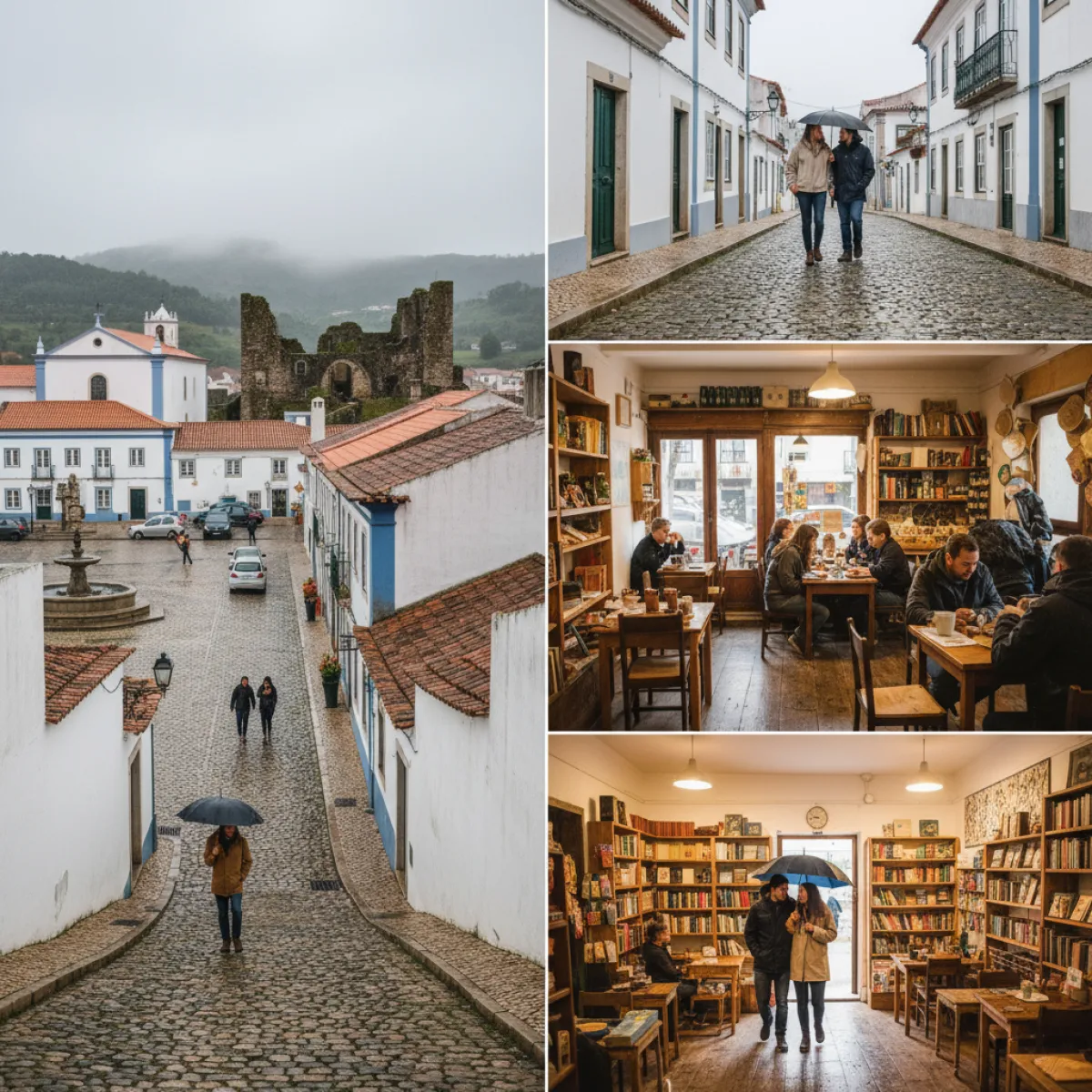
Santiago do Cacém in the rain isn't a backup plan, it's a different plan. Between a museum housed in a former prison, Roman ruins with a covered interpretation centre, and alcomonias eaten at the counter, there's more to do indoors than you'd think.
Let's be honest: nobody plans an Alentejo trip hoping for rain. You come for the dry plains, the punishing sun, the long afternoons with a bottle of red. But rain comes, especially between November and March, and Santiago do Cacém, for all its outdoor beauty, doesn't exactly advertise a rainy-day menu. That doesn't mean there isn't one.
The truth is, this hilltop town has more to offer indoors than most visitors realize. You just need to know where to look, and to accept a different pace. Slower. More Alentejano. On a rainy day, that's exactly what you want.
The Municipal Museum: A Prison With Good Stories
Start with the Museu Municipal de Santiago do Cacém, because it's probably the single best thing to do in town when it rains. The building, designed by Chiapa Monteiro in the 19th century, functioned as a prison until 1968. Read that again: 1968. There are people alive who remember this as a jail.
It opened as a museum in 1972, and the contrast between what it was and what it is now is part of the appeal. There's a preserved cell from the era when First Republic political prisoners were held here. It's not a sanitized reconstruction, it's at real scale, and it makes you understand what it meant to be a dissident in pre-democratic Portugal.
Beyond the cell, the museum unfolds into recreations of traditional Alentejo domestic spaces: a kitchen, a rural bedroom, a barbershop, a tailor's workshop, an old primary school classroom. It's not the Louvre, but it's honest and well-executed. The numismatics collection, spanning from the 3rd century BC to the Republic, gives you a sense of how deep the history runs here, this area was significant long before anyone called it Alentejo.
Hours: Tuesday to Friday 10am-12pm and 2pm-4:30pm, Saturdays 12pm-6pm. Closed Sundays, Mondays, and holidays. Check locally for seasonal changes.
The Miróbriga Interpretation Centre: Rome Without Getting Wet
The Roman ruins of Miróbriga are, obviously, outdoors, and in heavy rain, walking the archaeological site isn't ideal. But what many visitors don't realize is that the Centro de Acolhimento e Interpretação, built by IPPAR, has a permanent thematic exhibition that's worth the visit on its own.
Miróbriga was a settlement that began in the Late Bronze Age (6th-1st centuries BC) and survived until the 4th century AD. During the Roman period, it gained a forum, temples, one probably dedicated to the imperial cult, another to Venus, baths, a commercial zone, and a hippodrome about one kilometer from the main nucleus. We're talking about a hippodrome measuring 370 meters long with a central spina, built for chariot races. On a rainy day, the Interpretation Centre is where you absorb all of this calmly, through panels, scale models, and archaeological artifacts.
Hours: 9am-12:30pm and 2pm-5:30pm. Guided tours are available, if it's raining, it might be worth booking one and then making a dash for the hippodrome when the rain lets up.
The Igreja Matriz and What's Inside
The Igreja Matriz de Santiago do Cacém is classified as a National Monument, and rightly so. Founded by the Order of Santiago in the 13th century, it was significantly altered in the 14th century under the patronage of D. Vataça Lascaris, yes, a Byzantine princess, and nearly destroyed by the 1755 earthquake. Reconstruction took 34 years, from 1796 to 1830.
The sober white exterior doesn't prepare you for the interior. There are relief sculptures depicting Santiago fighting the Moors, and the church houses the Museum of Sacred Art, which deserves at least half an hour of your attention. On a rainy day, the acoustics of the empty nave are reason enough to step inside.
Sweets and Coffee: The Most Honest Program
If there's one thing the Alentejo does well on rainy days, it's the pastry-and-coffee routine. In Santiago do Cacém, the regional sweets are the perfect excuse to sit down and watch the rain fall.
Look for alcomonias, a sweet of Arab origin, lozenge-shaped, made with toasted flour, pine nuts, and honey. They're drier and denser than most Portuguese sweets, and they pair perfectly with an espresso. The bolo de Santiago, made with almond, black seed squash, cinnamon, and sugar, is another local specialty you won't find in other Alentejo towns. I'm not going to recommend a specific pastry shop because the ones here are modest and vary in quality, ask a local and follow the recommendation of the day.
In fact, that's the best advice for Santiago do Cacém: ask. People here genuinely enjoy pointing visitors in the right direction, and the right recommendation almost always comes from a conversation at the counter.
Where to Stay When You Don't Want to Go Out
Not every rainy day calls for a cultural program. Sometimes the best rainy day is the one where you don't leave your accommodation. And for that, the accommodation has to deserve the stay.
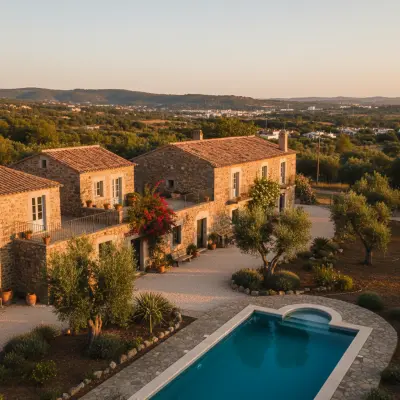
Casas da Moagem is exactly that kind of place. Real rural tourism, without the pretension of boutique hotels that charge a fortune for a scented candle. It's the sort of place where staying in with a blanket, a book, and a cup of tea is a perfectly legitimate program, and probably the most Alentejano one of all.
When the Rain Stops
Rain in the Alentejo rarely lasts all day. There's almost always a window of two or three hours when it stops, the light changes, and suddenly you want to go outside. When that happens, the Castelo de Santiago do Cacém is minutes on foot from the center, the Moorish-origin walls, with ten square towers and an imposing keep, are impressive even with wet ground underfoot.
If your visit coincides with the right date, the Feira do Monte is a traditional Alentejo fair worth the trip, check the dates, as it runs on a variable calendar. It's one of those experiences that gives context to everything else you've seen in the town.
Beyond Santiago: Planning From the Couch
A rainy day in Santiago do Cacém can be the excuse to plan the rest of your trip. If the Alentejo is already in your blood and you want to keep exploring the interior, our guide to Portalegre without the tourist traps is a good starting point, another Alentejo town with enough substance for a full weekend. And if you want to know where locals actually eat in Portalegre, we've got that covered too.
Because here's the thing: the Alentejo in the rain is a different Alentejo, but it's not a lesser one. The light is different, the cafés are fuller, and there's a certain complicity among those who decided to stay instead of fleeing to the coast. Santiago do Cacém rewards those who take the day as it comes, even when it comes wet.