Mogadouro at Sunset: June Viewpoints on the Plateau
In Mogadouro, sunset isn't a moment, it's a whole evening. Six viewpoints from Penedo Durão to Algoso Castle, plus the one without a name yet, and everything you need to see them properly in June.
In June, Mogadouro wakes at five in the morning to the song of skylarks and only quiets at ten at night, when the last red glow fades behind the Bornes mountains. It's the best time of year to stand still and watch. The sun doesn't simply set here: it drags itself across the plateau, lingers among the oaks, and finally drops as if reluctant. Anyone who visits Mogadouro just for the castle or the bacalhau à transmontana is missing half the show. The other half happens between 8.30pm and 10pm, and you only need to know where to stand.
This is not an exhaustive list. It's mine. Six viewpoints that justify the trip out to the easternmost county of Trás-os-Montes, plus a trick or two to make sunset more than a photo: a whole evening, instead. June helps. The long days, the gold light that stretches past 9pm, and the temperatures that still call for long sleeves on a terrace at night. Bring a bottle of water, decent shoes, and the patience of someone who understands the best part of any trip happens when you turn the engine off.
Miradouro do Cabeço de Vale de Águia: the easy starting point
I always begin here, and not by accident. Cabeço de Vale de Águia, on the outskirts of Mogadouro, is the most accessible viewpoint: you can drive up, there's space to park, and the view opens west over the plateau, with the mountain ridge cut sharp against the sky. The light, in June, starts getting interesting around 8pm. The sun is still high, but it has stopped burning, and the rye fields around Mogadouro turn a honey colour that no phone filter can reproduce.
Practical advice: don't show up in a hurry. Bring a blanket. The locals, when they appear, are shepherds or older couples who have known the spot for decades and rarely exchange more than a quiet boa-tarde. Respect the silence. If you hear a sheep bell in the distance, it's a flock heading home, not a picturesque detail laid on for you.
How to get there
- From central Mogadouro, follow signs to Vale de Águia. Five to seven minutes by car.
- Informal parking along a rural lane. No tourist signs.
- No restrooms, no café. Come prepared.
Penedo Durão: the viewpoint everyone wants and nobody deserves without effort
Technically this one is in Freixo de Espada à Cinta, not Mogadouro, but any honest local will admit it belongs to the same trip. Penedo Durão is a stone platform suspended over the International Douro, at almost 600 metres altitude, and the view, especially in late afternoon, is one of those things that justifies the hour-and-a-half drive from Mogadouro.
I'll be blunt: at midday it's a disappointment. Coach tours, occasional litter, and the noon sun crushes the colours until everything looks badly exposed. But after 7.30pm, when the last visitors start leaving and the valley fills with that almost-orange light, Penedo Durão transforms. Vultures still fly low. The Douro, far below, turns black and still. Spain, on the other side, looks closer than it is.
If you want to make this more ambitious, combine the viewpoint with a morning on the water. The kayaking experience on Lagos do Sabor from Mogadouro is, in my opinion, the best way to understand this territory before seeing it from above. Kayak in the morning, lunch slowly, and drive up to Penedo Durão for sunset. In June, this combination is hard to beat.
Miradouro de São Cristóvão (Bemposta): sunset over the dam
In Bemposta, a parish of Mogadouro, the dam is the protagonist. The Miradouro de São Cristóvão sits on a hillock above the reservoir and offers one of those views where the setting sun seems to reflect twice: once in the sky, once on the still water. It's far less frequented than Penedo Durão, and that's precisely why I recommend it.
Access is easy by car. From Mogadouro, around 25 minutes. Save the descent to the dam itself for another day: at sunset, stay up high. The light lasts longer there. In June, expect the sun to disappear around 9.15pm, but the good light, the light that actually means something, is between 8.30pm and 9pm.
The small detail that changes everything
Bring a thermos of coffee. There's no café open in Bemposta at that hour. Once the sun drops, the temperature falls two or three degrees within minutes, and a hot coffee is the difference between staying another half hour to watch the stars come out and giving up and walking back to the car.
Miradouro de Nossa Senhora do Castelo (Algoso): the vertical sunset
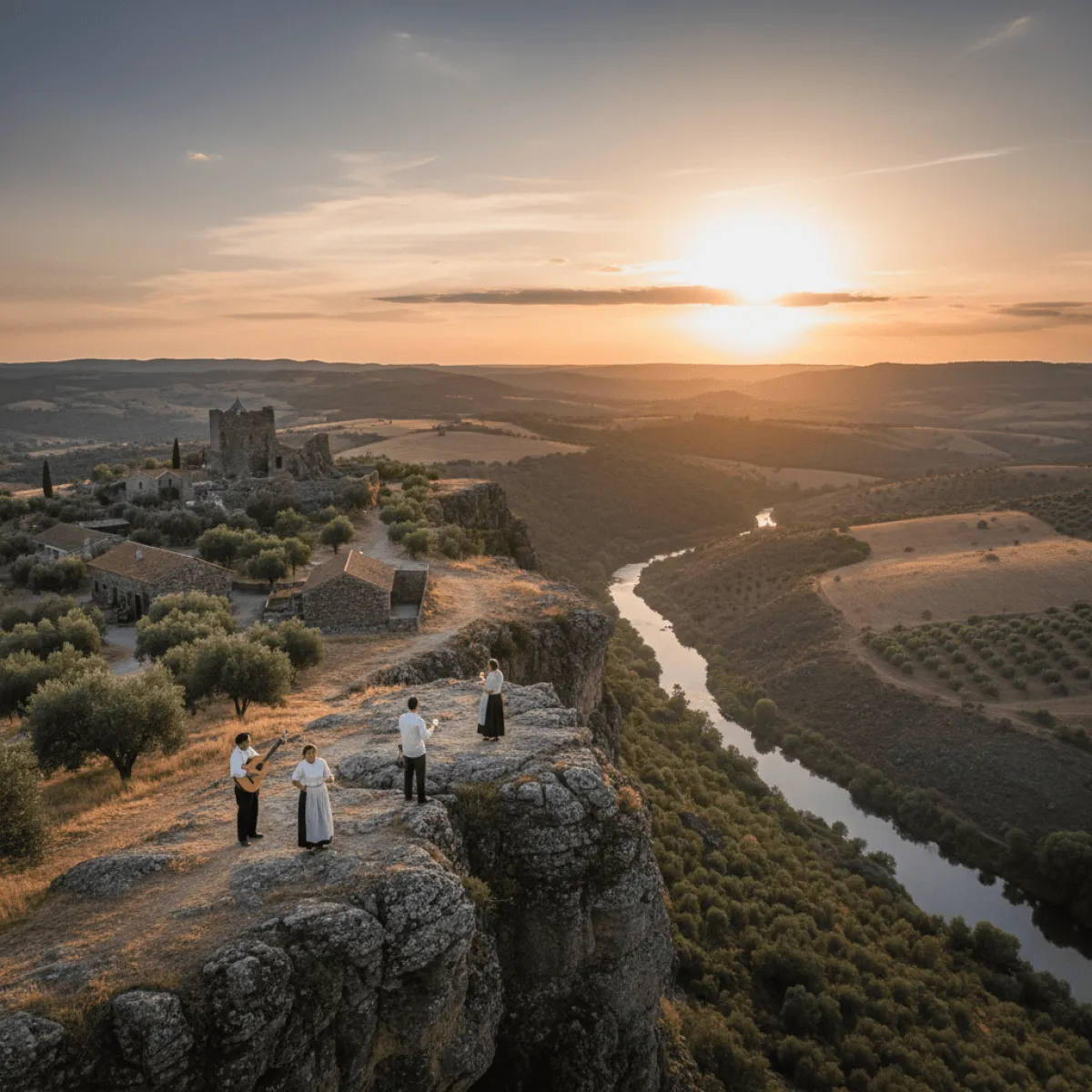
Algoso, twenty minutes from Mogadouro, has a castle nobody visits and everybody should. The Miradouro de Nossa Senhora do Castelo, at the top of the rocky outcrop where the medieval tower stands, is one of the most cinematic views in the entire county. The river Angueira runs far below, and in June, when the sun tilts, the valley turns bronze.
It's a short climb on foot, but steep. Closed shoes, please. Not a place for flip-flops or very small children. Take your time, walk slowly, carry water. At the top, there are rocks to sit on, and the silence is broken only, occasionally, by the croak of a raven. After 9pm, the sky above Algoso is one of the cleanest in northern Portugal. If you're not exhausted, stay until the first stars appear. Worth the effort.
Where to sleep so the morning light works for you too
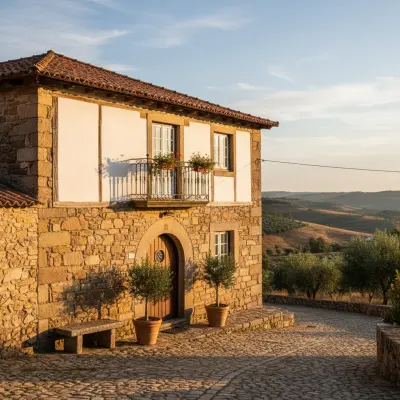
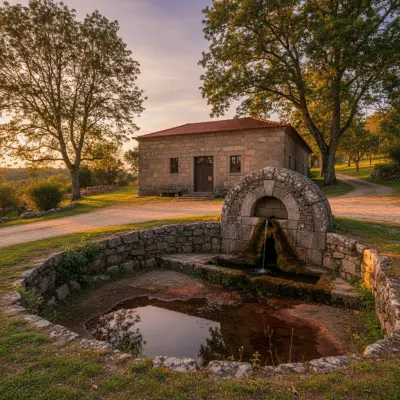
The best viewpoints are useless if at 11pm you have to drive 100 km to reach a bed. In Mogadouro, there are two options I recommend without reservation. A Casa do Gi is a solid choice for travellers who want warmth and comfort without frills, with that Trás-os-Montes hospitality that begins with a glass of wine and ends with hand-drawn directions to the village you should visit tomorrow. For something more isolated, more rural, Casa das Águas Férreas is the place to sleep after a sunset evening at Penedo Durão. It's one of those houses where night silence still genuinely exists.
Book ahead for June. Weekends fill up fast, especially after São João. Expect 70 to 110 euros per night, depending on season and room, but check locally.
Miradouro do Castelo de Mogadouro: the obvious that should not be skipped
Yes, it's the most predictable viewpoint. Yes, it's inside the town. No, I will not tell you to skip it. The Castle of Mogadouro, even in ruins, offers a high platform in the centre of town with a circular view across the plateau. In June, at the end of the day, walk up after dinner. The sun drops to the west, over the stone houses, and there's a moment, perhaps five minutes long, when everything turns orange: walls, roof tiles, even the swallows looping around the tower.
It's the most democratic viewpoint in the county. Families with kids, older couples, teenagers on mopeds. Everyone passes through at some point, and that's fine. No preparation required, no hike. Sunset without excuses.
What to eat before or after
- Posta à mirandesa: the region produces some of the best grilled beef in Portugal. Order it rare and generous.
- Bola de carnes or folar transmontano: stuffed bread, ideal for a picnic if you're heading to Penedo Durão for sunset.
- Wines from the Douro Superior: small-producer bottles from this region are worth every euro.
I'll deliberately not name specific restaurants, because the best places in Trás-os-Montes change hands, close, reopen, and any tip from me may be out of date. Ask at your guesthouse, ask at the café on the main square at lunchtime. The locals know.
The sixth viewpoint: the one without a name yet
I'll be honest. The best sunset I've ever seen in Mogadouro was on a secondary road, halfway between Mogadouro and Bemposta, in a makeshift lay-by where someone, one day, parked a tractor and realised you could see the entire Sabor valley from there. No sign, no name, not on Google Maps. I won't tell you where it is, because part of the magic is finding it by accident.
What I will say is this. When you drive across the plateau in June after 8pm, slow down. Pull over when a view stops you. Get out of the car. The best viewpoints in Trás-os-Montes are not signposted. They were discovered by shepherds, farmers, priests walking from one chapel to another. Even today, the best views belong to those who slow down.
Stretching the trip: other Trás-os-Montes refuges
If Mogadouro leaves you hungry for more Trás-os-Montes, and it usually does, it's worth combining with other corners of the territory. The silence of Montesinho Natural Park, to the north, offers entirely different light and wildlife. And to the west, on the Barroso frontier, Montalegre has a mountain kitchen that completely changes how you think about Portuguese food. For travellers carrying a camera, I'd also recommend the photography itinerary in Montalegre, although that one is best in winter rather than the gold June of Mogadouro.
Honest logistics: the things nobody tells you
- Fuel: fill up in Mogadouro before heading to any viewpoint. In Bemposta or Algoso, petrol stations may be closed after 7pm.
- Phone signal: coverage drops at parts of Penedo Durão and on secondary roads. Don't rely only on Google Maps. Bring a paper map, or at least download offline.
- Insects: in June, around dusk, there are mosquitoes near the reservoirs. Repellent, always.
- Clothing: even at 30 degrees during the day, sunset on the plateau easily drops to 17. Long-sleeved shirt and, ideally, a thin jumper.
- What time to arrive: be at the viewpoint 45 minutes before official sunset. In June that generally means between 8.15pm and 8.30pm.
What to do with all this
Mogadouro is not a classic weekend destination. It doesn't have the glamour of the Douro wine country or the tourist choreography of Bragança. It has something else: a rhythm that forces you to stop. The viewpoints aren't check-in spots, they're excuses to pause. In June, with the long light and the honey-coloured fields, they're also the best possible introduction to this corner of Portugal.
My final advice is simple. Stay three nights, not two. One to arrive and rest. Another for a major viewpoint plus the kayak on Lagos do Sabor. A third for the viewpoint that has no name yet, the one you'll discover around a bend, perhaps with no one nearby, perhaps with a shepherd waving from afar. That evening, more than any photograph, is what will stay with you for years.