Walking the Pombaline Grid in Vila Real de Santo António
The Passeio Pombalino (PR3 Cidade Pombalina) is a free, self-guided 3 km circular urban trail starting at Praça Marquês de Pombal and running along the Guadiana waterfront. The best part is late afternoon, with the sun setting behind Ayamonte in Spain.
A town drawn with a ruler
Vila Real de Santo António is the only town in the Algarve built from scratch on a perfect grid. It went up in just over two years, from 1774, on the orders of the Marquês de Pombal, using the same prefabricated method that rebuilt downtown Lisbon after the 1755 earthquake: stone blocks cut to standard sizes and assembled on site. The result is a historic centre where streets always cross at right angles and the buildings share the same height. Walking is the right way to feel this, and the good news is that there is an official route for it.
That route is the Passeio Pombalino, also classified as the PR3 Cidade Pombalina. It is a circular urban trail of about 3 km, certified by Portugal's Camping and Mountaineering Federation, starting and finishing at Praça Marquês de Pombal. It takes an hour and a half to two and a half hours, depending on how long you linger over a coffee. It is self-guided and free: there is no operator selling tickets and no guide waiting. The map and documentation are available on the Portuguese Trails portal, run in coordination with the Vila Real de Santo António town council.
What the route involves, step by step
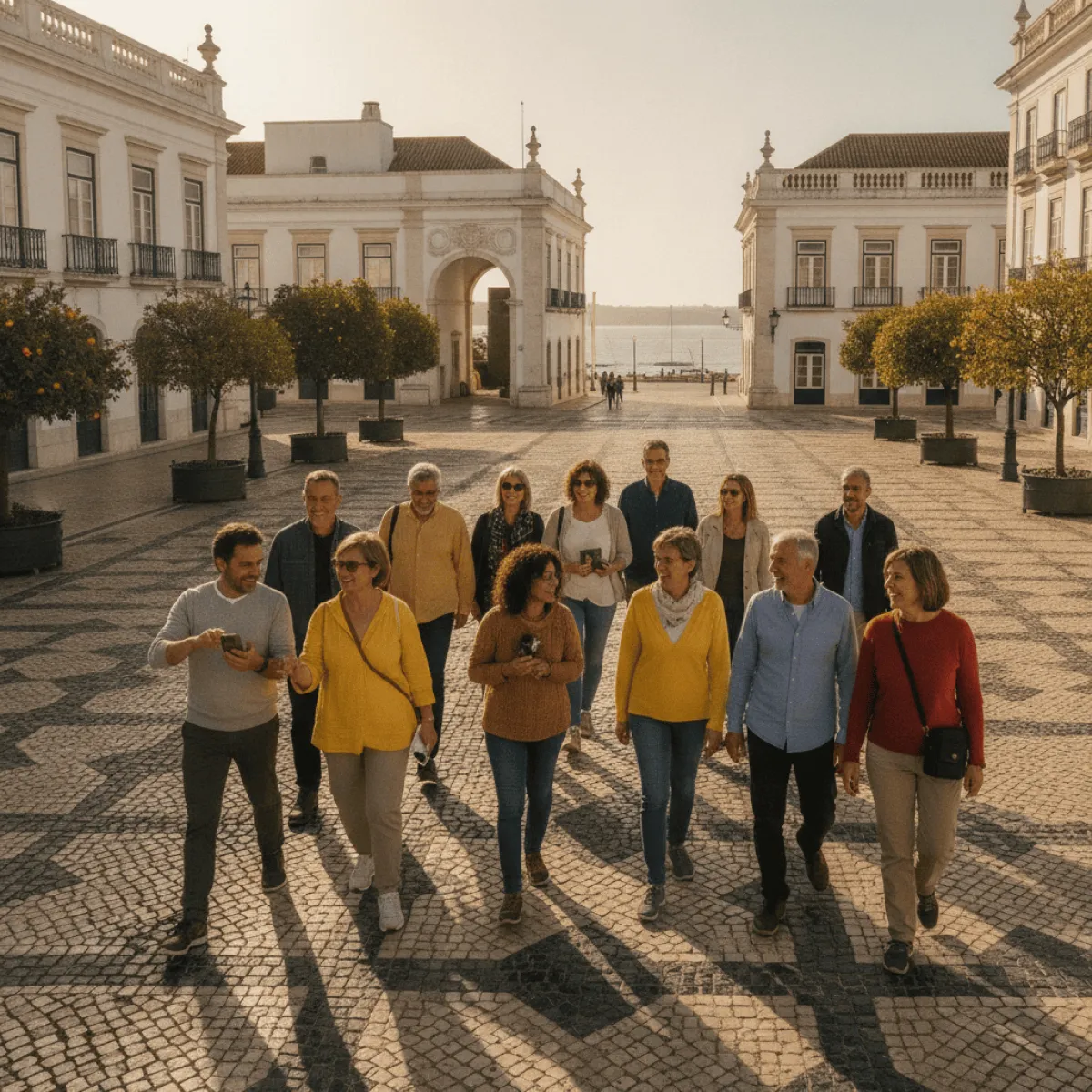
The starting point is Praça Marquês de Pombal, the heart of the town. It is a square with an obelisk at the centre, black-and-white Portuguese cobblestones laid in a radial pattern, and orange trees around the edge. Stand still for a minute first: from the obelisk you take in the whole symmetry at once. The four exits from the square line up with streets that look drawn with a ruler.
From here the route leads you through the pedestrian streets running off the square, full of shops, cafe terraces and Pombaline stone facades. It is not signposted on the ground, because it crosses the town centre, so bring the map on your phone. Look at the details: the stone door frames, the uniform windows, the way each block is almost identical to the next. That repetition is what makes the place unusual.
The second half is the part most people prefer: the Guadiana River waterfront. Drop down to Avenida da República, the palm-lined promenade that runs along the water. On the far bank is Spain, the town of Ayamonte, so close you can see the houses and hear the boats. The promenade links the square to the marina and then carries on south towards the river mouth, where the Guadiana meets the Atlantic.
The best time to do it
Walk this early in the morning or late in the afternoon. At midday in summer the grid offers no shade and the light bounces hard off the pale stone. In the morning the terraces are quieter and the light over the Guadiana is softer, the fishing boats still moored. Late afternoon, the promenade fills with locals on a stroll and the sun sets behind Ayamonte on the Spanish side. For me that is the best moment of the route: sitting on a bench on Avenida da República watching the river change colour.
Practical tips
- Footwear: trainers or comfortable flat shoes. Portuguese cobblestones are handsome but slippery when polished, especially in rain.
- What to bring: water, a hat and sunscreen in summer. The route is flat but almost entirely exposed.
- Real duration: allow two hours if you want to stop for coffee and photos, not just the estimated walking time.
- Getting there: Vila Real de Santo António has a train station (the end of the Algarve line) a few minutes' walk from the centre. By car, there is parking by the marina and the waterfront.
- Cost: the route is free. No booking needed. Just download the map and GPX file from the Portuguese Trails portal.
What to pair with the walk
The walk fits easily into a morning, leaving the rest of the day free. The town museums are worth your time, and this guide to the museums worth your time helps you choose. After dark, once you have rested your legs, the town has good small-plate options, as we explain in the wine and petiscos after dark guide. If you are travelling on a budget, this free route fits neatly into our shoestring guide, and anyone travelling with family will find ideas in the honest guide with kids. To stretch the trip beyond the town, the Miradouro de Cacela Velha is a few kilometres away and has one of the best views over the Ria Formosa.
Is it worth it?
It is, with one honest caveat: this is not a ticketed attraction or a narrated guided tour. It is a self-guided walk through a small, flat town. What makes it special is precisely the grid, an 18th-century exercise in town planning that you understand better with your feet than from photographs. If you like history, urban design and river promenades without crowds, it is a morning very well spent. If you would rather have a guide explaining everything, confirm directly with local providers, but be aware that, at the time of writing, there is no dedicated commercial guided tour of the Pombaline grid: the official route exists to be walked on your own.