Vila Real de Santo António on a Shoestring: No Compromises
Fifty euros a day, the Pombaline square, Cacela's miradouro at sunset, and fresh shrimp from the market cooked in the hostel kitchen. Three days in Vila Real de Santo António without missing what matters, and without remortgaging anything.
There's a lazy assumption that the Algarve only works for people with deep pockets. Spend forty-eight hours in Vila Real de Santo António and that assumption falls apart on the first esplanade. A galão here costs what it costs in Bragança. Grilled fish at lunch comes in under twelve euros at half a dozen places along Avenida da República. The beach, naturally, remains free. The southernmost Pombaline town in Portugal, drawn with a ruler by the Marquis of Pombal in 1774, is one of the few Algarve destinations where you can spend three days without bleeding cash and still leave feeling you saw something that mattered.
This guide is for travellers arriving by train, by bus, or in a friend's back seat, with fifty euros a day in their pocket and a stubborn refusal to eat badly because of it. I'll tell you where to sleep without remortgaging, where to eat the way locals eat, what to see for free, and when the fifteen euros you do spend will actually transform the trip.
Getting in without burning the budget
The regional train from Faro to Vila Real de Santo António is just over seven euros and takes about ninety minutes. It's slow, it's antiquated, it crosses Tavira and Cacela, and it's the best way to arrive. The Eva bus is similarly priced. If you're coming from southern Spain, the ferry from Ayamonte costs under three euros and docks right in front of the Pombaline square, which is probably the most cinematic arrival you can buy in Portugal for that money.
Once in town, ditch the car. Vila Real fits on foot. The Pombaline grid was designed for walking, and the Guadiana riverfront is flat as a pool table. Bike rental is around ten euros a day from several shops near the train station, and that's all you need to reach Monte Gordo beach, the National Pine Forest, or the Castro Marim Salt Marsh Reserve.
Where to sleep for twenty-something euros
If you're tight on budget, the answer almost always begins and ends at The Sun Hostel. It's a decent, central hostel with a shared kitchen that will save you breakfasts and dinners if you want it to, and it has the fundamental quality that separates good hostels from bad: the people working there know where to eat well for seven euros and they tell you without resentment. In low season, a dorm bed runs fifteen to twenty euros. In August, push that to twenty-five. Book ahead in July and August because Spanish travellers also do their math.
If you can't share a room, small guesthouses around the Apolo shopping centre and Rua de São Sebastião charge between forty and fifty euros for a double in low season. Not luxury, just honest beds with basic breakfast. That's what you need.
The three-euro breakfast and the rest
A local pastry-shop breakfast, with coffee, juice, and a tosta mista or buttered toast, comes in under four euros at any pastelaria off Praça Marquês de Pombal. Avoid the cafés directly on the square with views of the pillory, where the price climbs a euro for the view. Walk a street inland: the coffee is the same, comes from the same machine, and the bread is the same baker dropping it off.
For lunch, the rule is simple: order the daily set menu, the prato do dia. Most restaurants on Avenida da República and the parallel streets serve daily plates between eight and twelve euros, with soup, main, and coffee included. Order the catch of the day if there is one, especially conger eel, sardines in season, or sea bream. Some places serve individual portions of monkfish or seafood cataplana for under fifteen euros: ask before sitting down.
For seriously cheap dinner, do what locals do: hit the municipal market before one in the afternoon, buy half a kilo of coastal shrimp, a bunch of fresh coriander, garlic, an Alentejano loaf, and cook it back at the hostel. Fifteen euros for two people, and you'll eat better than in half the riverfront restaurants.
What to see for free, which is almost everything
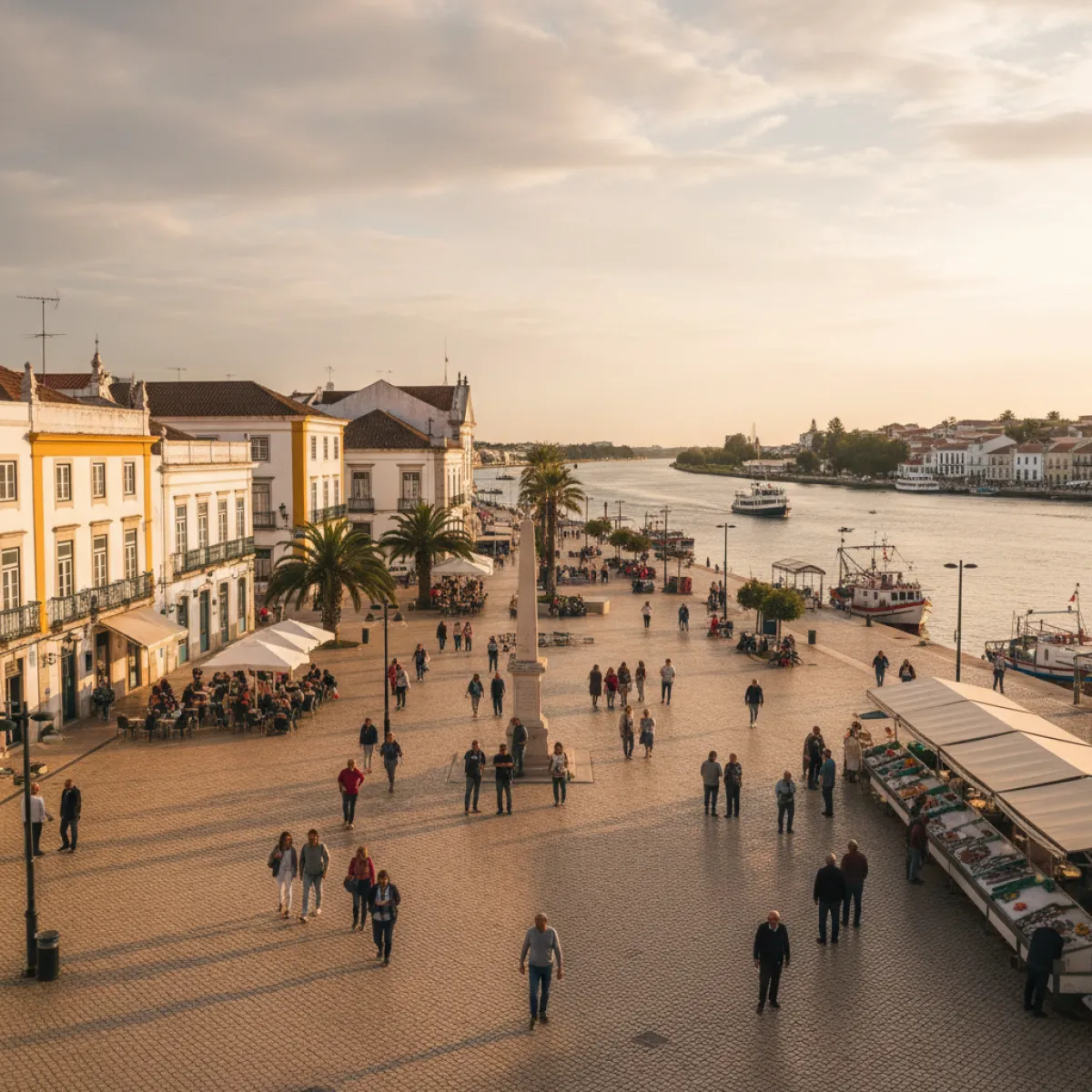
The plain truth about Vila Real is that the city itself is the monument. Praça Marquês de Pombal, with its radial black-and-white cobblestone pattern around the central obelisk, was designed to impress and still does. You can spend an entire morning there spending nothing, watching how the light moves across the white facades with their ochre trim. By late afternoon, the sun cuts the square at an angle that turns the whole place into a Wim Wenders set.
The Mother Church, the Chapel of Nossa Senhora da Encarnação, and the António Aleixo Cultural Centre, housed in the old Casa do Despacho, are free or cost almost nothing. The Manuel Cabanas Museum, dedicated to the local master woodcut artist, charges a token fee and is one of the best visits in town if you care about graphic art. Check opening hours locally because they shift with the season.
The Guadiana riverfront is free and goes on forever. Walk out to the small fort of Santo António da Anta da Areia, then climb into the Mata Nacional das Dunas Litorais, a tame pine forest planted on sand where you can picnic and never see more than three other people at any hour of the day.
Monte Gordo beach, properly done
Monte Gordo is four kilometres away and has the best beach on the eastern Algarve: wide, flat, south-facing. Walk along the cycle path or grab the local bus, which is just over two euros return. The beach itself is free, obviously. What costs is the umbrella and lounger, eight to ten euros a day in high season. Solution: bring a big towel, your own hat, and set up halfway down the sand, away from the restaurants. The beach in August at eleven in the morning still has room.
For lunch on the sand, the cheap option is a sandwich made at the hostel kitchen and a bottle of water. The middle option is to step into one of the second-line snack bars, not the front-row ones, and order grilled sardines with salad, eight euros, plus a beer.
The detour that earns its bus fare: Cacela Velha
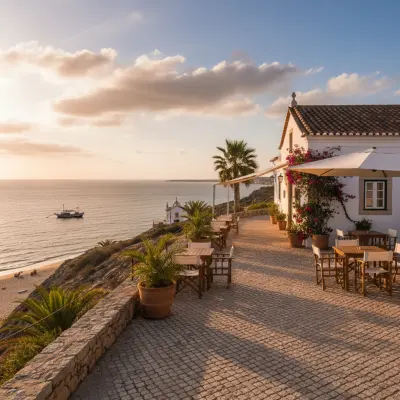
Cacela Velha sits fifteen kilometres west and the bus is around three euros each way. Or rent a bike and ride the cycle path, which is flat and lovely. Cacela Velha is a hamlet with a fortress, a church, two or three cafés, and the Miradouro de Cacela Velha, which is probably the best free terrace in the eastern Algarve. From the top, you see the Ria Formosa branching out into endless arms of water, with Ilha da Fábrica like a comma in the middle. Go in late afternoon. Bring a beer bought at the local café, three euros, and stay until the sun drops behind Tavira.
In summer, people walk down to the island beach at low tide, wading across. Ask locally about tide times before you try. It's free, it's wild, and it's one of the few places on the Algarve where you can still feel what the coast was before the concrete arrived.
When it's worth opening the wallet
Two things in Vila Real justify spending more. The first is the Sunset Boat Tour in Vila Real de Santo António. It costs what it costs, but it's the only way to see the town from the river side with the golden hour light melting over the Pombaline facades. For a couple travelling on a budget, this is the single splurge they'll remember in five years. The others, they won't.
The second is Craft Beer Tasting at Senescal Brewery, Castro Marim. Castro Marim is four kilometres away, a forty-minute walk uphill on the cycle path, and the local brewery serves honest craft beer with sharing boards in an unpretentious setting. It's not the cheapest place to drink, but it's the most interesting place within twenty minutes of Vila Real, and the average ticket is below what you'd spend at a touristy esplanade on the riverfront.
The mistakes that will gut your budget
Don't eat lunch in the front row of the marginal thinking it's all the same. It isn't. Restaurants directly on the river charge three to five euros more for the same plate served two streets inland. Watch where the construction workers are sitting at one in the afternoon: that's where you eat.
Don't buy small bottles of water at the shops on the square. There are two supermarkets a five-minute walk away where water costs a third.
Don't rent a car just to get to Tavira or Castro Marim. The train to Tavira is just over two euros, and Castro Marim is doable by bike or local bus. Cars in August cost fifty euros a day: save that money for dinner on your last night.
Read this before you go
If you're extending the trip elsewhere in the Algarve, three pieces we've written are worth your time and will change how you walk around. Our guide to local culture in Faro helps you understand why the eastern Algarve, where you are, is different from the brochure version. The Lagos neighbourhood guide is for when you want to see the other end of the coast without falling into the usual traps. And if you're travelling with kids, our honest Silves family guide is the only decent piece you'll find in English on the subject, written by someone who actually went.
What to bring home for under ten euros
Skip the plastic magnets. At the municipal market, buy a bottle of local medronho, the strawberry tree spirit, seven to eight euros, or a tin of tuna from Comur or similar, three to four euros. At one of the old groceries on Rua Teófilo Braga, grab a packet of dried figs with almonds for under five euros. Real food, local, the kind of thing Portuguese grandmothers mail to grandchildren abroad, and cheaper than a coffee at any airport.
Three days, one hundred and fifty euros, no lying
Do the math: two hostel nights, forty euros. Three breakfasts at three euros, nine. Three lunches at ten, thirty. Two cooked dinners at ten per head, twenty. A trip to Cacela Velha including transport and a beer, ten. A round at Senescal in Castro Marim, ten to fifteen. The sunset boat trip, twenty-five to thirty. Buffer for surprises.
You're around one hundred and fifty. You can hit one eighty if you drink more, or come in at one twenty if you cook every dinner. Either way, you leave without missing anything that matters: the square, the light, the Ria Formosa from above, the Guadiana at dusk, and a couple of honest plates that will remind you the Algarve is not just Vilamoura.
Vila Real de Santo António is not the most glamorous town in the Algarve. That may be exactly why it still works for travellers with little to spend. Use it while it lasts.