Vila Real de Santo António: Wine and Petiscos After Dark
Vila Real de Santo António is not a drive-through city. It is a stay-the-night one: an hour-by-hour route through the tascas where you eat tuna with onions, local tinned fish and estupeta with Alentejo wine, slowly, and without crowds taking pictures.
Vila Real de Santo António has an image problem. Drivers on the A22 heading for Tavira or Spain glance at a tidy Pombaline grid, the Guadiana on their right, and keep going. Mistake. The city was founded by order of the Marquis of Pombal in 1774, built in just five months, and has one of the most rationally planned urban centres in the country. It also has a nighttime food scene that nobody puts on a brochure. That is where the magic lives, in a network of tascas, neighbourhood adegas and unfussy restaurants that open at seven and close when the last customer decides to go home.
This is an itinerary, not a list. Start it properly hungry, in comfortable shoes (the main square is paved in calçada portuguesa, and by midnight you will feel every stone), and ready to spend an hour arguing whether the tuna with onions was better twenty years ago. That is what people do here. They eat slowly, drink Monte Velho or, if lucky, a glass of Tapada do Chaves red, and talk until late.
Before dinner: the early evening ritual
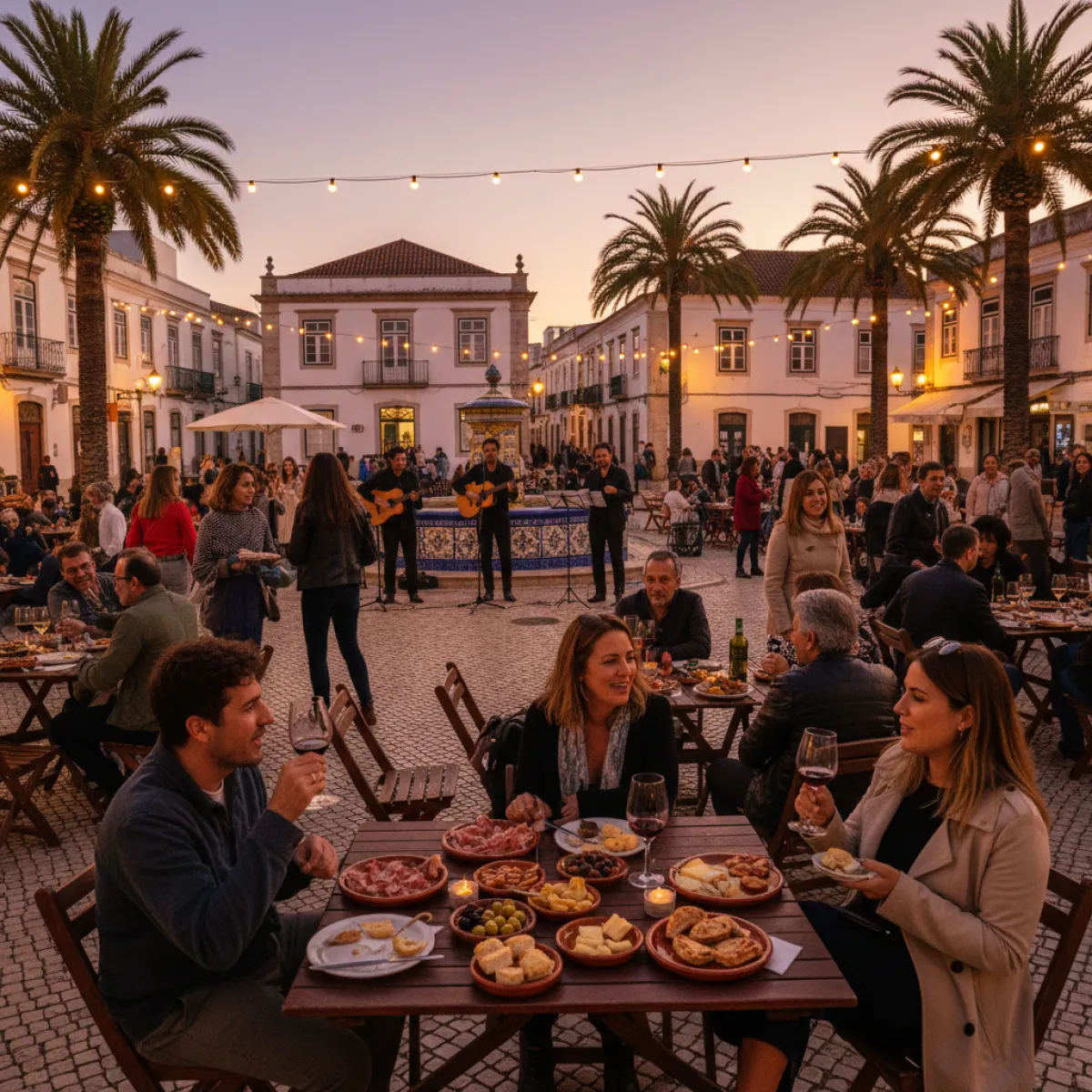
In Vila Real de Santo António the night begins early. Around six in the evening, especially between May and September, the sun hits the yellow facade of the town hall and Praça Marquês de Pombal fills with people who have nowhere to be. They sit on terraces, order a small beer, stay. There is a ritual here without a name, but with rules: nobody looks at their phone, nobody is in a rush, and the conversation is mostly about the weather, football or who passed away last week.
If you are in responsible-tourist mode and want to start the night with a view, take the short drive to the Miradouro de Cacela Velha. It is about 15 minutes by car, the sunset over the Ria Formosa is among the best in the eastern Algarve, and it has a practical benefit: it sharpens the appetite. Watching the sandbanks at twilight makes the first olive of the night taste better. Coming back in time for dinner is easy if you leave Cacela around eight.
Alternatively, if you would rather start the evening on the water, the sunset boat tour on the Guadiana is one of the few organised experiences here that genuinely earn the money. You see Ayamonte on the Spanish side, you watch the river bar open out toward the ocean, and you disembark with that honest hunger that only wine and bread can fix.
What petisco is, and what it is not
A warning to avoid disappointment: petisco is not tapa. Spanish tapas are appetisers. Portuguese petiscos are full meals disguised as appetisers. You order a plate of carapau alimado, another of broad beans with chouriço, another of pig ear vinaigrette, and three plates in you are already loosening your belt. In Vila Real de Santo António this is taken seriously, for one good reason: the city has spent centuries between the Alentejo (which sends the cured meats and the bread) and the sea (which sends tuna, mackerel, clams).
Things you should try, no excuses:
- Tuna with onions (atum de cebolada): the local star, and historically important. Vila Real was for decades the capital of Portuguese tuna fishing and canning. Look for thick steaks, caramelised onions, a drizzle of olive oil. If it arrives shredded and stingy, change tasca.
- Vila Real tinned fish: the canning tradition never fully died. Order a board of mackerel fillets in olive oil and tuna in escabeche with mixed-grain bread. Five euros and half an hour of pleasure.
- Carapaus alimados: small mackerel, grilled, then marinated in garlic and vinegar. Eaten cold, with boiled potato.
- Estupeta de atum: a salad of cured raw tuna, tomato, onion, pepper and olive oil. Practically a signature dish of the eastern Algarve.
- Clams Bulhão Pato style: not exclusive to here, but you are a stone's throw from the Ria Formosa. Ordering them elsewhere in Portugal is acceptable; ordering them here is mandatory.
On wine, drop the wine-list theatre. Most tascas have a house red between five and eight euros a bottle that is perfectly fine with tuna. If you want to step up, ask for a Monte Velho red or an Esporão Reserva, both Alentejo, both almost always available. For whites, an ice-cold Casal Garcia with shellfish is a cliché for a reason: it works.
Where to sleep so this actually works
Here is the practical bit nobody tells you: a wine-and-petiscos itinerary only works if you are not driving. The city is small, flat, easily walkable, and has simple, well-located lodging. For travellers without grand expectations who want to be a five-minute walk from the tascas, The Sun Hostel is an honest pick. Clean rooms, relaxed atmosphere, staff who know where you eat well (and where you do not), and the price leaves room in the budget for an extra bottle.
That said, if you stay two nights, and you should, split your time. One night in town, the next half an hour away in Castro Marim or Tavira. The Sotavento changes a lot in just a few kilometres, and it would be a shame to see only one side of it.
The itinerary, hour by hour
7pm: the first stop is light
Start with something small. A beer, two olives, maybe a small plate of cheese. The point is to open the appetite, not close it. The terraces around Praça Marquês de Pombal are roughly equivalent at this hour; pick one with sun still on your face and stay half an hour.
Don't forget: in Portugal, the couvert (bread, butter, olives, sometimes pâté) is not free. It typically costs between 2 and 4 euros per person. If you don't want it, send it back. It is not rude.
8pm: the actual first meal
This is the hour for serious petiscos. Look for small tascas, paper tablecloths, photocopied A4 menus, and a TV on in the corner. The dimmer the lighting, usually the better the food. Order three or four small plates to share between two, a bottle of red, and stay for an hour and a half.
Practical tip: never order everything at once. Order two plates, taste, then decide the rest. People who throw eight plates at the table get cold food in front of them within fifteen minutes.
10pm: the second round
If you still have room, change venue. The whole point of petiscos is that it is not one full meal in one restaurant, it is a route. Cross two or three streets, find another tasca, order one more thing. It could be clams, a board of cured meats, or just another bottle of wine with bread.
11.30pm: the dessert that is not on the menu
Finish with a coffee and an aged aguardente. Most tascas keep a bottle of Macieira or medronho behind the bar. It costs a euro and a half, two euros, and closes the night as it should be closed. On weekends, there is always somewhere open until one in the morning.
A small detour out of town
The night is beautiful in Vila Real, but dinner does not have to start there. Halfway between Vila Real and Castro Marim, consider an alternative night: a craft beer tasting at Senescal Brewery. It is a small, professional brewery whose beers easily beat the average of what you drink in a typical bar. For travellers tired of red wine, it is a real alternative, and Castro Marim with its castle lit up at night is a hard backdrop to beat.
If you stay an extra night in the region, going inland completely changes the rhythm. Castro Marim, Alcoutim and the upper Guadiana are a different Algarve, no noise, no crowds, a more land-based, more Alentejo-influenced cuisine, more game.
Logistics without drama
- Getting there: by car, A22 to the final exit. By train, a direct line connects Faro to Vila Real de Santo António, around 90 minutes, with the Ria Formosa on view for most of the trip. Worth the ticket for the journey alone.
- Where to park: the main square is partly pedestrianised. There is free parking near the riverfront, by the ferry terminal. Five minutes on foot to the centre.
- When to go: avoid August, when the city fills up and prices rise. May, June, September and October are ideal. Winter has its own charm, with tascas full of locals and almost no tourists, but some places close one weekday.
- How much: a full night of petiscos and wine for two, in local tascas, easily comes in between 35 and 50 euros. In more formal restaurants, expect 70 to 100 euros.
- Reservations: small tascas rarely take bookings, you arrive and wait at the door if you must. For restaurants, calling in the afternoon is worth it.
If you want to keep going across the Algarve
Vila Real is a strong gateway to the less-obvious Algarve. If you are on a longer trip, consider continuing to Faro, where the local culture in Faro carries traditions and experiences quite distinct from the postcard image of the regional capital. To the west, Lagos rewards time spent in it: our Lagos neighborhood guide helps you navigate the city without falling into the usual traps. And if you are travelling with kids, a detour through Silves makes sense, and our honest Silves family guide tells you exactly what is worth it and what is not.
One last opinion
Vila Real de Santo António is not a city to drive past. It is a city to stop in for a night, eat slowly, drink without rushing, and discover that the eastern Algarve has its own identity, distinct from the touristic west. It does not have a poster beach, it does not have a beachfront five-star, it does not have a famous golf course. It has a perfect Pombaline grid, a river dividing two countries, and a set of tascas where 25 euros per head buys better food than half the restaurants in Lisbon at 60. That is not folklore, that is arithmetic. Go with time, go hungry, and save some appetite for breakfast the next day. It is over a slice of bread with Serra cheese and a coffee at the market square that the previous night finally makes sense.