Stargazing in Montalegre: Dark-Sky Nights in Barroso
In Barroso, around 1,000 metres up with almost no light pollution, you see the Milky Way with the naked eye from an empty viewpoint. There is no fixed tour in Montalegre: here is how to do it yourself and which local operators can arrange the night.
Let me be straight with you before anything else: right now, Montalegre has no operator selling a fixed "stargazing tour" with a ticket and a set time. I looked. What exists is both worse and better than that. Worse, because you have to sort it out yourself or ask a local operator to put together the outing. Better, because the Barroso plateau, sitting at around 1,000 metres with almost no light pollution, hands you one of the cleanest skies in northern Portugal without charging anyone a cent.
What it actually is
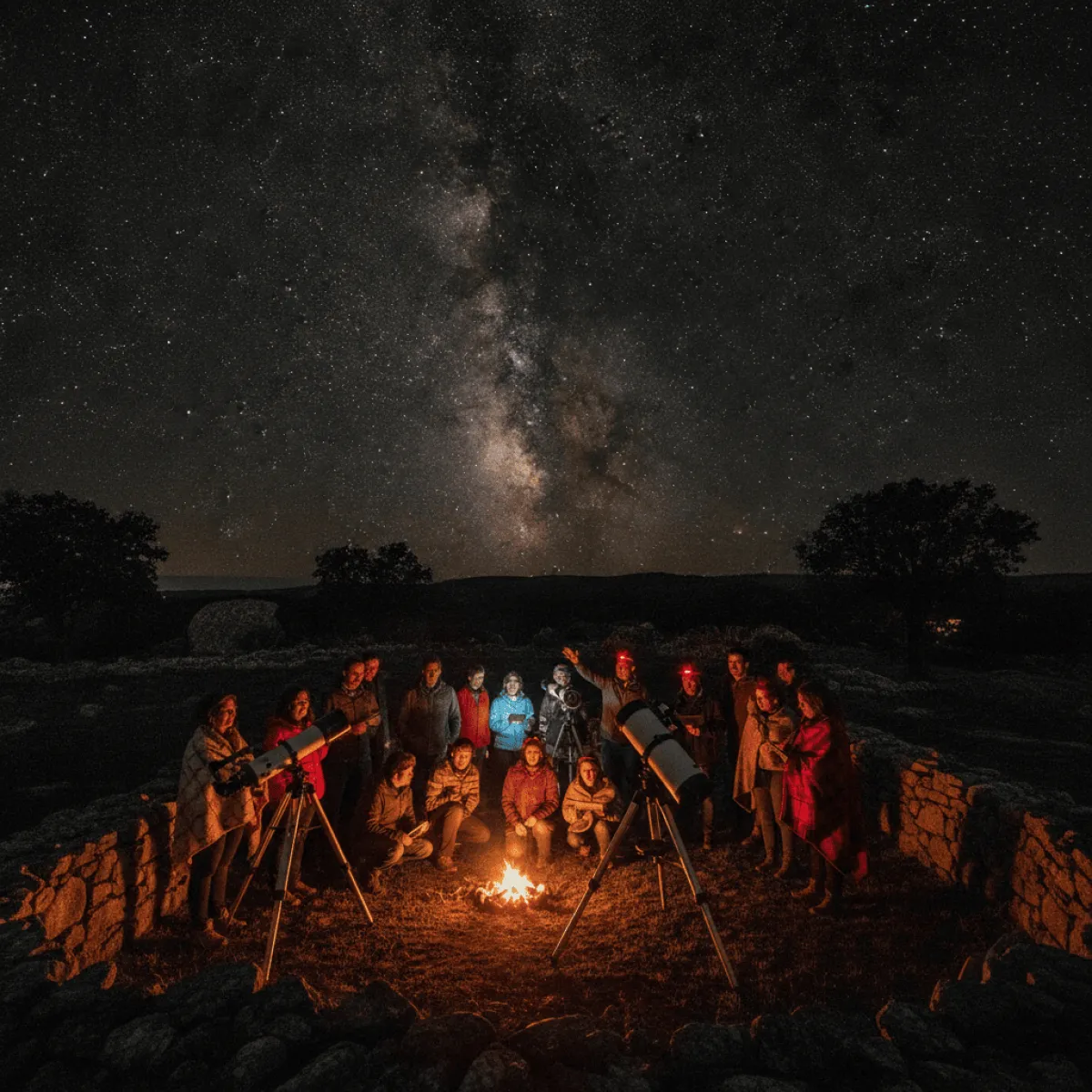
Barroso is high, empty country. For anyone chasing stars, that is gold. Drive ten minutes out of Montalegre town, kill your headlights at any pull-off, and the sky cracks open. On a moonless, cloudless night you see the Milky Way with the naked eye, that pale band stretching from one horizon to the other. You do not need a telescope for that. You need darkness, patience and warm clothes, and Barroso gives you the first two for free.
The "experience," the way I do it, is simple: pick a high, dark spot, arrive at sunset, let your eyes adjust for a good twenty minutes (the step everyone skips and the one that matters most) and stay put. I bring a blanket, a flask and a star-map app on my phone with the screen in red mode. That is it. The best moment is not when you spot your first constellation, it is later, when you stop trying to name things and simply notice how many stars there are.
Where to go, specifically
My favourite spots sit south and west of town. The high ground near Pitões das Junias and Paredes do Rio, shepherds' villages above 1,000 metres, has open horizons and almost no light. The Alto Rabagao reservoir, with its bridge over the water, is another place where the sky reflects and doubles. If you want serious altitude, the Larouco range is the roof of the region, but the road is demanding and I would not send anyone up there in the dark who does not know the ground.
An honest warning: these are real geographic points, not equipped observation stations. No toilets, no cafe, nobody. Bring everything in and carry everything out.
If you would rather not go alone
There are two serious active-tourism companies based in Montalegre that know the terrain cold and can arrange a tailored night outing on request. NaturBarroso (Terreiro do Acougue, Montalegre; geral@naturbarroso.net; +351 276 511 237 / 935 663 068) runs walks and routes across the region by appointment. CEITA, in Friaes, runs guided hikes and jeep tours. Note: neither advertises stargazing as a catalogue activity, so a night session is something you would need to agree and confirm directly with the operator, price included. I am not inventing figures I could not verify.
If you want a genuinely organised astronomy experience, with a guide and equipment, the nearest certified site is not in Montalegre but across in Peneda-Geres National Park: the Porta do Mezio star-observation park in Arcos de Valdevez, the country's first "Starlight Stellar Park." Worth the detour if what you want is a telescope and an explanation.
When to go
Winter skies in Barroso are the most spectacular and the most brutal. The cold, dry air leaves the stars razor-sharp, and Orion owns the sky from December to February. But it is genuinely cold: nights of minus five are normal and the wind on the plateau cuts. If you have never been here in the dark, come first in summer or early autumn, August and September nights, gentler and with the Milky Way at its peak. Always plan around the new moon; a full moon erases half the sky.
If you are bringing a camera, my winter photography itinerary across the plateau points to the same viewpoints that work after dark, and helps you read the region's light before you shoot it blind.
What to bring
- More clothing than you think you need: layers, hat, gloves. Even in summer the temperature drops sharply after sunset.
- A head torch, ideally with a red mode, so you do not wreck your night vision or anyone else's.
- A blanket or camp chair, a flask of tea or soup, and a snack.
- A charged phone with a star-map app and your spot's GPS saved offline; signal fails in many places.
- Closed shoes and watch your footing: loose granite and free-roaming cattle are part of the scene.
Where to stay and what else to do
Driving back through the mountains in the dark after a freezing night is not ideal. It pays to sleep nearby: the Hostel Retiro do Geres is a simple, well-placed base, minutes from the viewpoints.
While you are here, Barroso is worth far more than one night. By day, the castle, the castro and the mountain kitchen easily fill a day, and the region's stories, from its Celtic roots and superstitions to the famous Friday the 13th night, add another layer to the darkness around you under the stars.
Is it worth it?
It is, with one condition: come with the right expectations. No astronomer will greet you in a heated observatory. You will be alone on the plateau, cold, looking up. But that lack of production is exactly what makes it good. The silence of Barroso at night is near total, and when the Milky Way rises over a granite village without a single light on, you understand why you drove this far. Always check the weather, and if you hire an operator, confirm the programme and price directly with them.