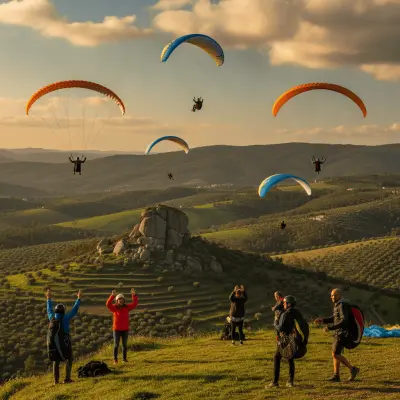
Paragliding in Linhares da Beira: Portugal's Free-Flight Cathedral
The launch sits at 1,152 metres and the wind rising off Serra da Estrela keeps the tandem wing airborne long enough to watch the medieval castle shrink. Clube de Voo Livre Vertical runs baptism flights with pilots certified by the Portuguese Free Flight Federation.
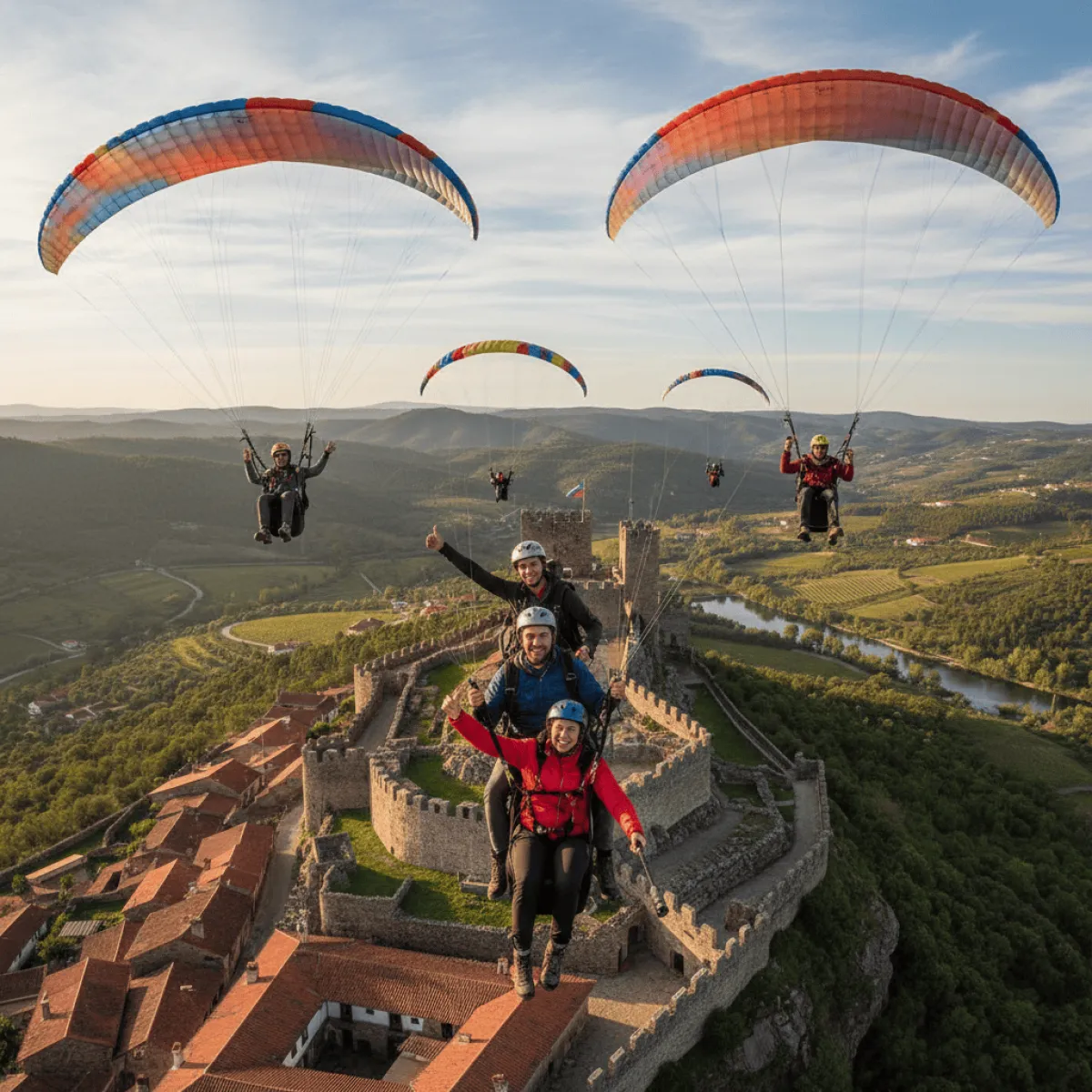
There's a moment, roughly halfway through the flight, when you understand why Linhares da Beira is called the Cathedral of Paragliding. It's not marketing copy. It's literal: the launch site sits at 1,152 metres, faces southwest, and the wind rising off the Serra da Estrela ridge keeps you airborne long enough to watch the medieval castle shrink to the size of a toy. Pilots who've flown here for twenty years say few places in the Iberian Peninsula deliver such consistent conditions for first-time tandem flights. After trying it, I tend to agree.
Who runs the flights: Clube de Voo Livre Vertical
The operator to know is Clube de Voo Livre Vertical, based in Sameiro, a few minutes from Linhares. It's the club that has kept the activity alive in the area since the 1990s, organises the International Paragliding Festival every summer, and works with pilots certified by the Portuguese Free Flight Federation (FPVL). Baptism flights are flown on a two-seater tandem wing, with an experienced pilot strapped in behind you. You don't need any prior experience. You don't need to run hard.
Direct contact: phone +351 966 387 251, email clube@clubevertical.org, address Largo da Reboleira, Sameiro, 6260-311. The website is clubevertical.org and has a booking form. Prices vary depending on flight length and season, so confirm directly with the provider before driving up.
How a flight works, start to finish
The logistics are simpler than they sound. You agree on a time and meeting point. The club usually directs you to the landing zone, an open field at the entrance of the village, near the road junction. From there you drive up to the launch site, about 6.5 km away on a narrow mountain road, roughly a 15-minute ride. The drive is slow and scenic and counts as part of the experience.
At the top, your pilot reads the wind. If conditions aren't right, you wait or reschedule. Nobody flies just to fly. Once the window opens, you're fitted with a harness and helmet, given a short briefing (basically: keep running and don't sit down too early), and within three or four steps you're off the ground. This part surprises most people: the launch is so quick you barely register it.
The flight itself
A tandem baptism flight typically lasts between 15 and 30 minutes, depending on thermals. On good days with a strong pilot, it stretches longer. You fly over the medieval village, see the 12th-century castle from above (a view nobody else gets), and on clear days you can pick out the Cova da Beira plain extending almost to the Spanish border. The best moment, in my opinion, is not the panoramic view. It's the tight turn the pilot makes just after launch, when the whole village swings beneath your feet. That's when your stomach realises you're actually flying.
If you're sensitive to heights, don't worry. Being suspended under an open wing is less vertiginous than looking off a balcony. Almost nobody gets motion sickness. Pilots read their passengers: if you want calm, it's calm; if you ask for tricks, they'll throw in a couple of wingovers before landing.
When to go and what to wear
Flights run year-round, but May to September is the sweet spot. Afternoons work better than mornings here, opposite to many Portuguese sites: the launch faces northwest and needs the breeze that builds as the day warms. Book a few days ahead, especially on weekends, and keep your phone on the day itself in case your pilot needs to push the slot.
- Closed shoes, ideally trainers or hiking boots. Skip the sandals.
- Long trousers. At 1,000 metres up it's always cooler than down in the valley.
- A windproof jacket, even in summer.
- Sunglasses and sunscreen. You'll be facing into the sun for a few minutes.
- Camera or phone on a neck strap. Holding anything loose in the air is a bad idea.
Getting there and where to stay
Linhares is about 50 minutes off the A25 motorway, exiting at Celorico da Beira. From Lisbon it's nearly three hours, from Porto just over two. The village has no useful public transport, so a car is essential.
If you want to build a weekend around the flight, INATEL Linhares da Beira Hotel Rural is the logical pick: the club partners with the hotel during the festival, and it's right at the village entrance. For smaller, more characterful options, see the guide on where to stay in a village without neighborhoods. To fill the rest of the day once you've landed, the piece on the museum with no walls or ticket helps explain why this village deserves more than two hours. If you'd rather stay on your feet, the hiking trails ranked by difficulty and scenery guide has good options nearby.
What nobody tells you
Two things. First, don't choose your flight day by clear blue sky. Days with scattered cumulus clouds give the longest flights, because they mark the thermals. Ask the pilot what he thinks of the day, don't just glance out the window. Second, pay for the video if it's offered. Photos taken from the camera on the end of the wing all look pretty similar; the video, with the sound of the wind and your real face working out that you're actually flying, is what you'll keep.
Linhares is, practically speaking, the best place in Portugal to do this flight for the first time. Not because of marketing. Because of geography and because competent people have been working this hillside for thirty years.

Similar Experiences
Paragliding in Linhares da Beira: Portugal's Free Flight Cathedral
Paragliding in Linhares da Beira: Flying the Serra da Estrela