Linhares da Beira: Hiking Trails Ranked by Difficulty and Scenery
Linhares da Beira has at least four signposted trails right at its doorstep, from a 3 km stroll by the castle to a 44 km stage of the GR22 Historic Villages route. We ranked each one by difficulty and scenery so you know exactly what you're getting into.
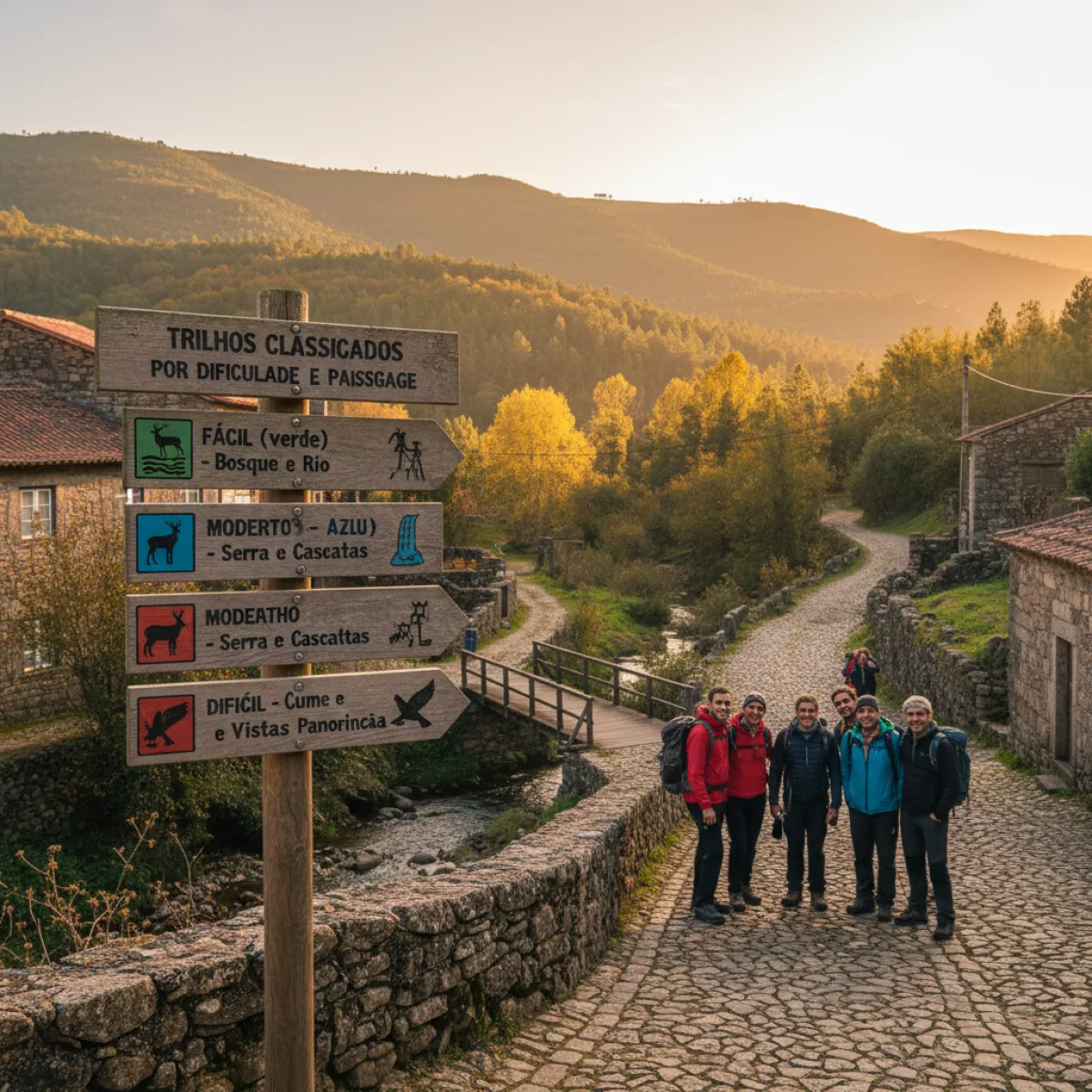
Linhares da Beira is known as Portugal's paragliding capital, but most visitors never lace up a pair of hiking boots. That's a mistake. This historic village, perched at 820 metres on the slopes of Serra da Estrela, is the starting point for some of the most beautiful, and emptiest, trails in central Portugal. The network of walking routes in the municipality of Celorico da Beira has been refreshed in recent years, and Linhares serves as a base for at least four short routes and a stage of the Grande Rota das Aldeias Históricas (GR22).
Here's what you need to know before you tie your laces.
PR1, Trilho das Ladeiras (3 km | Easy)
If you only have one morning in Linhares, do this one. The PR1 starts and ends at the castle, drops down along an old ox-cart track to the agricultural fields in the valley, and loops back through the village. About 3 kilometres with minimal elevation change, which translates to ninety minutes of relaxed walking, or three hours if you stop to photograph every granite wall, which you will.
The opening descent is the highlight. You pass through still-active farmland on classic terraced hillsides, and the Mondego Valley opens up ahead at a scale that photographs can't capture. Halfway through, you cross the paraglider landing field, and if you're lucky, someone will be gliding directly overhead. If that sparks your curiosity, read our practical guide to paragliding flights in Linhares.
Best for: Families, casual walkers, anyone with dodgy knees. No fitness required.
Scenery: Farmland, stone walls, open views over the Mondego Valley. Pretty, but not the most dramatic in the area.
PR4, Trilho da Calçada Romana (5 km | Easy to Moderate)
This is my favourite of the short routes. The PR4 follows a stretch of Roman road, original granite flagstones, worn smooth by centuries of carts and livestock, that once connected Linhares to other settlements in the mountains. Five kilometres, circular, with slightly more elevation gain than the PR1 but nothing intimidating.
What sets this trail apart is the historical context. Walking on stones that Roman legions once trod gives the landscape a different weight. The route passes through grazing areas with traditional stone corrals (locally called "cortes") and there are stretches where you walk between ancient walls so high they block the view, until they suddenly open onto a valley panorama. It feels like a deliberate scenic trick.
Best for: Anyone with an interest in history and archaeology. Also works well for beginner hikers who want a slight step up from the PR1.
Scenery: Roman road, rural granite architecture, pastoral landscape with occasional valley views. More intimate and sheltered than the other trails.
PR3, Trilho da Serra do Ralo (Moderate)
Things get more serious here. The PR3 starts from the substation at Serra do Ralo Wind Park, in São Cornélio (Vide-Entre-Vinhas parish), and runs through terrain within the Serra da Estrela Natural Park and the Natura 2000 network. It's more isolated, wilder, and demands more attention to trail markers.
The landscape shifts register: fewer granite walls and cultivated fields, more scrubland, rock outcrops, and that particular mountain silence. On clear days, visibility is enormous, you can see beyond the Mondego Valley towards the Gardunha range. If that horizon intrigues you, we have a guide on seeing the cherry blossoms in Fundão and the Serra da Gardunha, which is spectacular in spring.
Best for: Experienced walkers seeking solitude and wilder landscapes.
Scenery: Open mountain terrain, wind turbines, low scrub, vast horizons. The trail with the least human presence in the Celorico da Beira network.
GR22, Grande Rota das Aldeias Históricas (Trancoso–Linhares Stage: 44 km | Hard)
The GR22 is the long-distance route linking Portugal's 12 Historic Villages across 565 kilometres. The stage from Trancoso to Linhares da Beira covers roughly 44 kilometres with over 1,000 metres of cumulative elevation gain. This isn't a hike, it's an expedition. Expect 11 to 13 hours of walking, which in practice means splitting it over two days with an overnight stop in one of the intermediate villages.
If you commit to the full stage, the reward is landscape diversity: you start on the cereal plains around Trancoso, climb through woodland, and finish on the dramatic hillside of Linhares, with the castle silhouetted atop the rocky spur. Arriving at the village this way, on foot, tired, with the sun dropping, is incomparably more beautiful than pulling up in a car off the IC12.
For those who prefer something less extreme but still on the GR22 logic, the next stage, from Linhares to Piódão, is equally spectacular and passes through some of the most beautiful schist villages in the region.
Best for: Experienced hikers, multi-day trekkers. Requires preparation, proper gear, and logistical planning.
Scenery: The best in the network. Crosses plateaus, deep valleys, woodlands, and villages with preserved medieval architecture. The complete Beira Interior experience.
PR2, Trilho de São Gens
I'm including the PR2 for completeness, but available information on this trail is limited. It's part of the same Celorico da Beira walking network and starts in the Linhares area. Check locally at the parish council or the village tourist office before setting out, signage may not be as current as on the other routes.
When to Go
Spring (April to June) is the best season. The mountains are green, temperatures are comfortable for hiking (15-22°C), and wildflowers blanket the fields. Autumn (September to November) is the second-best option, with less heat and beautiful colours in the vegetation.
Avoid summer for the more exposed trails, Serra do Ralo at 2pm in August is an exercise in masochism, not hiking. Winter can be beautiful, but temperatures drop below freezing at higher elevations and rain makes some dirt paths treacherous.
Practical Logistics
Linhares da Beira is in the municipality of Celorico da Beira, Guarda district. By car, it's roughly 3.5 hours from Lisbon via the A1/A25 and 2 hours from Porto. There's no decent public transport, a car is essential.
In the village, accommodation options are limited but they exist: there's rural tourism and country houses. Book ahead in high season. For food, look for local restaurants serving roast kid goat, Serra da Estrela cheese, and corn bread, simple dishes made with ingredients that justify the trip.
Gear: For the PR1 and PR4, decent trail shoes are enough. For the PR3 and GR22, hiking boots, poles, plenty of water, and sun protection are mandatory.
Maps and signage: The PR routes are marked with standard waymarks (yellow and red for small routes), but carry an offline map, mobile coverage in the mountains is patchy. Wikiloc and AllTrails both have GPS tracks for all of these routes.
What to Do After the Hike
Linhares is small, but it deserves time. The castle, with its two towers (the Keep and the Clock Tower), is open to visitors and the view from the top repays the steep steps. In the village, look for the parish church with three panels attributed to Vasco Fernandes (Grão Vasco), it's remarkable to find work by one of Portugal's greatest painters in a village this remote.
The 16th-century pillory topped with an armillary sphere and the medieval forum with its stone tribune are unique pieces. And if after the hike you still have energy for adrenaline, Linhares is the place: the paragliding launch over the Mondego Valley is one of the most reputed on the Iberian Peninsula.
To explore the mountains in more depth, Manteigas and the Snow Wells trail are less than an hour's drive away and offer trails of a different character, more vertical, more alpine, equally beautiful.
Linhares da Beira doesn't need marketing. It needs boots.
