Paragliding in Linhares da Beira: Portugal's Free Flight Cathedral
The launch sits at 1152 metres, 450 above the valley, at a site Portuguese pilots call the Cathedral of Paragliding. Tandem baptism flights run with Clube de Voo Livre Vertical, the club that manages the site and hosts the international festival each summer.
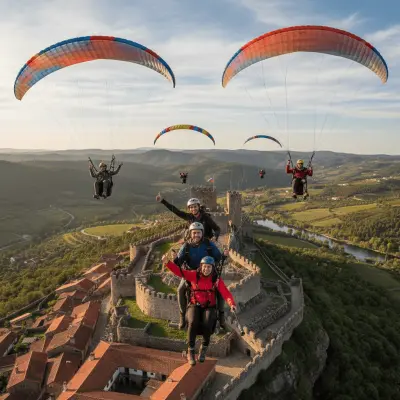
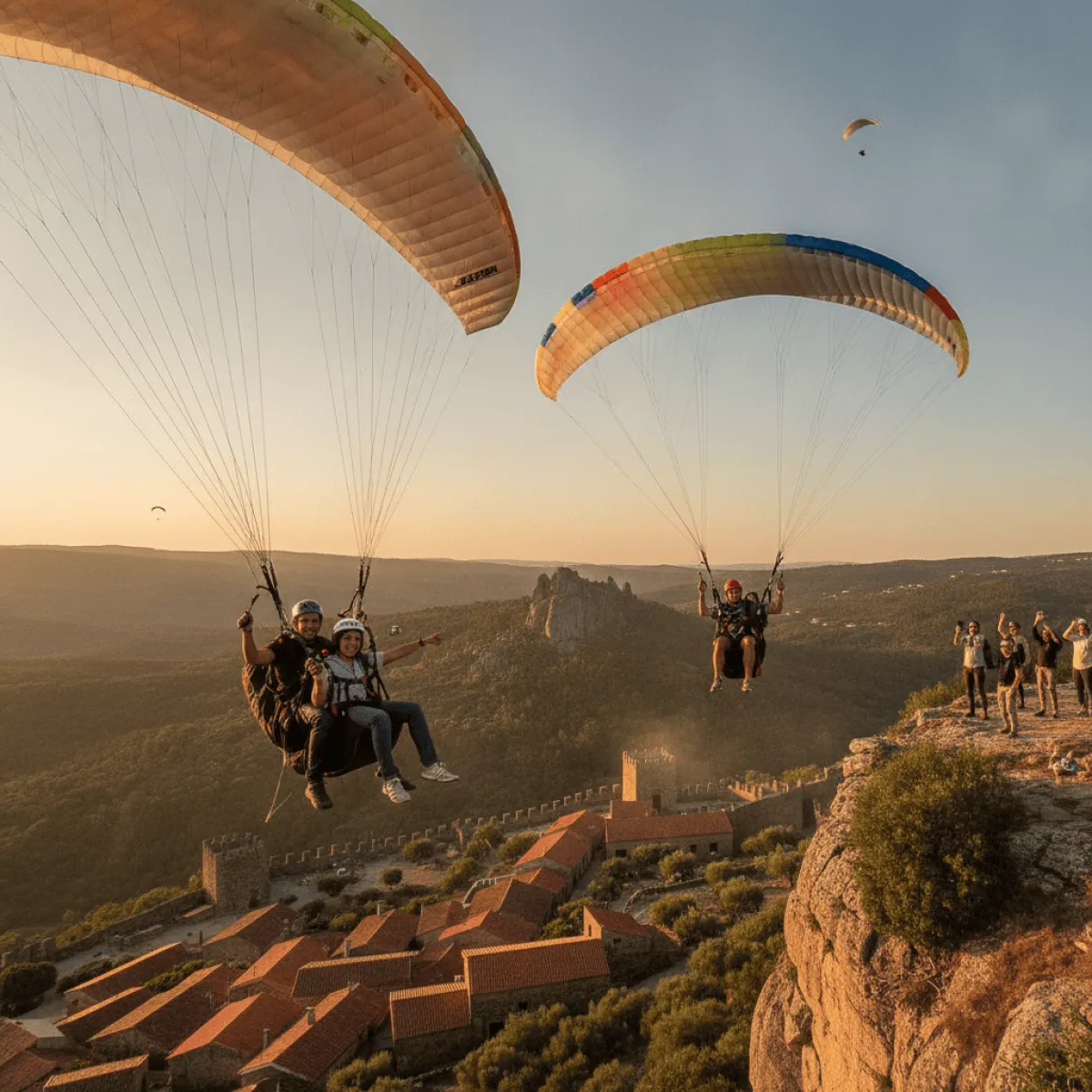
The takeoff above Linhares da Beira sits at 1152 metres, roughly 450 metres above the valley floor. You run six steps down a slope, the wing loads up, and suddenly the Templar castle below looks like something from a model railway. Portuguese pilots call this site the Cathedral of Paragliding, and that name was not invented by a tourism board. It comes from the free flight community itself, because the thermals here are among the most reliable in the country and the international festival held in the village every summer pulls pilots from across Europe.
Who actually runs the flights
The flying site is managed by Clube de Voo Livre Vertical, a proper free flight club based in Sameiro near Manteigas. They organise the Linhares International Paragliding Festival, run competitions, and maintain the official takeoff and landing zones. For first-timers they offer tandem baptism flights with pilots certified by the Portuguese Free Flight Federation. At recent festival editions, a baptism flight registration cost 80 euros, which is a useful benchmark, but confirm the current rate directly with the club. Contact: +351 966 387 251, [email protected], clubevertical.org.
A second verified option is Montanae, run by pilot Pedro Ferrão Patrício, who holds a current FAI tandem licence, has logged over 1700 flight hours, and flies Linhares regularly along with other Serra da Estrela sites. Book via WhatsApp (+351 969 574 509) or email ([email protected]) through montanae.com. They do not publish prices online, so ask for a quote when you book.
How it works, step by step
The usual meeting point is the official landing field at the entrance to the village, though you should confirm directly with the provider when booking. From there you drive up to the launch: 6.5 kilometres, of which 5 are tarmac and 1.5 are dirt track, about 15 minutes of switchbacks with increasingly ridiculous views.
- Briefing: ten minutes covering the takeoff run, body position, and the landing. Your only real job is to run when told and not sit down in the harness too early.
- Gear: harness, helmet, all provided. You sit in front, the pilot behind.
- Takeoff: a handful of steps down the slope and the wing does the rest. It feels far gentler than you expect, more like an elevator than a rollercoaster.
- The flight: duration depends entirely on the day. With good thermals the pilot can spiral upwards and stretch the flight; on a calm evening it is a smooth glide down to the valley. Budget around two hours for the whole experience including the drive up and briefing.
- Landing: in the big field at the village entrance. Lift your feet, let the pilot work, done.
The best moment
Honestly, it is not the takeoff. It is the minute when your brain stops auditing the equipment and you actually look down: the granite lanes of Linhares threaded between boulders, the castle with its two towers, the Mondego valley opening to the north. It is the only viewpoint that does the village justice. If conditions are right, you may share the air with raptors riding the same thermals. Experienced pilots watch the birds to find rising air, and seeing a vulture circle twenty metres off your wingtip is the sort of thing you will still be describing at dinner parties years later.
Practical tips
- Clothing: bring a windproof layer even in July. At altitude with airflow in your face, the perceived temperature drops fast. Closed shoes with decent grip, never sandals.
- Stomach: eat something light beforehand, neither fasting nor fresh from a three-course lunch. Save the feast for afterwards at Restaurante Cova da Loba in the village, which is the correct reward for jumping off a mountain.
- Weather: flights are only confirmed 24 to 48 hours ahead because everything depends on wind. Favourable directions at Linhares are southwest, west, northwest and north. If your operator cancels, take it as proof they take safety seriously, and build flexibility into your plans.
- Season: spring and early summer bring the strongest thermals. For atmosphere, aim for the summer festival, when the sky above the village fills with colour and baptism flights run back to back. For quiet, book a midweek slot outside festival dates.
- Photos: ask whether the pilot carries a camera. Holding your phone mid-flight is how phones end up in the Mondego valley.
Before and after the flight
Do not treat this as a drive-by activity. Stay the night, for instance at the INATEL Linhares da Beira Hotel Rural, so you are at the meeting point without a pre-dawn drive. The next morning, walk the ground you flew over: the trails around Linhares range from easy strolls to genuine climbs. And give the village itself a slow couple of hours, because it really is a museum with no walls or ticket: pillory, manor houses, and a castle you will want to climb again just to watch the paragliders drift past at eye level.
Getting there
Linhares da Beira is in the municipality of Celorico da Beira, about 20 minutes from the A25 motorway exit. There is no practical public transport to the village, so a car is essentially mandatory. The landing field sits right at the village entrance and is impossible to miss: on flying days it is the flat meadow full of folded wings and pilots packing kit.
One honest closing note: this is not a theme park ride with fixed departure times. It is real free flight, run by people who fly because they love it, and the weather has the final word. That unpredictability is half of what makes it worth doing. When the day is right and the wing inflates above the Cathedral, you understand why some people rearrange their whole lives around this.
Similar Experiences
Paragliding in Linhares da Beira: Flying the Serra da Estrela
Paragliding in Linhares da Beira: Iberia's Flying Cathedral