Mushroom Foraging in Montalegre: What Actually Exists
There is no year-round commercial mushroom tour operator in Montalegre. What does exist is the Vila Nova Mycological Meeting, run by the town hall every November, with wicker baskets, a working mycologist and wild mushroom soup at the end. That is the one to book.
Let me be straight with you: as of May 2026, there is no commercial year-round tour operator in Montalegre offering guided mushroom foraging walks with fixed pricing, online booking, and set departures. I looked. I checked the obvious candidates (CEITA Montalegre, Passa Montanhas, the Ecomuseu de Barroso), and the answer is the same everywhere. Mycological foraging in the Barroso region does happen, but it is run as seasonal community events organised by the Câmara Municipal de Montalegre (the town hall) and local associations, mostly between October and December. Anyone telling you otherwise in May is improvising.
That said, it is absolutely worth doing. Barroso, with altitudes ranging from 300 to 1500 metres, has some of the best fungal habitat in Portugal: damp oak woods, chestnut groves, pine stands and heather scrub. You can find porcini (Boletus edulis), saffron milk caps (Lactarius deliciosus, locally called míscaros), tortulhos, and the magnificent parasol mushroom (Macrolepiota procera) that village kids still call "frade". The trick is to hit the right window, and to go with someone who actually knows.
The real events that exist (and that you can sign up for)
Vila Nova Mycological Meeting (Encontro Micológico)
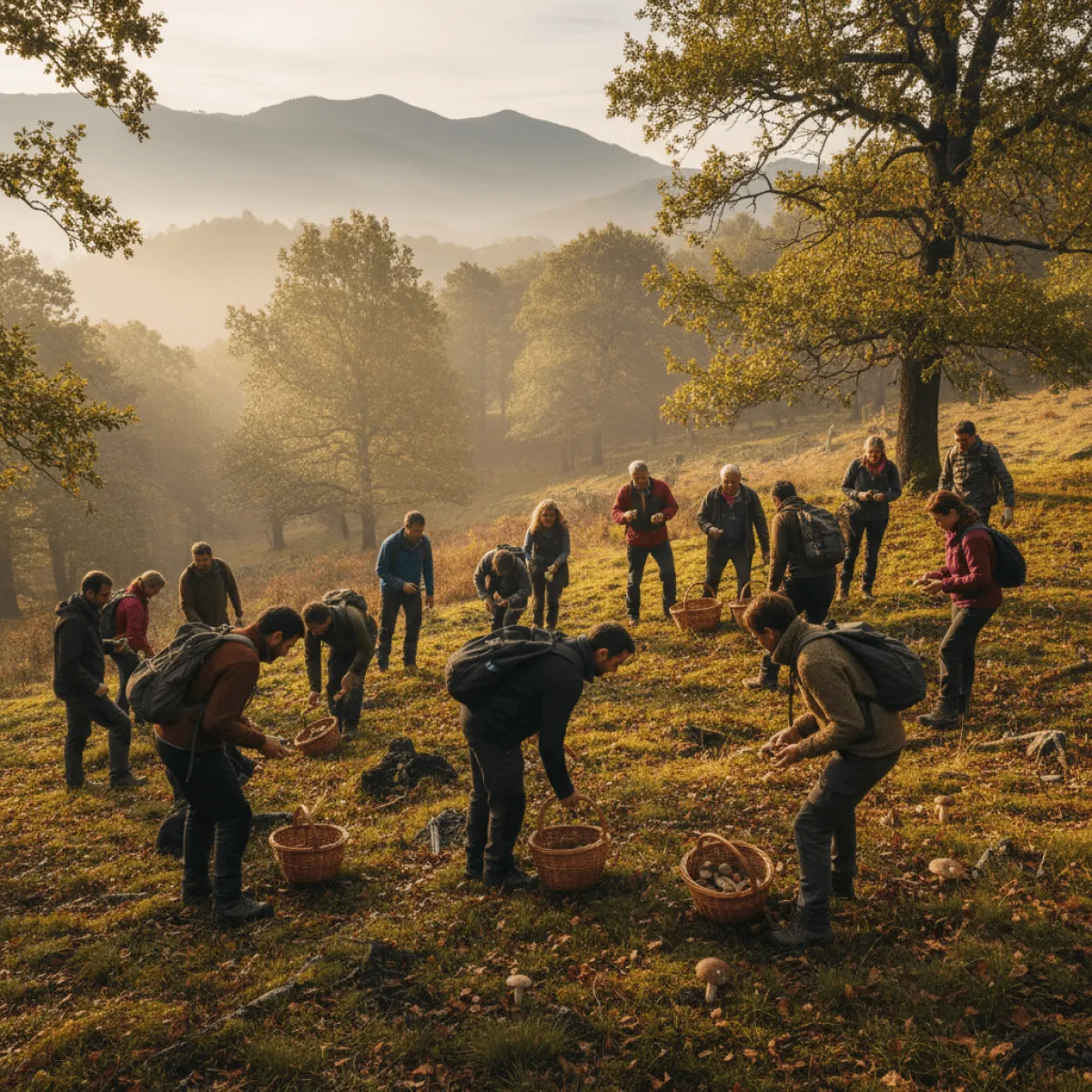
Organised by the Municipality of Montalegre, usually in early November, in the village of Vila Nova (Cervos parish). This is the most consistent date on the calendar. It starts at first light: wicker baskets are handed out, there is a short briefing on edible and poisonous species, and then a field walk led by invited mycologists. In the afternoon you get mushroom soup, identification of the morning's haul, and a tasting. You register directly with the town hall, by phone (+351 276 510 200) or via their official page.
Mushroom and Chestnut Festival in Salto
Annual, late October, in the parish of Salto (Montalegre). Includes a guided mycological walk, a lecture and an exhibition. When it started in the early 2000s it cost under ten euros for association members. Confirm directly with the provider for current pricing, because in some years it doubles depending on whether lunch is included.
Borralha Mycology Meeting
Run by the Ecomuseu de Barroso, based in Montalegre. It is more technical, with mycologists from UTAD university, but open to the public. It does not happen every year, so write ahead.
What to expect on the day
Meeting is early, between 8 and 9 am, usually at the town hall square or at the host village centre. You get a wicker basket (and this matters: no plastic bags, the spores need to drop along the way), a printed species sheet, and you join a group of 15 to 25 people split between one or two guides with formal mycology training.
You drive up to the oak woods. In Barroso the best ground is often between Pitões das Júnias, Tourém and Paredes do Rio: damp, mossy woodland, where saffron milk caps appear in vivid orange patches under the pines, and porcini favour the old oaks. The guide stops every five minutes or so, picks up a specimen, shows you the stem, the spongy underside of the cap, the smell, and explains how to tell the edible one from the lookalike. Amanita phalloides, the death cap, grows in the same spots. This is why you do not do this alone on your first time.
By late morning you head back, spread the haul out on a long table, and the mycologist sorts it species by species. This is the best part of the day. You learn more in twenty minutes watching what other people picked than in an hour of lecture. Lunch follows: wild mushroom soup, rice with míscaros, and if you are lucky, a barrosã beef steak.
What to wear and what to bring
- Waterproof hiking boots, no compromise. The ground will be wet, with rotting leaves, and in November there will be ice in shaded patches.
- Long trousers and a thermal base layer. Montalegre in November can be 2°C with fog at dawn, even when you left Porto in 18°C sunshine.
- Waterproof jacket, beanie, light gloves.
- Wicker basket or rigid ventilated container (organisers provide one, but bring your own if you have it).
- Small folding knife to cut the stem without ripping out the mycelium.
- Water bottle and a snack. Four hours in the woods is real work.
- Charged phone. Mobile coverage is patchy on the plateau.
When to go, where to sleep, how to get there
The good window is October through mid-December. September is too early unless there has been heavy rain. January and February still produce some winter species, but the cold is no joke. I would strongly recommend sleeping in Montalegre the night before, not trying to round-trip from Porto on the day, because departure is before sunrise and the Cabreira road can be treacherous with frost.
For accommodation, Hostel Retiro do Gerês is a solid pick with early breakfast. If you stay an extra day, I suggest the winter photography itinerary on the plateau, or the more cultural route through castle, castro and mountain kitchen. If you happen to land on a Friday the 13th, it is worth understanding what is real and what is staged before you buy the ticket.
The best moment, in my view
It is not finding the big porcini, although that does give you a ridiculous level of satisfaction. It is the lunch table, after sorting, when you taste a saffron milk cap grilled over oak embers with sea salt flakes for the first time and realise it cannot be bought. It grew 200 metres from where you are sitting, met two people in its life (the guide and you), and tastes like nothing on a supermarket shelf. That is why you make the trip.
Direct contact
Câmara Municipal de Montalegre: +351 276 510 200. Mushroom page with event calendar: cm-montalegre.pt. My advice is to email in September asking for the November dates. Places are limited, registration usually opens three to four weeks ahead, and fills fast.
For background on the territory before you go, read about the Celtic roots and superstitions of Barroso. It explains why the forest is respected here in a different way than elsewhere.