Where to See the Almond Blossoms in the Algarve in March
In March, the Algarve's interior transforms into a blanket of white and pale pink as the almond trees bloom. From the barrocal of Loulé to the Serra de Monchique, this is the guide to chasing the blossom, with stops for fresh almonds, xerém, and piri-piri chicken along the way.
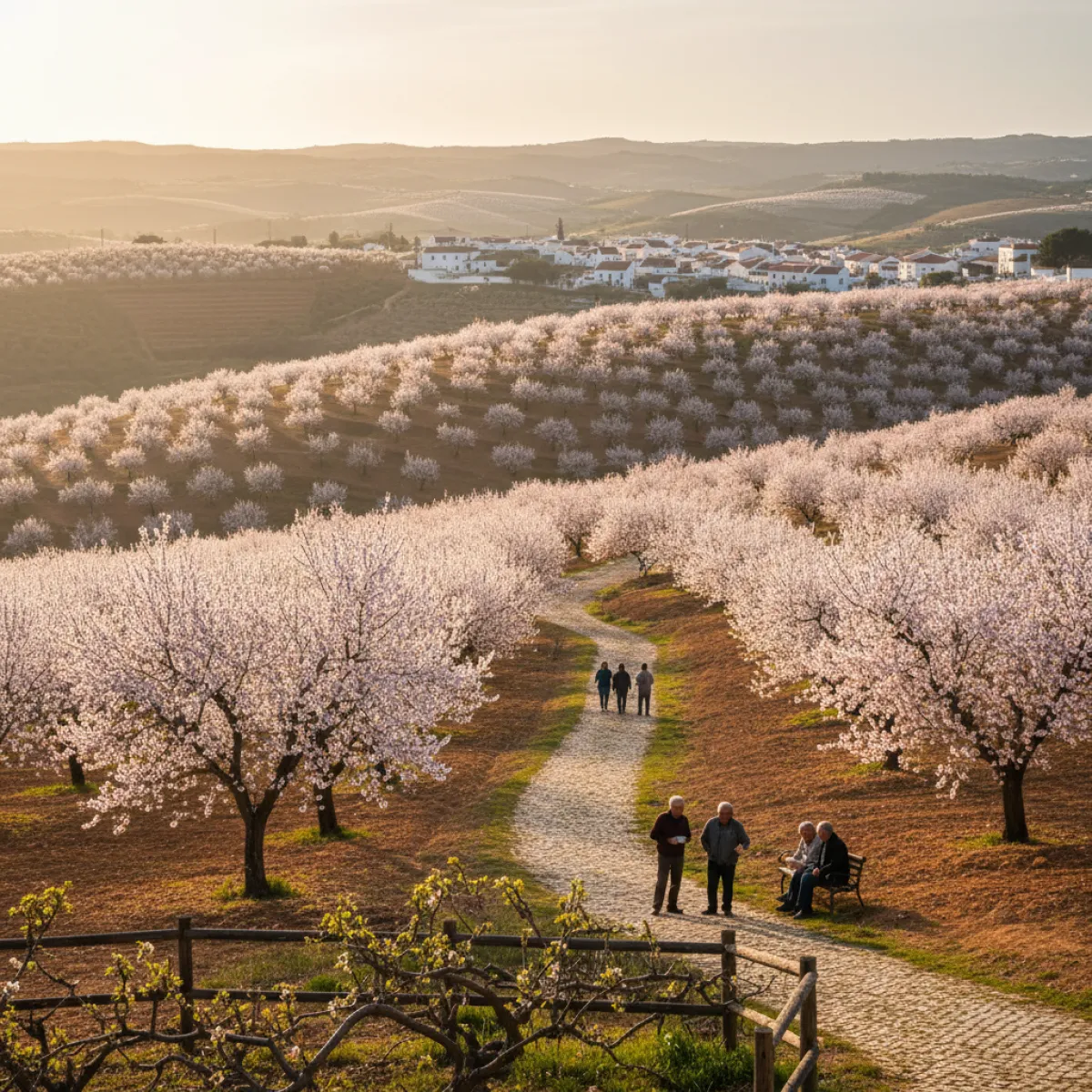
There is something quietly defiant about a tree that blooms before spring has officially arrived. The almond trees of the Algarve don't wait for permission from the calendar. By February, sometimes as early as January, they begin draping the region's interior in white and pale pink, as if someone had shaken out a bedsheet over the hills. But it is in March, when the bloom reaches its peak in the higher, more inland areas, that the spectacle becomes genuinely impossible to ignore.
This is not the Algarve of the brochures. There are no golden beaches here, no sunset cocktails, no golf courses. The Algarve of the almond blossoms is another country entirely: narrow roads between dry-stone walls, villages where cafés still serve medronho brandy at the counter before noon, and a late-winter light that makes everything look like an oil painting.
Why the Algarve Has Almond Trees (And Why We Forgot)
The story of the Algarve's almond trees begins with the Moors, as so many good things in southern Portugal do. They planted the first ones more than a thousand years ago, transforming the barrocal, that strip of limestone terrain between the mountains and the coast, into a productive landscape of almonds, figs, carobs, and olives. For centuries, almonds were one of the region's major exports. There were processing factories in Loulé, Faro, and Tavira.
Then came tourism. From the 1960s onward, the coast filled with concrete, and the almond groves of the interior were gradually abandoned. Many trees were uprooted to make way for citrus orchards, or simply left to neglect. But the almond tree is stubborn, and resilient. In recent years, a quiet movement has been replanting almond trees and championing this agricultural heritage. Today, the almond blossom is one of the finest reasons to visit the Algarve outside peak season.
The Bloom Map: Where to Go and When
The flowering doesn't happen all at once. It depends on altitude, sun exposure, and the variety of tree. As a general rule, almond trees closer to the coast, in the lower barrocal, bloom first, between January and February. Those in higher areas, in the transition zone toward the mountains, bloom later, in March. This means that with some planning, you can chase the blossom for nearly three months.
Alta Mora and the Barrocal of Loulé
The area between Loulé and Salir is, arguably, the epicenter of the bloom. The road climbing from Loulé toward Fonte da Benémola, a nature reserve with natural pools fed by springs, cuts through kilometers of almond groves. In March, this road is cinematic. Trees line both sides, petals fall onto the tarmac, and the morning light turns everything into a kind of rural impressionism.
In Loulé, the municipal market is worth a stop. Not for the building, though it's handsome, with its neo-Moorish arches, but for the fresh almonds sold at the stalls in March. Buy a bag of local almonds in their shells and eat them in the car as you drive through the barrocal. It's the best snack you'll have on this trip.
Paderne and the Quarteira River Valley
The village of Paderne, north of Albufeira, is another highlight. The ruined castle, a twelfth-century Almohad fortress, rises above a valley where almond trees grow on terraces. The circular walk that descends to the river and loops around the castle takes about ninety minutes and, in March, is one of the most beautiful hikes in the Algarve. Bring water and shoes with good grip, the limestone terrain can be slippery.
The Deep Interior: Alcoutim and Castro Marim
For those who want to escape crowds entirely, and in March, in the Algarve's interior, crowds is a relative concept, the far east of the region offers a different landscape. Between Alcoutim and Castro Marim, the road that follows the Guadiana River is flanked by almond trees that seem to have been planted centuries ago, without anyone bothering to arrange them in rows. The result is a charming disorder, with trees growing at improbable angles on the slopes descending toward the river.
In Alcoutim, the café by the river, Café Guadiana, serves a passable espresso and a toasted cheese-and-ham sandwich that impresses no one, but the view across to Spain makes up for it. On the other side of the river, Sanlúcar de Guadiana looks close enough to toss an almond into.
The Serra de Monchique
At the opposite end of the Algarve, the Serra de Monchique offers a later bloom, sometimes stretching into the final days of March. Here, almond trees mix with cork oaks and eucalyptus, creating a mosaic of colors that shifts from week to week. The road climbing from Monchique to Fóia, the Algarve's highest point, at 902 meters, passes through several almond groves, particularly on the south-facing slopes.
In Monchique, Charrete is the restaurant that justifies the journey: piri-piri chicken grilled over charcoal, with a simplicity that would put many a starred restaurant to shame. Budget fifteen to twenty euros per person, including house wine and dessert.
What to Eat (Because Everything Here Involves Almonds)
Algarvian cuisine is saturated with almonds, and this is an excellent thing. The regional sweets, many of conventual origin, use ground almonds as their base. The most famous are morgados (dense almond-and-egg cakes) and D. Rodrigos (threads of egg yolk with almond filling, wrapped in silver foil). In any pastry shop in Loulé, Faro, or Tavira, you'll find variations of these for one or two euros apiece.
But the star product is the almond itself. The Algarvian almond, when fresh, still green, its outer shell velvety, has a flavor that bears no resemblance to the dried almonds from the supermarket. It's milky, faintly sweet, with a herbaceous finish that recalls freshly cut hay. In March, you'll find them at markets and sometimes at the roadside, sold by local producers in plastic bags. Buy whenever you can.
For something more substantial, look for xerém, a kind of cornmeal polenta typical of the Algarve, served with clams or cockles. It's not a pretty dish, but it's honest, comforting, and perfectly suited to lunch after a morning walking among almond trees.
Practical Information
When to Go
The almond blossom in the Algarve generally occurs between January and March. For the higher areas of the barrocal and the serra, the peak is March. Check the municipal councils of Loulé and Silves, which tend to post updates on the state of the bloom on their social media channels.
Getting There and Getting Around
Faro Airport is the most obvious gateway. A rental car is essential, the Algarve's interior is not served by public transport in any practical way. Expect to pay twenty-five to forty euros per day for a compact car in March, outside peak season. The barrocal roads are narrow but well maintained. Watch for blind corners and tractors that appear without warning.
Where to Stay
Avoid the coast. Stay inland, where the experience makes sense. In Loulé, the Pousada de Loulé, housed in a former convent, is one of the best options, with rooms from ninety euros per night in March. For something more rural, the farmhouses between Salir and Alte offer absolute silence and, often, almond trees in the garden. Airbnb has good options in this area, between fifty and eighty euros per night.
How Long
Three nights is the minimum to explore the barrocal properly. With five nights, you can add the Serra de Monchique and the eastern interior, all the way to Alcoutim. Don't try to do everything in a day, the joy is in getting lost on secondary roads, stopping when a particularly striking almond tree catches your eye, and having lunch at a tavern that doesn't have a Google listing.
After the Almond Blossoms
If this journey through the Algarve's interior awakens an appetite for a less obvious Portugal, consider extending the exploration northward. Porto is an extraordinary starting point for day trips that reveal the best of the north, from the Douro Valley to the historic cities of the Minho. Braga, an hour from Porto, is a city that surprises with the way it balances tradition and irreverence, with a food scene that rivals Lisbon's. And Guimarães, birthplace of the nation, is the place where Portugal learned to be itself, and where, curiously, almond trees also make an appearance, though with less fanfare than in the south.
But that's a journey for another time. For now, pull the car over onto some barrocal verge, sit beneath a blossoming almond tree, and notice how the petals fall slowly, in no hurry at all. The Algarve, when it wants to, knows how to be patient.
