Vinhais: The Rhythm of Smoke and the Solstice of the Cold Land
Vinhais, in the Cold Land of Tras-os-Montes, is a place where time is measured by the smoke of hearths and the curing of Bísaro pork. From pagan solstice rituals to the iconic butelo with casulas, we explore the visceral soul of one of Portugal's most authentic regions.
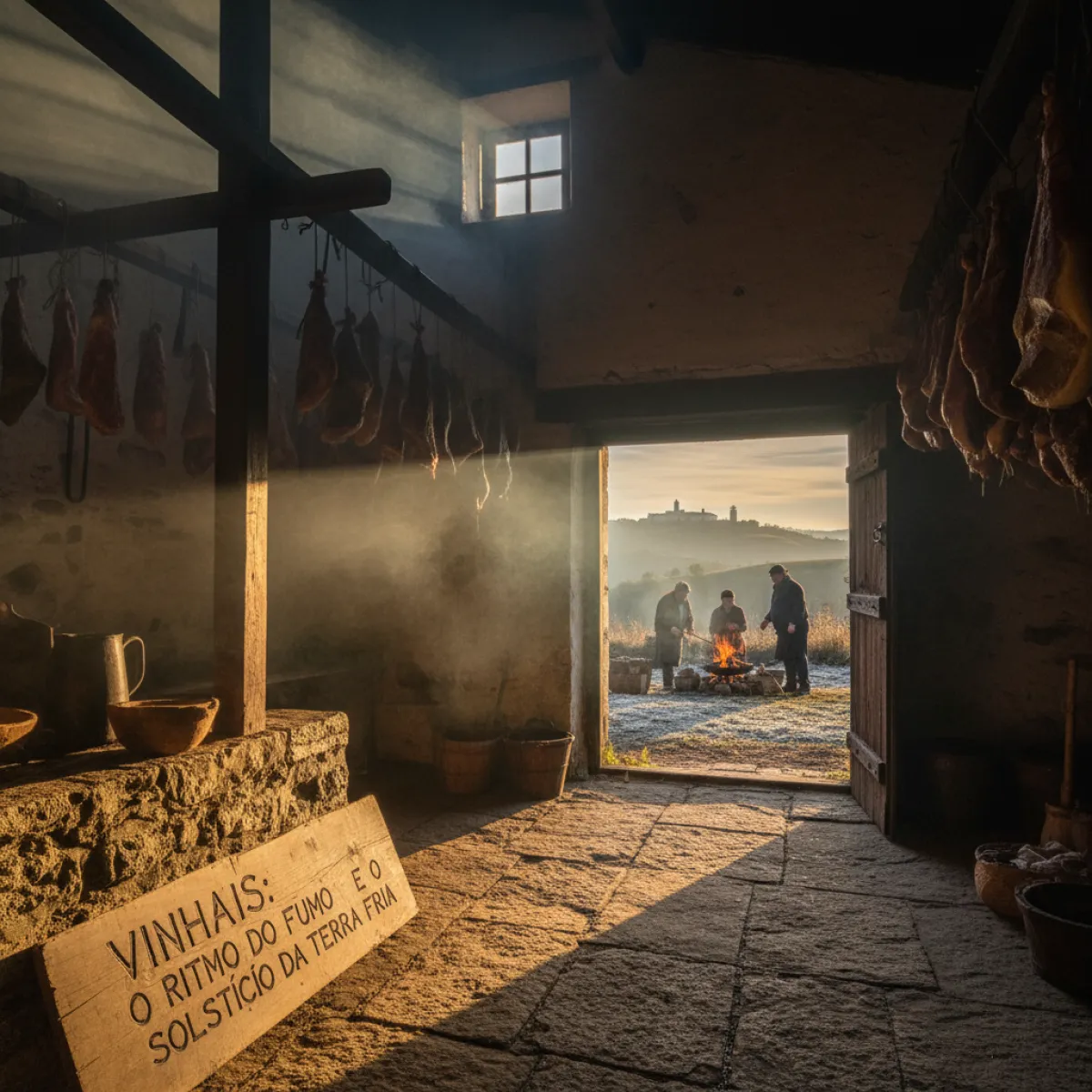
The Geometry of the Cold
To arrive in Vinhais during the winter months is to undergo a lesson in geographical humility. Here, in the northeastern corner of Portugal, the landscape offers no apologies for its rawness. The fog settles into the valleys carved by the Tuela River with a near-geological permanence, and the air carries the omnipresent scent of burning oak. One does not come to Vinhais for the obvious hospitality of the coast; one comes for the honesty of a culture molded around survival and the celebration of scarcity. It is a territory where time does not pass; it accumulates, like moss on schist walls.
This is the capital of smokehouse products, but the title is reductive. To limit Vinhais to its sausage production is like reducing Venice to its canals: it ignores the spiritual infrastructure that sustains the practice. The Bísaro pig, an indigenous breed with long legs and drooping ears, is the architect of this economy. Unlike the southern Iberian pig, which feeds on acorns in flat dehesas, the Vinhais Bísaro climbs slopes, consumes chestnuts, and lives in a regime of freedom that gives its meat a muscular texture and fat infiltrated with surgical precision. The result is a raw material that demands respect and patience.
The Empire of Smoke
The Feira do Fumeiro (Smokehouse Fair), held annually in February, is the zenith of this cycle. It is not merely a market; it is an exhibition of technical mastery. For months, the hearths of granite houses are kept lit, not just to warm the bones of the inhabitants, but to cure the alheiras, the salpicões, and the majestic butelo. Smoke is the invisible ingredient, the preservative that carries the flavor of the wood into the meat fibers. For those seeking to understand the complexity of this heritage, it is impossible not to draw parallels with neighboring regions, where culinary resilience takes other forms, as seen in Beyond the Alheira: Mirandela’s Culinary Resilience. While Mirandela refined the alheira for the urban palate, Vinhais kept it rustic, dense, and visceral.
Butelo and Casulas: The Diet of Memory
If there is one dish that defines the Transmontano soul of Vinhais, it is butelo with casulas. Butelo is a singular sausage, made with rib and spine bones, wrapped in the animal's stomach or bladder. It is a monument to total utilization. Slow-cooked, the bones release collagen and marrow, creating a rich broth that bathes the casulas, bean pods dried in the sun during the summer. Eating this dish in a local restaurant while the wind batters the windows is an experience of communion with the land. There is no room here for gratuitous sophistication; elegance resides in the proportion of salt, garlic, and curing time.
Winter Rituals and the Canhoto of Cidá
Vinhais is also the epicenter of a pagan spirituality that survived thin Christianization. The Festa da Cabra e do Canhoto (Festival of the Goat and the Log), celebrated in the village of Cidá in December, is the rawest example of this persistence. At the winter solstice, a massive bonfire (the canhoto) is lit in the village center. A goat is sacrificed and consumed in a communal banquet, while masked figures known as caretos burst through the night with cowbells and ritual cries. It is a moment of purification by fire, a celebration of the light that will grow again after the longest night of the year.
This relationship with isolation and mysticism is common throughout the Montesinho Natural Park. The quietude of these mountain villages is almost palpable, a silence that extends beyond the borders of Vinhais, as we explored in The Silence of Montesinho: A Winter Retreat in the Last Frontier of Portugal. In these places, modernity is a thin layer that barely covers ancestral traditions of mutual aid and communal life.
The Transition to Comfort
For the traveler venturing along these winding roads, the contrast between the harshness of Vinhais and the thermal sophistication of the neighboring region is fascinating. After a few days immersed in the smoke and cold of the Terra Fria, the descent toward the Tâmega valley offers a necessary reprieve. Proximity to Chaves allows for a plunge into Roman history and the luxury of thermal springs, a perfect counterpoint to the Transmontano rusticity. We detailed this historical transition in The Roman Legions' Legacy: Exploring the Ancient Thermal Springs of Chaves. It is this balance between body and spirit, between mountain survival and valley rest, that makes the northeastern Tras-os-Montes a destination without parallel.
Logistics and Planning
Vinhais is not a destination for last-minute decisions. The best time to visit is between November and February if your goal is to experience the smokehouse culture and winter festivals. During the Feira do Fumeiro (February), rural tourism units sell out months in advance. Expect to pay between €80 and €120 per night for high-quality accommodation. Regarding gastronomy, a hearty lunch of butelo with casulas at a top restaurant like A Lareira will cost around €30 per person, including regional red wine, which must be robust enough to cut through the pig's fat.
- What to order: Butelo with casulas, Vinhais alheira (PGI), and the local chestnut-based sweets.
- When to go: February for the fair, December for pagan rituals, October for the chestnut harvest.
- How to get there: From Porto, the A4 highway leads to Bragança, then follow the N103. The journey is long, but the landscape justifies every kilometer.
Vinhais demands that you relinquish the urban rhythm. It is a place to walk slowly, to listen to the sound of water in the creeks, and to understand that, in the end, a people's culture is what remains when the world goes quiet. It is, above all, a celebration of an identity that requires no external validation.
