Viana do Castelo: High Design and Coastal Heritage on a Minho Budget
Discover how to explore the 'Princess of the Lima' with sophistication and value, from the famous custard doughnuts to the secrets of Minho's gold filigree.
There is a certain sobriety to Viana do Castelo that escapes the tourist frenzy of Porto or the accelerated gentrification of Lisbon. Anchored between the mouth of the Lima River and the Atlantic, the city that once outfitted the caravels of the Discoveries and the cod-fishing fleets of the North Atlantic remains a bastion of authentic Minho heritage. For the traveler seeking real value, that precise balance of aesthetics, comfort, and cost, Viana is perhaps Portugal’s smartest destination. Here, sophistication isn't measured by the price of a wine bottle, but by the lineage of filigree jewelry and the preservation of Manueline architectural lines.
The Architecture of Value
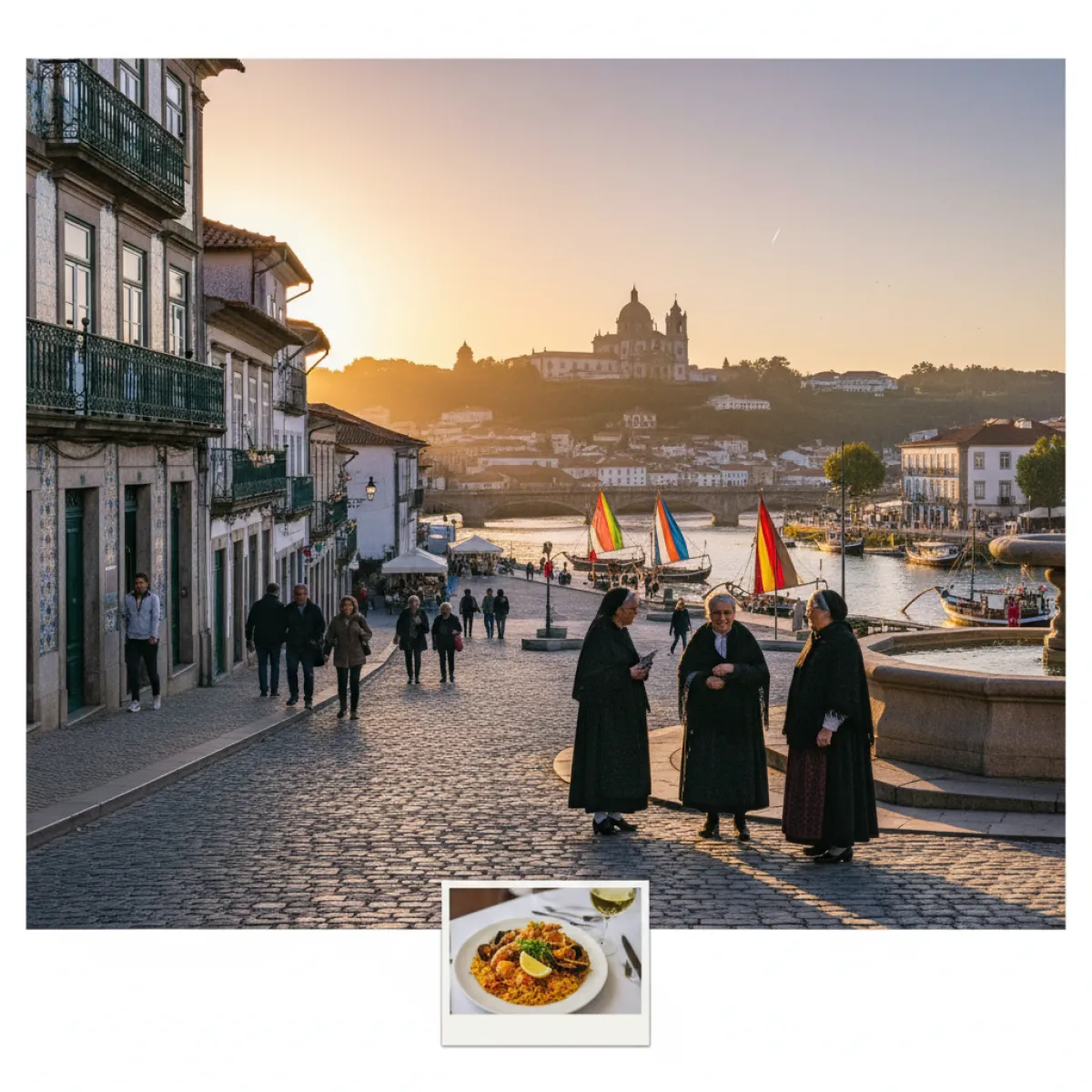
Starting your day at Praça da República is an exercise in historical observation that costs exactly zero euros. Surrounded by buildings that narrate the city’s mercantile wealth, the square is dominated by the 1553 fountain and the Old City Hall. The aesthetic is rigorous, granitic, yet softened by the light reflecting off marble and limestone. It’s here that one realizes Viana doesn’t need artifice to impress.
For those traveling on a conscious budget, the best way to experience the city's scale is to ascend Monte de Santa Luzia. While many opt for the funicular, which, though charming, comes at a price, the more vigorous can tackle the stone steps that wind up the hillside. The effort is rewarded by a view that National Geographic once ranked as one of the best in the world: a river delta embraced by the ocean and watched over by a neo-Byzantine basilica that, interestingly, is more photogenic from the outside than the in. Access to the temple is free, and the peace found at the summit compensates for any climb.
Gastronomy: The Value of Honesty on the Plate
In Viana, eating well doesn't require a three-month-in-advance reservation or a platinum credit card. The golden rule is to avoid establishments with photos of dishes at the door and seek out the taverns where retirees play cards and local workers take their break. The 'menu do dia' or 'diária' is your best savings tool. For about 10 to 12 euros, you’ll be entitled to soup, a main course, a drink, and coffee.
One cannot discuss Viana without mentioning Pastelaria Manuel Natário. While the name Amália em Viana resonates as a cultural tribute to Portugal’s greatest fado singer, it is in the queue at Manuel Natário that you feel true local devotion. Around 4:00 PM, the aroma of cinnamon and sugar invades the street. The Bolas de Berlim (custard-filled doughnuts), served while still warm, are a mandatory ritual. They cost just over a euro and are, without exaggeration, the finest representation of democratic Minho luxury. Regarding fish, the cod tradition is absolute. Look for the restaurants in the narrow streets connecting Rua da Bandeira to the river; the Bacalhau à Viana, served with punched potatoes and plenty of caramelized onions, is a staple that rarely disappoints.
Culture and Heritage: The Hospital-Ship and the Gold
Viana’s identity is inextricably linked to the sea. The Gil Eannes Ship, anchored in the commercial dock, is now a museum serving as a testament to the epic saga of cod fishing. The entrance fee is symbolic, but the historical value is immense. Walking through the corridors of the former hospital-ship, seeing the operating rooms and the cabins, is to understand the resilience of these people. It is a visceral experience that puts modern comfort into perspective.
Equally essential is the Costume Museum (Museu do Traje). Minho is Portugal’s most colorful region, and Viana is its highest expression. The traditional costumes of the 'mordoma' and 'lavradeira,' laden with gold filigree, are not mere folklore; they are symbols of status and pride. If you visit the city in August during the Nossa Senhora da Agonia festivals, you will see this gold on the streets. Throughout the rest of the year, the museum offers a detailed look at this tradition for a fraction of the cost of an industrial souvenir.
Explorations Beyond the City Limits
Viana do Castelo is also the gateway to a deeper, more rural Minho. If time permits, an escape to the interior is recommended to understand the contrast between the coast and the valley. You might, for instance, immerse yourself in The Slow Rhythm of Ponte de Lima: A Family Guide to Portugal’s Oldest Village to discover how time seems to have stopped on the banks of the Lima. The geographical proximity allows these incursions to be made economically, using local public transport or, ideally, a short car trip.
For those visiting during the colder months, the atmosphere changes radically. Minho under fog has a mystique that summer sun cannot replicate. It is the perfect time to read about The Fog and the Feast: Why Ponte de Lima is Portugal’s Most Evocative Winter Escape, a guide that captures the essence of comfort gastronomy and the lit fireplaces that define the North in winter. At these times, accommodation prices in Viana drop significantly, making the city an excellent base for exploring the region without the crowds.
Practical Tips for the Traveler
- Transport: Viana is perfectly explorable on foot. The historic center is compact and distances are short. If you arrive by train, the station is right in the center, eliminating the need for taxis.
- When to go: May offers the best balance between weather and tranquility. August is vibrant but expensive due to the festivals. Winter is melancholic and very budget-friendly.
- Budgeting: Set aside about 50 to 60 euros per day (excluding accommodation) to live like a local, including two full meals, coffee, and museum entries.
Finally, before leaving, be sure to visit the craft workshops that still persist on the outskirts of the city. While Viana’s gold is the most famous, the pottery from the neighboring region is equally fascinating. It is worth exploring The Living Craft of Minho: A Deep Dive into the Pottery of Barcelos to understand the iconography of the famous rooster and how folk art remains a vital force in the domestic economy of the Minho.
Conclusion
Viana do Castelo makes no apologies for its granitic austerity or its sometimes biting Atlantic wind. It is a city that rewards the attentive gaze and genuine curiosity. Traveling on a budget in Viana is not a matter of deprivation but rather of conscious choice. By choosing the municipal market over supermarkets, walking over motorized transport, and the 'dish of the day' over tasting menus, the traveler discovers that the true soul of Portugal remains alive, accessible, and profoundly elegant.