The Slow Rhythm of Ponte de Lima: A Family Guide to Portugal’s Oldest Village
Discover why Ponte de Lima is the ideal destination for families seeking authenticity and nature. From the fascinating Toy Museum to the trails of the Bertiandos Lagoons, we explore the best of Portugal's oldest village.
A Village Where Time Chose to Rest
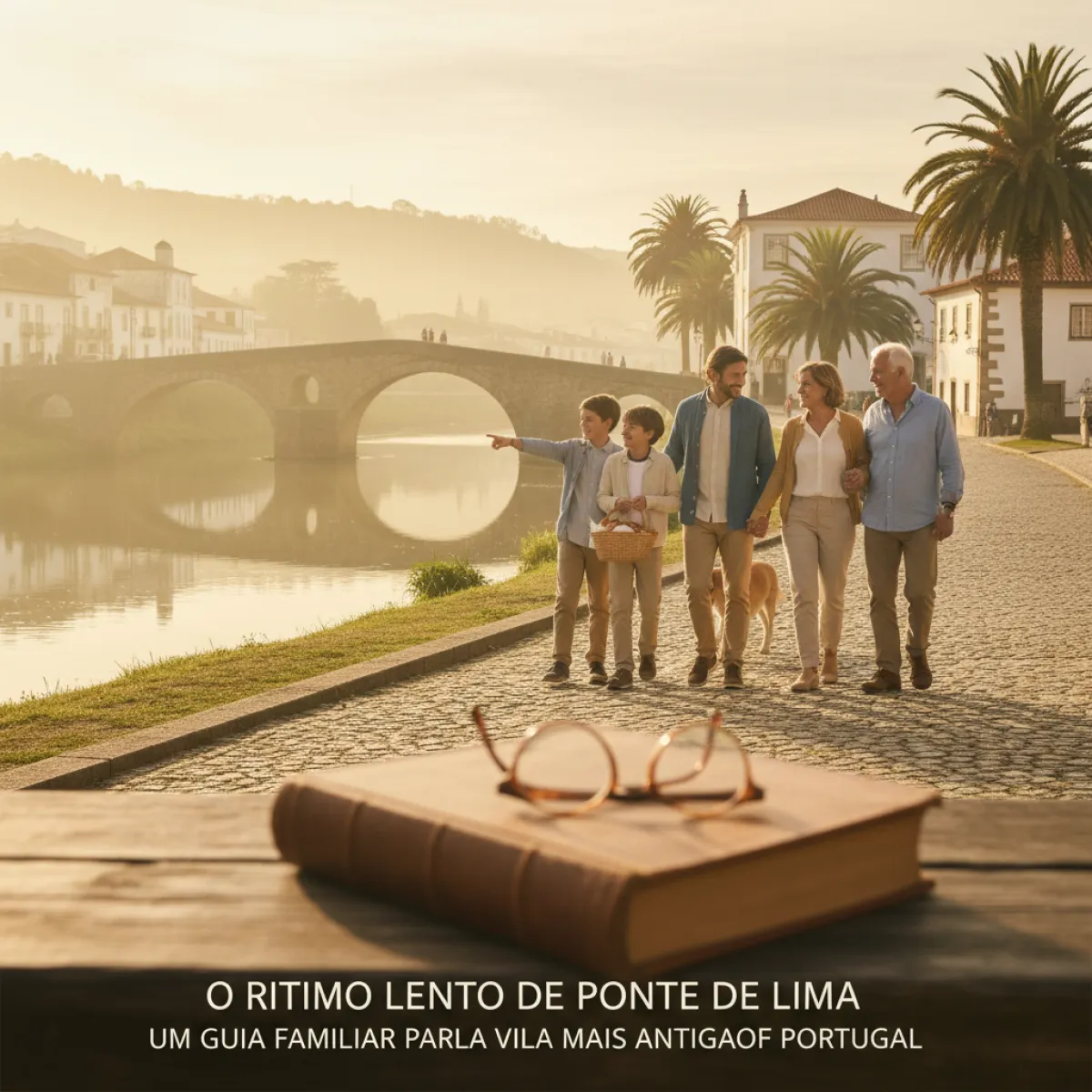
Ponte de Lima is not a destination to be consumed in haste. In the heart of the Minho region, what is proudly Portugal’s oldest village demands a different tempo, a pace that synchronizes with the gentle flow of the Lima River. For those traveling as a family, this is perhaps its greatest asset: here, luxury isn’t measured by the stars of impersonal hotels, but by the freedom of letting children run through the Avenue of Plane Trees or the discovery of a Roman legend that still echoes through the arches of the bridge.
Arriving in Ponte de Lima is like stepping into a living canvas. The first image is invariably the silhouette of the Roman-Gothic bridge, a monument that is as much a vital thoroughfare as it is the gravitational center of social life. For families, crossing it is the first great ritual. This is where stories are told of the River Lethe, the River of Forgetfulness, which Roman legionaries feared to cross for fear of losing all memory of their homeland. Today, the greatest risk for those who visit is precisely the opposite: the impossibility of forgetting the soft light that hits the Baroque facades in the late afternoon.
The Ritual of the Bridge and the River Lethe
The experience in Ponte de Lima almost always begins by the water. The Lima River is not merely an ornament; it is the protagonist. For the younger ones, the vast expanse of sand and grass along the left bank is the ideal setting to burn off initial energy. We recommend starting the day with a stroll along the bank, watching the kayakers glide silently by. If the weather is fair, renting a small boat for an hour of family rowing is an excellent way to see the village from a different perspective, away from the bustle of the historic center.
While many destinations become one-dimensional with the change of seasons, Ponte de Lima maintains a poetic gravity throughout the year. For those visiting during the colder months, we captured that melancholic and comforting essence in our guide The Fog and the Feast: Why Ponte de Lima is Portugal’s Most Evocative Winter Escape. However, it is in the summer and spring that the village explodes in color, offering activities that seem specifically designed for educational and outdoor entertainment.
The Toy Museum: A Generational Journey
Located in the Casa do Arnado, right at the bridge's entrance on the right bank, the Portuguese Toy Museum (Museu do Brinquedo Português) is a mandatory stop that transcends simple childhood entertainment. Unlike generic toy museums, this space meticulously curates national production from the late 19th century to the present day. For children, it’s a world of colors and shapes; for parents and grandparents, it’s a powerful exercise in nostalgia.
The museum is organized chronologically, allowing visitors to observe the evolution of materials, from wood and tinplate to plastic, and the social themes that the toys reflected. There is something profoundly educational about showing a digital-age child a clockwork train or a papier-mâché doll. The entrance fee is symbolic (around 3 euros for adults, with family discounts), making it one of the best cultural investments in the region. Set aside at least an hour and a half for a leisurely visit, allowing the kids to get lost in the details of the miniatures and dioramas.
The International Garden Festival
If visiting between the last Friday of May and the end of October, the International Garden Festival is the highlight of the itinerary. Set within a walled enclosure by the river, this festival annually presents twelve ephemeral gardens, selected through an international competition. Each year has a different theme, from sustainability to music, and landscape architects create spaces that are often highly interactive.
For families, this is the perfect spot. Many gardens allow for physical interaction: there are hidden paths, water features, structures to climb, and textures to touch. It is an open-air art museum where "do not touch" is replaced by "feel." It’s also an excellent place for an impromptu picnic, taking advantage of the shade and tranquility the space offers, away from traffic. The entrance ticket is affordable and allows for re-entry during the day, which is ideal if you need to take a break for lunch in the village center.
Active Nature: Ecovias and the Protected Landscape
The Rio Lima Ecovia is one of the best-kept secrets for outdoor enthusiasts. With several kilometers of flat, well-marked paths following the riverbanks, it is the ideal place for a family bike ride. The stretch connecting Ponte de Lima to the Bertiandos and S. Pedro de Arcos Lagoons is particularly recommended. It’s about 5 to 6 kilometers of uninterrupted natural beauty, crossing wooden walkways and dense shaded areas.
Upon reaching the Bertiandos Lagoons Protected Landscape, you’ll find a rich and preserved ecosystem. The Environmental Interpretation Center offers valuable information about local fauna and flora. Children love watching the Garrano horses grazing freely and trying to spot otters or the various migratory birds that find refuge there. It’s a practical ecology lesson, far from school textbooks, where the silence is only broken by the croaking of frogs or the singing of birds. Look for the various nature-watching activities regularly organized for family groups.
Gastronomy: The Ritual of Sarrabulho and Other Treats
One cannot speak of Ponte de Lima without mentioning Arroz de Sarrabulho. This dish, though it may visually intimidate younger palates due to its dark color (from pig's blood), is an institution. Restaurants like *Encanada* (with a superb view over the river) or *Taberna Afonso* treat this dish with the reverence it deserves. For less adventurous children, the Minho region always offers safe alternatives: an excellent sirloin steak or the ever-present cod (bacalhau), prepared with the region's best olive oil.
Sunday lunch in Ponte de Lima is a social event. You will see entire families, spanning three or four generations, gathered around bountiful tables. The budget for a full meal in a mid-range restaurant is around 25 to 35 euros per adult, but portions are typically generous, and often a plate of Sarrabulho easily serves two people. To finish, the *Leite Creme* (custard) caramelized on the spot with a red-hot iron is the final spectacle that delights both the eyes and the stomach.
Practical Tips for a Smooth Visit
Ponte de Lima is a compact village, but parking in the center can be challenging, especially during the Feiras Novas in September or on summer weekends. The best strategy is to use the large parking lots on the right bank of the river (near the Toy Museum) and cross the bridge on foot, the view more than makes up for the extra effort.
In terms of budget, Ponte de Lima remains extraordinarily affordable compared to the urban centers of Lisbon or Porto. A family weekend, including accommodation in a rural tourism unit, meals, and museum entries, can be managed very reasonably. The best time to go is between May and September to take advantage of the Garden Festival and the drier weather, although autumn brings the golden colors of the Loureiro vineyards surrounding the village, offering a free and unforgettable visual spectacle.
In summary, Ponte de Lima offers something that has become rare in modern tourism: authenticity without pretension. It is a place where children can be children and adults can rediscover the pleasure of slowness. Whether cycling along an ecovia or contemplating the illuminated bridge, the village leaves a deep mark, a desire to return when the rhythm of the outside world becomes too frantic.
